
the Qualcomm RF Software Engineer recruitment drive is one you shouldn’t skip — especially if your background is in Electronics and Communication Engineering (ECE) or embedded systems. Qualcomm India Private Limited has opened applications for its Modem-RF Wireless Software Engineering team, targeting engineers with 0-3 years of experience who understand RF theory, digital communications, and embedded C/C++ programming.
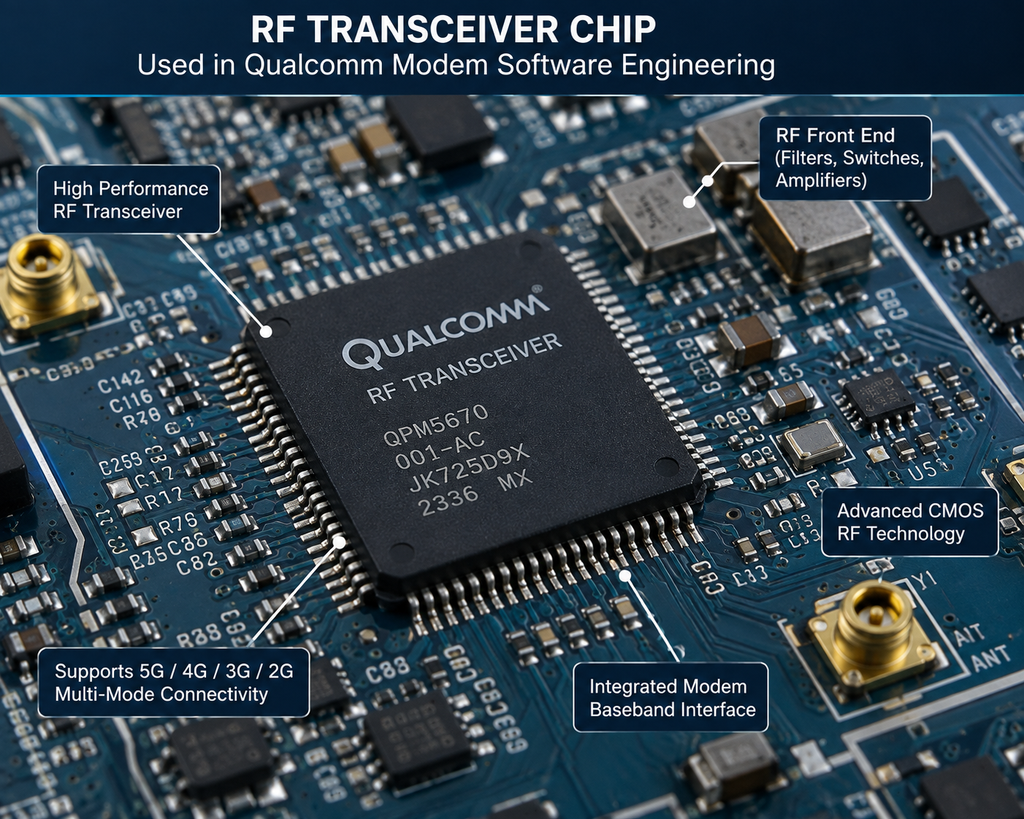
This role sits at the heart of how your smartphone actually talks to a cell tower — the invisible layer of software that manages radio frequency transceivers, antenna tuning, and signal processing before your call even connects. In this guide, we’ll walk through everything publicly available about this opening: what the job actually involves, who qualifies, what skills matter most, how the hiring process typically unfolds at a company like Qualcomm, and how to put together an application that doesn’t get lost in the pile.
Whether you’re a final-year ECE student prepping for campus placements or a working engineer eyeing a lateral move into wireless communications, this article breaks down the opportunity in plain language — no recycled job-portal copy, no filler.
Table of Contents
1. About Qualcomm and the Modem-RF Software Team
Qualcomm is one of the world’s leading semiconductor and wireless technology companies, best known for the Snapdragon chipset family that powers a huge share of Android smartphones globally. Beyond mobile processors, Qualcomm is a foundational player in cellular technology itself — the company holds deep intellectual property in CDMA, LTE, and 5G, and its modem chips sit inside phones, laptops, IoT devices, and automotive systems worldwide.
Within Qualcomm’s engineering organization, the Modem-RF Software Team in India plays a specialized but critical role. This team doesn’t build the apps or the user interface you interact with — it builds the low-level software drivers that control the actual RF transceiver hardware. Think of it as the translation layer between the physical radio chip and the higher-level modem software stack that decides when and how your phone connects to a network.
The team works in close coordination with:
- RF Hardware engineering, which designs the physical transceiver and antenna front-end
- Modem/Baseband teams, who own the digital signal processing and protocol stacks
- RF ASIC design teams, who build the custom silicon
- Systems and Test Engineering, who validate that everything performs to spec in real-world conditions
This kind of cross-functional collaboration is fairly typical of large semiconductor companies, but Qualcomm’s scale — and its central role in setting global wireless standards — makes this particular team’s work unusually high-impact. If you’ve ever wondered how your phone maintains a strong signal while moving between cell towers on a highway, teams like this one are the reason it (mostly) works.
2. Role Overview: What Does an RF Software Engineer Do?
The official title for this opening is “Engineer – RF SW – ECE – 2024/25/26”, and it’s aimed at candidates from ECE and related engineering backgrounds, spanning multiple graduating batches (2024, 2025, and 2026), which suggests Qualcomm is casting a fairly wide net for both recent graduates and early-career professionals.
Day-to-day, this role typically involves:
- Driver development: Writing and maintaining software drivers for Qualcomm’s Modem-RF transceivers, which sit between the RF hardware and the broader modem software stack.
- Algorithm development: Creating and optimizing RF transceiver, antenna, and RF front-end algorithms to improve overall system performance, manufacturing yield, and how testable the RF subsystem is on the factory floor.
- Debugging complex issues: Investigating hard-to-diagnose problems that span both hardware and software — a skill that requires comfort working across the stack rather than staying purely in code.
- Feature delivery: Collaborating with physical layer (PHY) teams to roll out new features that keep Qualcomm’s modem performance competitive as wireless standards evolve.
- Cross-team coordination: Working alongside RF Systems, Hardware, and Test Engineering throughout every phase of product development, from early design to mass production.
This is not a pure software role in the way a backend or app development job would be. It sits at the intersection of embedded software engineering and RF/communications theory, which is exactly why Qualcomm is specific about wanting candidates with an ECE (or equivalent) background rather than a general computer science degree.
3. Eligibility Criteria and Educational Requirements
Qualcomm’s stated qualifications for this role are fairly specific, and it’s worth reading them carefully before you apply, Qualcomm RF Software Engineer recruitment since mismatched applications rarely make it past the initial resume screen.
Minimum Qualification
- A Bachelor’s degree in Engineering, Information Systems, Computer Science, or a related field.
Preferred Education
- A Master’s or Bachelor’s degree specifically in Electronics and Communication Engineering (ECE) or an equivalent discipline is preferred, given the RF-heavy nature of the work.
Experience Level
- Qualcomm is hiring at the 0-3 years of experience band for this posting, meaning both fresh graduates and early-career engineers are encouraged to apply. Freshers are explicitly welcomed, provided they can demonstrate strong fundamentals rather than professional experience.
What “Fresh Grads” Specifically Need
Qualcomm’s job description calls out a distinct expectation for fresh graduates: a solid grasp of C and/or C++, core software engineering concepts (particularly as applied to embedded software), digital and wireless communications theory, ECE fundamentals, and RF theory. In other words, campus coursework in signals and systems, communication theory, and embedded systems isn’t just background knowledge here — it’s directly tested.
4. Technical Skills Qualcomm Is Looking For
This is where the role differentiates itself sharply from a typical “software engineer” posting. Qualcomm is explicit that this position blends embedded programming with communications and RF domain knowledge. Here’s a breakdown of the skill areas mentioned in the job description:
| Skill Area | What It Means in Practice |
|---|---|
| C / C++ Programming | Strong hands-on coding and debugging ability, specifically on embedded real-time operating systems (RTOS) |
| RF Theory | Understanding of radio frequency behavior, transceiver design principles, and antenna/front-end concepts |
| Digital Communications | Grasp of modulation, signal processing, and how data is transmitted over wireless channels |
| Embedded Real-Time Systems | Familiarity with how software behaves under strict timing constraints on embedded hardware |
| Wireless Standards Knowledge | Exposure to LTE, 5G NR, or other radio access technologies is considered a plus, not mandatory |
| Driver Development Experience | Prior experience with modem or communications device drivers is an added advantage |
| Test Equipment Familiarity | Working knowledge of protocol test equipment, spectrum analyzers, and oscilloscopes is valued |
| Software Engineering Fundamentals | Solid grounding in general software engineering concepts and practices |
| Communication Skills | Ability to work well in a cross-functional team environment, since this role touches hardware, systems, and test teams constantly |
A useful way to think about this list: Qualcomm doesn’t expect every candidate to check every box, especially at the fresher level. But the further along your experience, the more these “plus” skills — LTE/5G exposure, driver development, test equipment familiarity — start to matter for standing out among applicants.
Why RF Theory Knowledge Matters So Much Here
A lot of software engineering roles in India’s job market are language- or framework-agnostic — you learn the stack on the job. This role is different. RF and communications theory isn’t something you can pick up casually in a few weeks; it typically requires a semester or two of dedicated coursework (or equivalent self-study) in areas like signal processing, modulation techniques, and antenna theory. If your engineering background didn’t cover this deeply, it’s worth brushing up before you apply, since technical interviews for this kind of role tend to probe fundamentals directly.
5. Salary Expectations for RF Software Engineers in India
Qualcomm’s official job posting does not publish a specific salary figure for this role — this is standard practice for most large multinational technology employers in India, who typically disclose compensation only after an offer is extended, and it can vary based on your college, prior experience, interview performance, and location.
That said, based on how the broader Indian semiconductor and embedded engineering job market generally compensates similar roles, here’s a general sense of what candidates in this experience band typically consider a competitive range for large MNC semiconductor companies:
- Freshers (0-1 years): Entry-level compensation at large chipmakers in India tends to be structured as a mix of base pay plus joining bonuses and stock components, and is typically benchmarked against other top-tier semiconductor employers in the same city.
- 1-3 years experience: Compensation usually scales with demonstrated project impact, specialization in RF/embedded domains, and performance in technical rounds.
Because Qualcomm doesn’t publish exact numbers publicly, treat any specific figure you see on third-party salary aggregator websites as an estimate rather than a guarantee. The most reliable way to get an accurate number is directly from the recruiter once you’re in the interview process, or from verified current employees on professional networks.
6. Typical Selection Process at Qualcomm
Qualcomm’s careers portal for this listing doesn’t publish a detailed, role-specific breakdown of interview rounds — this information typically isn’t made public for any individual job posting, at Qualcomm or most large employers. However, based on how large semiconductor and technology companies in India generally structure hiring for engineering roles at this level, candidates can generally expect a process that includes some combination of the following:
- Resume/application screening — Your application is reviewed against the stated qualifications, with particular attention to your academic background, relevant coursework, and any project or internship experience touching RF, embedded systems, or communications.
- Online assessment — Many large tech employers use an initial coding and/or aptitude test to filter applicants at scale, especially for fresher hiring.
- Technical interview round(s) — Expect deep questions on C/C++ fundamentals, embedded systems concepts, and RF/communications theory. Interviewers at this level often probe not just what you know, but how you think through a problem.
- Hiring manager or team-fit round — A conversation focused on your interest in the specific team, your understanding of the role, and general communication skills.
- HR/offer discussion — Final compensation, location, and joining logistics are typically discussed here.
Keep in mind this is a general pattern seen across similar roles in the industry, not an official Qualcomm-published sequence — the actual number and order of rounds can vary by location, team, and candidate experience level. Always refer to communication directly from Qualcomm’s recruitment team for the specific process tied to your application.
7. How to Apply for the Qualcomm RF Software Engineer Role
Applying is done entirely through Qualcomm’s official careers portal. Here’s the general path:
- Go to Qualcomm’s official careers website and search for the role using terms like “RF SW” or “Modem-RF” combined with your preferred location (Qualcomm’s India engineering hubs include cities like Hyderabad and Bengaluru, among others).
- Create or log into your Qualcomm careers profile.
- Upload an updated resume that clearly highlights any coursework, projects, or prior experience related to RF, embedded systems, digital communications, or driver development.
- Fill out the application form completely — incomplete profiles are often deprioritized in automated screening.
- Double-check your contact details and preferred location before submitting, since these are used for follow-up scheduling.
Because Qualcomm’s careers site is powered by a dynamic job board, direct listing links can expire or shift positions over time. If a specific link doesn’t load the role, search the careers portal directly using the job title.
A Word of Caution
Qualcomm explicitly states it does not accept resumes or applications routed through unauthorized staffing agencies for postings like this one, and any such submissions are treated as unsolicited. Apply only through Qualcomm’s official careers site, and be wary of third-party websites or individuals claiming to guarantee placement in exchange for payment — this is a red flag common to job-market scams generally, not specific to Qualcomm.
8. Important Dates and Application Window
Qualcomm’s job posting for this role does not list a specific application deadline in the publicly available description — many large-company postings for ongoing or high-volume hiring needs (like this one, which spans 2024, 2025, and 2026 graduating batches) remain open on a rolling basis rather than closing on a fixed date.
Given that, the most reliable approach is:
- Apply as early as possible once you’re confident you meet the eligibility criteria, since rolling hiring often fills faster than fixed-deadline postings.
- Check the official Qualcomm careers portal periodically for the live status of the listing, since postings can close without extensive prior notice once a role is filled.
- If you’re a campus placement candidate, coordinate with your college’s placement cell, as Qualcomm may run structured campus drives separately from open online applications.
9. Life as an RF Software Engineer at Qualcomm
Beyond the technical scope, it’s worth understanding what the broader employee experience looks like, since this affects long-term career decisions as much as the job description itself.
Qualcomm’s own careers materials emphasize a few consistent themes for engineers joining the company:
- Access to deep technical mentorship — working alongside senior RF and modem engineers who have shaped industry-wide wireless standards.
- Continuous learning programs — including tuition reimbursement and structured mentorship programs designed to help engineers grow technically over time.
- Comprehensive benefits — Qualcomm’s benefits framework is generally organized around four pillars: health coverage, financial wellness programs, personal/emotional wellbeing resources, and broader lifestyle support.
- Global impact — because Qualcomm’s RF and modem technology sits inside such a large share of the world’s connected devices, engineers on this team often work on problems with outsized real-world reach compared to their team size.
For someone early in their career, a role like this offers something relatively rare in the Indian tech job market: deep, specialized domain expertise (RF and wireless communications) combined with the software engineering skill-building that keeps your resume broadly competitive even if you eventually move into adjacent fields like embedded systems, IoT, or telecom infrastructure.
10. Common Mistakes to Avoid
If you’re applying for this role, a few recurring mistakes tend to hold back otherwise qualified candidates:
- Treating it like a generic software role: Applicants who lean entirely on general programming skills, without demonstrating any communications or RF theory understanding, often struggle in technical interviews for this specific position.
- Weak or generic resumes: A resume that doesn’t clearly call out relevant coursework (signals and systems, communication theory, embedded systems) or hands-on projects involving RF/embedded work tends to get filtered out early.
- Ignoring the “fresh grad” specifics: Qualcomm explicitly lists what fresh graduates need to know. Skipping brush-up on ECE fundamentals and RF theory before interviews is a common and avoidable mistake.
- Applying through unofficial channels: Submitting applications via unauthorized agencies or third-party sites instead of Qualcomm’s official careers portal can mean your application never reaches the actual hiring team.
- Underestimating the cross-functional nature of the role: This job requires comfort working across hardware and software boundaries. Candidates who present themselves as purely “code-only” engineers, with no interest in the hardware side, may come across as a weaker fit.
- Not preparing for embedded/RTOS-specific questions: General C/C++ knowledge isn’t quite the same as embedded, real-time-constrained programming. Practicing with RTOS concepts specifically will help.
11. Expert Tips to Strengthen Your Application
- Build a small RF or embedded side project, even a simple one — something like a basic signal-processing simulation, an embedded driver for a hobby board, or a wireless communication protocol demo. Concrete project experience speaks louder than a list of coursework on a resume.
- Revisit your core ECE subjects deliberately before interviews: signals and systems, digital communications, antenna theory, and RF front-end basics. These aren’t optional extras for this role — they’re core interview territory.
- Practice embedded C/C++ specifically, not just general-purpose coding problems. Focus on memory management, real-time constraints, and low-level hardware interaction, since this is quite different from typical app or web-focused coding interview prep.
- Learn the vocabulary of wireless standards, even at a conceptual level — understanding what LTE and 5G NR actually change at the physical and protocol layers will help you speak credibly about “plus” skills Qualcomm lists.
- Prepare to explain trade-offs, not just definitions. RF and embedded interviews often reward candidates who can reason about why a particular driver design or algorithm choice matters for performance or manufacturing yield — not just recite textbook definitions.
- Tailor your resume’s project section to highlight anything touching hardware-software interaction, testing with lab equipment (oscilloscopes, spectrum analyzers), or communications theory coursework, even if it was academic rather than professional.
- Follow Qualcomm’s official careers page directly rather than relying solely on third-party job aggregators, since postings, requirements, and application status are most accurately reflected there.
12. Frequently Asked Questions
Q1. What is the Qualcomm RF Software Engineer role about?
It’s a Modem-RF Wireless Software Engineering position focused on developing and validating drivers and algorithms for Qualcomm’s RF transceiver chipsets, working closely with hardware, systems, and test engineering teams.
Q2. Who is eligible to apply for this Qualcomm role?
Candidates need a Bachelor’s degree in Engineering, Information Systems, Computer Science, or a related field, with a Master’s or Bachelor’s in Electronics and Communication Engineering (or equivalent) preferred. The role targets 0-3 years of experience.
Q3. Can freshers apply for this position?
Yes. The listing explicitly welcomes fresh graduates from the 2024, 2025, and 2026 batches, provided they have strong fundamentals in C/C++, embedded software concepts, digital/wireless communications, ECE basics, and RF theory.
Q4. Is prior LTE or 5G experience mandatory?
No, it’s listed as a plus rather than a requirement. However, having conceptual familiarity with these standards can strengthen your candidacy, especially against other applicants.
Q5. What programming languages does this role require?
Primarily C and/or C++, with an emphasis on programming and debugging in embedded real-time operating system (RTOS) environments.
Q6. Does Qualcomm disclose the salary for this role publicly?
No, the official job description does not include salary details. Compensation is typically discussed directly with candidates during the hiring process.
Q7. How do I apply for this Qualcomm RF Software Engineer job?
Applications are submitted exclusively through Qualcomm’s official careers portal. Avoid submitting resumes through unauthorized third-party agencies, as Qualcomm does not accept unsolicited applications through such channels.
Q8. What is the typical selection process like?
While Qualcomm doesn’t publish an official step-by-step process for this specific listing, roles at this level generally involve resume screening, a technical assessment or interview, and a hiring manager discussion, followed by an HR/offer stage.
Q9. Is there a fixed application deadline?
The publicly available listing does not specify a fixed deadline. Given the role spans multiple graduating batches, it appears to be part of an ongoing hiring effort, so applying early is advisable.
Q10. What makes this role different from a typical software engineering job?
Unlike many general software roles, this position requires domain-specific knowledge of RF theory and digital communications alongside programming skills, making it a strong fit specifically for ECE graduates and embedded systems enthusiasts.
13. Conclusion
The Qualcomm RF Software Engineer opening is a genuinely distinctive opportunity in India’s engineering job market — it’s not just another software role, but a position that rewards candidates who’ve invested time in understanding wireless communications and RF theory alongside solid embedded programming skills. For ECE graduates who sometimes feel like their core coursework doesn’t map cleanly to standard tech-industry software jobs, this is exactly the kind of role where that background becomes a genuine advantage.
If you meet the eligibility criteria and are ready to put in the preparation this role demands, don’t wait too long to apply — head to Qualcomm’s official careers portal, tailor your resume to highlight your RF and embedded project work, and get moving on interview prep. For more guides on core engineering recruitment drives, eligibility breakdowns, and interview preparation strategies, explore our Core Engineering Careers category page for the latest updates.