
The India Job Market 2026 is telling a genuinely different story than the headlines about layoffs and hiring freezes might suggest — and the latest data, released just days ago, backs that up with real numbers. While the US labor market has been dealing with shrinking payrolls, India’s white-collar hiring just closed its financial year at the strongest pace in three years, according to the most recent Naukri JobSpeak Index.
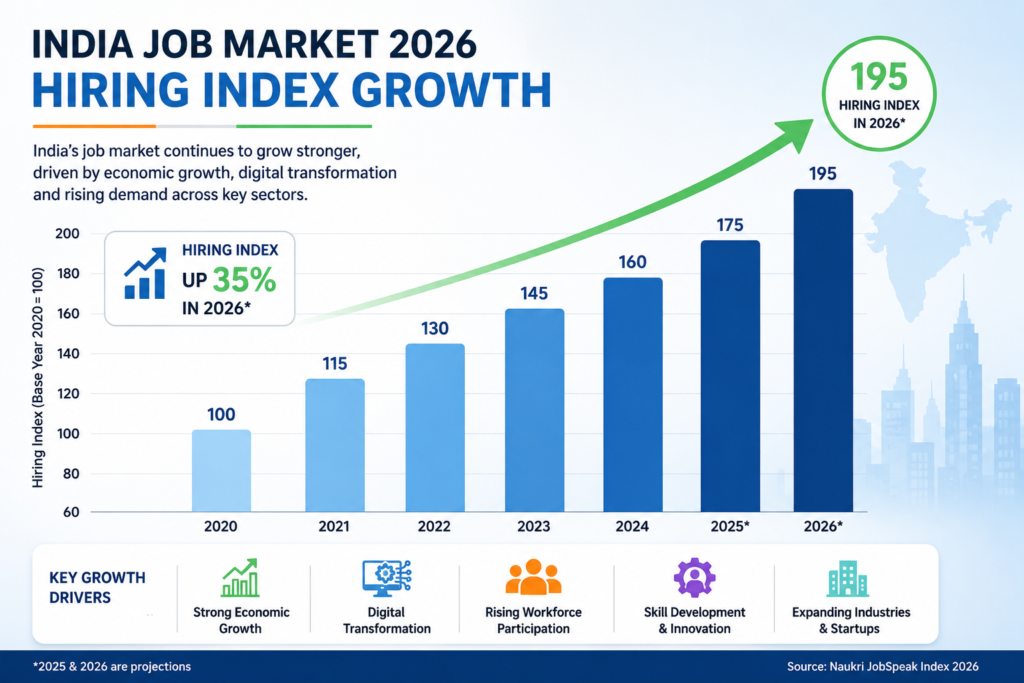
We pulled this straight from the data providers themselves rather than relying on secondhand vibes about “the job market being tough right now.” The picture that emerges is more nuanced and, frankly, more useful than either blanket optimism or blanket doom: some sectors and cities are genuinely booming, others are still catching up, and knowing exactly which is which can meaningfully shape where you focus your job search or skill-building right now.
Here are the seven signals from the latest data that are actually worth paying attention to.
Table of Contents
Signal 1: India’s Hiring Index Is Up While the US Slows Down
The Naukri JobSpeak Index — India’s most closely watched white-collar hiring gauge — came in at 3,227 for July 2026, up 5% year-on-year. This report, released on 3 August 2026, stands in genuine contrast to the US market, where recent jobs reports have shown payrolls shrinking rather than growing.
This isn’t a claim that India is immune to global economic pressure — it isn’t, and specific sectors within India have had a genuinely rough stretch. But the headline number is real, recent, and worth knowing if you’ve been assuming the entire global job market is contracting uniformly right now.
Signal 2: AI-ML Hiring Is Surging, Not Slowing
Roles specifically tagged AI and Machine Learning surged 33% year-on-year in the latest data — continuing a double-digit growth streak that’s shown up consistently in recent monthly reports. This isn’t a niche blip either; AI-ML hiring has been one of the most consistently strong categories across multiple consecutive reporting periods.
If you’ve been on the fence about investing time in AI/ML-adjacent skills specifically because you’re worried the hype has outpaced real hiring, this data suggests otherwise, at least in the Indian market right now.
Signal 3: IT Sector Hiring Has Turned Positive Again
Here’s a genuinely notable reversal: IT sector hiring, which had been flat to negative for months, turned positive again in the most recent report. Given how much anxiety has surrounded IT hiring in India through the earlier part of 2026 — including onboarding delays and slower fresher intake at several major companies — this shift is worth taking seriously as a potential inflection point, even if it’s too early to call it a full recovery.
A note of caution: one month of positive movement after a prolonged flat-to-negative stretch is an encouraging signal, not confirmation of a sustained trend. Keep watching subsequent monthly reports before treating this as a settled recovery.
Signal 4: Fresher Hiring Is Actually Expanding
Despite widespread concern about entry-level hiring slowing down, the latest data shows fresher hiring expanding rather than contracting. Combined with AI showing up more as a source of new roles than a reason to eliminate them, this pushes back meaningfully against the narrative that AI adoption is primarily displacing entry-level talent in India’s job market right now.
This doesn’t mean every fresher’s experience matches this data — individual outcomes vary widely by sector, city, and specific skill set. But at the aggregate level, the numbers don’t support a blanket “freshers are being locked out” narrative.
Signal 5: Tier-2 Cities Are Outpacing Several Metros
One of the more genuinely surprising findings: Bhubaneswar, Indore, and Coimbatore are outpacing several metro cities in hiring growth. Among the larger metros, Kolkata, Hyderabad, Chennai, and Bengaluru are leading the pack — but it’s the tier-2 city performance that stands out as a real shift in where opportunity is concentrating.
If you’ve been assuming your job search has to center on Bengaluru, Hyderabad, or another traditional hub, this data is a genuine reason to at least widen your search radius, especially if you have location flexibility.
Signal 6: Non-IT Sectors Are Quietly Carrying Growth
While IT has dominated the hiring conversation for years, recent reporting has repeatedly shown non-IT sectors posting strong year-on-year gains — Insurance, Hospitality/Travel, BPO/ITES, Education, and Real Estate have all registered healthy growth in recent monthly data, in some cases outpacing IT by a wide margin.
This matters for how you think about your own career options: if you’ve been narrowly focused on tech-sector roles because that’s where the conversation has centered, it’s worth actively considering whether your skills transfer into one of these consistently growing non-IT sectors.
Signal 7: Data and AI Skills Are Now Cross-Industry, Not Just Tech
Data-driven roles are hiring across every sector, not just IT — Insurance, BFSI (Banking, Financial Services, and Insurance), and Healthcare are all increasingly leaning on data and AI capability to make faster decisions. This reinforces a pattern worth internalizing: data and AI literacy is becoming a genuinely cross-industry requirement, not a specialization confined to tech companies.
If you’re building skills specifically to future-proof your career, this is a strong signal that data/AI fluency pays off broadly, not just within traditional tech roles.
What This Means for Your Job Search
Pulling these seven signals together into something actionable:
| If You’re… | Consider… |
|---|---|
| A fresher worried about the market | The aggregate data shows fresher hiring expanding — don’t assume the worst without checking sector and city-specific data first |
| Focused only on Bengaluru/Hyderabad-style metros | Actively researching tier-2 city opportunities, especially in Bhubaneswar, Indore, or Coimbatore |
| Only considering IT-sector roles | Looking seriously at Insurance, BFSI, Healthcare, and other non-IT sectors showing strong growth |
| Unsure whether to invest time in AI/ML skills | Treating this as a strong signal, given the consistent double-digit growth in AI-ML hiring specifically |
| Anxious about a recent IT hiring slowdown | Watching the next few months of data closely — one positive report is encouraging, not confirmation of a full recovery |
Where to Track This Data Yourself
Rather than relying on secondhand summaries (including this one), it’s worth knowing where this data actually comes from so you can check it yourself each month:
- Naukri JobSpeak Index (Info Edge) — released monthly, one of the most widely cited primary sources for India’s white-collar hiring trends
- foundit Insights Tracker — another regularly updated hiring trend source
- Sector-specific and city-specific breakdowns are typically published alongside each monthly release
Checking these directly each month, rather than only reading trend articles occasionally, gives you a much better sense of whether a signal like this month’s IT sector uptick is holding steady or was a one-off blip.
Common Mistakes to Avoid
- Assuming the global job market is uniformly bad right now. India’s aggregate hiring data tells a genuinely different story than recent US reporting — don’t apply one market’s narrative to another.
- Ignoring tier-2 cities out of habit. With Bhubaneswar, Indore, and Coimbatore outpacing several metros, restricting your search to traditional hubs alone may mean missing real opportunity.
- Treating one month of positive IT data as a confirmed trend. A single month’s reversal after a prolonged slow stretch is encouraging, not proof of a sustained recovery.
- Assuming AI is only relevant if you’re targeting a tech company. Insurance, BFSI, and Healthcare are all increasingly hiring for data and AI capability — this skill set is genuinely cross-industry now.
- Overlooking non-IT sectors entirely. Insurance, Hospitality/Travel, BPO/ITES, Education, and Real Estate have all shown strong recent growth — narrowing your search to IT alone may be limiting your options unnecessarily.
- Relying on outdated data. Hiring trend reports are released monthly — check the most current release rather than citing figures from several months ago as if they still apply.
Expert Tips to Act on This Data
- Check the monthly JobSpeak or foundit report yourself, rather than relying only on secondhand coverage, so you catch shifts as they happen rather than months later.
- If you have location flexibility, research specific tier-2 city opportunities directly, rather than assuming metro cities are automatically your best option.
- Build baseline data/AI literacy regardless of your target industry, given how consistently this skill set shows up as a hiring driver across sectors beyond just tech.
- Don’t rule out non-IT sectors if your skills transfer. Insurance and BFSI in particular have shown consistent recent growth and may be underexplored options for candidates with relevant analytical or customer-facing skills.
- Track sector-specific trends for your own field, not just the aggregate headline number, since the overall index can mask meaningful variation between industries.
- Revisit your job search strategy monthly, given how quickly individual sector signals (like IT’s recent reversal) can shift from one report to the next.
Frequently Asked Questions (FAQ)
1. Is the India job market actually growing in 2026?
Based on the latest Naukri JobSpeak Index (July 2026 data, released 3 August 2026), India’s white-collar hiring index rose 5% year-on-year, reflecting genuine aggregate growth, even as specific sectors have faced slower periods.
2. How is India’s job market different from the US right now?
Recent US jobs reports have shown shrinking payrolls, while India’s headline hiring index is expanding — a genuine divergence between the two markets’ current trajectories.
3. Are AI and ML roles really growing that fast in India?
Yes. AI-ML hiring surged 33% year-on-year in the most recent data, continuing a consistent double-digit growth streak seen in recent monthly reports.
4. Has IT sector hiring recovered in India?
IT hiring turned positive again after a prolonged flat-to-negative stretch, which is a genuinely positive signal — though it’s worth watching subsequent months before calling it a full recovery.
5. Is fresher hiring actually increasing or decreasing?
The latest aggregate data shows fresher hiring expanding, pushing back against the narrative that entry-level hiring is broadly contracting.
6. Which cities are hiring the most in India right now?
Bhubaneswar, Indore, and Coimbatore are outpacing several metro cities, while among larger cities, Kolkata, Hyderabad, Chennai, and Bengaluru are leading.
7. Which non-IT sectors are hiring well right now?
Insurance, Hospitality/Travel, BPO/ITES, Education, and Real Estate have all shown strong recent year-on-year growth.
8. Do I need to work in tech to benefit from AI/data skill demand?
No. Insurance, BFSI, and Healthcare are all increasingly hiring for data and AI capability, making this a genuinely cross-industry skill set rather than a tech-only requirement.
9. Where can I check this hiring data myself each month?
The Naukri JobSpeak Index and foundit Insights Tracker are both released monthly and are considered reliable primary sources for India’s hiring trends.
10. Should I change my job search strategy based on this data?
It’s worth considering — particularly widening your search to tier-2 cities and non-IT sectors if you have the flexibility, and prioritizing baseline data/AI literacy regardless of your target industry.
Conclusion
The India Job Market 2026 data tells a more encouraging, more nuanced story than the general “hiring is tough everywhere” narrative suggests — a rising hiring index, surging AI-ML demand, a tentative IT sector turnaround, expanding fresher hiring, and real momentum in tier-2 cities and non-IT sectors alike. None of this means every individual job search is easy right now, but it does mean broadening where and how you look — beyond just traditional metros and IT-only roles — is genuinely supported by the current data, not just optimistic guesswork.
Check the primary sources yourself each month, stay flexible about location and sector, and treat data/AI literacy as a skill worth building regardless of your specific industry.
For more practical, no-fluff career guidance, check out our Career Resources category page for regularly updated advice built for freshers and early-career professionals.
Suggested Internal Links
- Career Resources Category
- IT Onboarding Delay 2026
- AI Job Search Trends 2026
- Skills Freshers Need in 2026
Suggested External References (for fact-checking and updates)
- Naukri JobSpeak Index — Official Report Hub — Naukri’s own monthly hiring report archive
- Info Edge Investor Relations — Naukri JobSpeak — the primary official source, published by Info Edge (Naukri’s parent company)
- foundit Insights Tracker — monthly hiring trend data, formerly the Monster Employment Index