
AI Job Search Trends 2026 are quietly rewriting the rules of hiring from both sides of the table at once, and most job seekers are only seeing half the picture. Companies are using AI to screen, rank, and filter applications faster than ever. Job seekers are using AI to write, tailor, and mass-submit applications faster than ever. The result is an arms race that neither side fully advertises — and if you’re job hunting without understanding how it actually works, you’re competing at a real disadvantage.
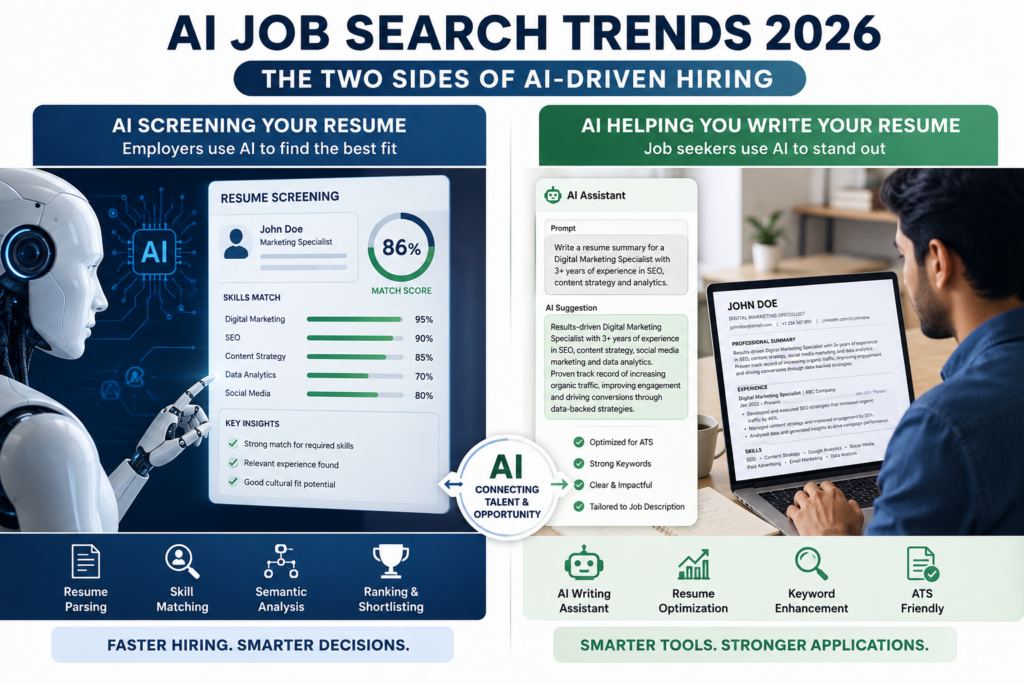
We looked at what’s genuinely trending in career and hiring searches right now, and the pattern is consistent across multiple independent sources: the conversation has shifted from “how do I write a good resume” to “how do I get past the AI before a human ever sees my resume” — and, increasingly, “how do employers verify I’m not just an AI-generated applicant.” That second question is newer, and it’s changing interviews as much as AI screening changed resumes.
This guide breaks down the eight biggest shifts happening in AI-driven hiring right now, what’s actually driving them, and what you should be doing differently as a result — whether you’re a fresher applying for your first role or a professional navigating a market that looks meaningfully different than it did even two years ago.
Table of Contents
Why This Is Trending Right Now
Two forces are colliding in the job market simultaneously, and that collision is exactly why this topic has become such a consistent search and discussion trend across career and hiring content in 2026.
On one side, employers have widely adopted AI-powered Applicant Tracking Systems (ATS) that screen, score, and rank resumes before a human recruiter ever opens them. Multiple industry sources now estimate that somewhere around 75% of resumes get filtered out before reaching a human reviewer — a figure repeated consistently enough across recruiting and career-advice sources to be treated as a reasonable working benchmark, even if exact percentages vary by company and industry.
On the other side, job seekers have widely adopted AI tools of their own — to write resumes, generate cover letters, and in some cases auto-apply to hundreds of listings with minimal manual effort. Recent survey data shows AI usage among job seekers climbing year over year, with a meaningful share using it specifically for resume writing and interview preparation.
The result: both sides are now using automation to out-maneuver the other, and the hiring process is visibly adjusting in response — which is exactly what the next eight shifts are about.
Shift 1: AI Screening Has Become the Default, Not the Exception
A few years ago, ATS software was mostly a keyword-matching filter used by larger companies. In 2026, AI-powered screening has become standard practice across mid-to-large employers, not a differentiator of a few tech-forward companies.
What’s changed specifically:
- Screening now goes beyond simple keyword matching, evaluating context, relevance, and how closely your experience maps to the actual role requirements.
- Rejection can happen before a human ever opens your resume, based purely on how well the AI system parses and scores your application against the job description.
- This applies increasingly across industries — not just tech roles, but customer service, operations, finance, and administrative positions as well.
The practical implication is simple: treating your resume as something written primarily for a human reader first is no longer a safe assumption. It needs to work for both audiences, and increasingly, the AI reads it first.
Shift 2: Candidates Are Fighting AI With AI
In direct response to AI screening, job seekers have widely adopted their own AI tools — resume builders, tailoring assistants, mock interview generators, and in some cases, full auto-apply tools that submit applications on a candidate’s behalf across job portals.
This has created a genuinely new category of job-search tool specifically built around this dynamic: platforms that track applications, auto-tailor resumes per job description, and even conduct AI-simulated interview practice modeled on how a specific company or role tends to interview. In the Indian market specifically, several of these tools have emerged built around local hiring norms — including practicing for the CTC and notice-period questions that tend to appear early in Indian HR screening rounds.
The upside is real: candidates can apply faster and more precisely than ever. The downside, covered in the next shift, is that this same capability has flooded the system with a volume problem.
Shift 3: The “Spray and Pray” Backlash
When AI tools made it trivially easy to generate hundreds of tailored-looking applications, a predictable thing happened: a lot of job seekers did exactly that — applying broadly and quickly rather than thoughtfully, betting on volume over precision.
Recruiters and hiring platforms have started actively pushing back against this pattern:
- AI screening has gotten better at detecting genuinely generic, low-effort applications, even when they’re technically “tailored” by an automated tool.
- Some companies have started requesting work samples or portfolio links earlier in the process — sometimes at the application stage itself — specifically to filter out purely AI-generated, unverified applications.
- Recruiters increasingly favor applications that show specific, verifiable evidence over ones that simply restate the job description back in resume form.
The lesson here isn’t “stop using AI tools” — it’s that AI-assisted speed without genuine specificity is now easier for both software and humans to detect than it used to be.
Shift 4: Portfolios Are Becoming as Important as Resumes
This is one of the more significant shifts happening right now, and it’s a direct response to the spray-and-pray problem: companies are increasingly asking candidates to prove their claims with actual, verifiable work.
- GitHub profiles, case studies, writing samples, and data notebooks are increasingly treated as a competitive advantage rather than a nice-to-have extra.
- Interview questions are shifting from purely behavioral (“tell me about a time you improved a metric”) to portfolio-based (“walk me through this specific project you built, the decisions you made, and what you’d change now”).
- This particularly benefits candidates who can show real, deployed work — a genuine project with a live link carries more weight than a bullet point claiming the same skill.
For freshers specifically, this is a meaningful signal: a small number of real, well-documented projects with live links now matters more than it did even a couple of years ago, when a well-written resume alone carried more of the weight.
Shift 5: Interviews Are Adding More Human Verification
As AI automates the early stages of hiring — resume screening, and increasingly first-round video interviews and skills assessments — companies have responded by adding more rigorous human verification later in the process, specifically because purely automated assessment has become easier to game.
This shows up as:
- Live coding or live task-based rounds, rather than relying solely on asynchronous, recorded assessments.
- Structured interview panels with defined scoring criteria, replacing more freeform, single-interviewer conversations.
- Deeper follow-up questions on specific claims, designed to distinguish candidates who genuinely did the work from those presenting AI-polished but shallow answers.
The practical takeaway: being able to speak in real depth about your own projects and experience — not just present them well on paper — matters more now than it did when interviews leaned more heavily on rehearsed behavioral answers.
Shift 6: Skills-First Formatting Is Replacing Chronological Resumes
Traditional chronological resumes — organized strictly by job title and date — are increasingly being replaced or supplemented by skills-first formatting, which leads with your core competencies before your work history.
This shift is partly about ATS optimization (skills-first formats tend to parse cleanly), and partly about recruiter behavior — a recruiter scanning quickly wants to see your relevant capabilities immediately, not infer them from a list of job titles.
For candidates with non-traditional backgrounds, career gaps, or limited formal experience — including many freshers — this shift is genuinely favorable, since it puts relevant capability front and center rather than requiring a recruiter to piece it together from a sparse work history.
Shift 7: Semantic Keywords Are Replacing Keyword Stuffing
Older ATS advice often boiled down to “stuff your resume with keywords from the job description.” Modern AI-powered screening has gotten meaningfully better at detecting this pattern and can now evaluate context and semantic relevance, not just literal keyword matches.
This means:
- Repeating a keyword unnaturally multiple times is less effective than it used to be, and can even work against you if it disrupts readability.
- Using the concept in genuine context — describing what you actually did with a specific tool or skill — tends to score and read better than a bare keyword list.
- Quantified, specific bullet points (a results-oriented “X-Y-Z” style: what you did, how, and with what measurable outcome) are increasingly favored over generic skill mentions.
This is good news in a sense: the systems are getting better at rewarding genuine, well-written specificity over mechanical keyword-matching tricks.
Shift 8: India’s Hiring Market Has Its Own Specific Patterns
While the broader AI-hiring shifts are global, India’s job market has some distinct characteristics worth knowing if you’re job hunting here specifically:
- CTC and notice-period questions tend to appear early, often in the very first HR screening call, rather than later in the process as in some other markets.
- Recruiters are increasingly sourcing from tier-2 and tier-3 cities, driven by improved digital infrastructure and growing remote/hybrid acceptance — widening the genuine opportunity pool beyond traditional metro-only hiring.
- A growing ecosystem of India-specific AI job-search tools has emerged, built around local resume conventions, regional job portals, and Indian-style interview screening patterns, rather than assuming US-centric tools translate directly.
If you’re preparing for an Indian hiring process specifically, it’s worth rehearsing your current CTC, expected CTC, and negotiation range out loud in advance, since this question tends to arrive earlier and more directly than many candidates expect.
What This Means for Your Job Search Right Now
Pulling these eight shifts together, here’s the practical shape of a competitive job search in 2026:
| Old Approach | 2026 Approach |
|---|---|
| One generic resume for every application | A tailored resume per role, with genuine specificity |
| Chronological format, keyword-stuffed | Skills-first format, semantically relevant language |
| Resume alone as your proof of skill | Resume plus a real, verifiable portfolio or project links |
| Rehearsed behavioral answers | Deep, specific knowledge of your own work, ready for follow-up questions |
| Applying to as many roles as possible | Applying to fewer roles, more precisely and thoughtfully |
None of this means abandoning AI tools — it means using them to support genuine specificity and speed, rather than as a substitute for real, demonstrable work.
Common Mistakes to Avoid
- Assuming a well-written resume alone is enough. With portfolio-based verification rising, a resume with no backing evidence is increasingly treated with skepticism.
- Over-relying on AI-generated applications without personalizing them. Both AI screening systems and human recruiters are getting better at spotting generic, low-effort “tailored” applications.
- Ignoring keyword relevance entirely because “stuffing doesn’t work anymore.” Semantic relevance still matters — the shift is toward genuine, contextual use, not away from keywords altogether.
- Neglecting your portfolio or GitHub profile. If you have real project work, not showcasing it accessibly is a missed opportunity in an interview landscape increasingly built around verifiable work.
- Being unprepared for early CTC/notice-period questions in Indian interviews. Walking into a screening call without a clear, rehearsed answer here can cost you momentum early in the process.
- Mass-applying without tracking or follow-up. Volume without a system for tracking status and following up tends to waste effort rather than multiply results.
Expert Tips for Navigating AI-Era Hiring
- Build one real, well-documented project or portfolio piece, even a small one, that you can speak to in depth — this now carries more interview weight than it used to.
- Use AI tools to tailor, not to template. Let AI help you adjust language and structure per job description, but keep the underlying specifics genuinely yours.
- Practice explaining your own work under follow-up pressure. Since interviews increasingly probe deeper into your actual contributions, rehearse explaining not just what you built, but the specific decisions behind it.
- Switch to skills-first resume formatting if your work history is short or non-traditional — it plays to how both AI screening and quick human scanning actually work now.
- Prepare your CTC and negotiation range in advance if you’re interviewing in India, since this question tends to surface earlier than candidates often expect.
- Track every application deliberately, even a simple spreadsheet, rather than mass-applying and losing track — precision and follow-through increasingly outperform sheer volume.
Frequently Asked Questions (FAQ)
1. What are the biggest AI Job Search Trends 2026 job seekers should know about? The biggest shifts include widespread AI resume screening, candidates using AI tools to apply faster, a backlash against generic mass-applications, rising importance of portfolios, more human verification in later interview rounds, and skills-first resume formatting.
2. What percentage of resumes get filtered out by AI before a human sees them? Multiple industry sources estimate around 75% of resumes are filtered out at the automated screening stage, though the exact figure varies by company and industry.
3. Does keyword stuffing still work on resumes in 2026?
Not effectively. Modern AI screening increasingly evaluates semantic context and relevance rather than rewarding repeated, unnatural keyword use.
4. Why are portfolios becoming more important in hiring?
As AI-generated applications have become more common, employers are increasingly asking for verifiable proof of skill — like GitHub profiles or project case studies — rather than relying solely on resume claims.
5. Are interviews changing because of AI too?
Yes. Many companies are adding more human verification in later interview stages, including live coding, structured panels, and deeper follow-up questions, specifically to distinguish genuine skill from AI-polished but shallow answers.
6. Is it okay to use AI tools to help with my job search?
Yes, and most job seekers already do. The key is using AI to support genuine tailoring and speed, not as a substitute for real, verifiable work and specific, honest answers.
7. What’s different about AI-era hiring in India specifically?
Indian hiring often surfaces CTC and notice-period questions early in the HR screening call, and there’s a growing ecosystem of India-specific AI job-search tools built around local resume and interview conventions.
8. What is skills-first resume formatting?
It’s a resume structure that leads with your core skills and competencies before your chronological work history, which tends to work better for both AI screening and quick human review, especially for candidates with shorter or non-traditional work histories.
9. Should freshers worry about AI resume screening too?
Yes. AI screening is now standard across mid-to-large employers across most industries, not just for experienced-hire roles, so freshers should apply the same ATS-aware formatting and specificity principles.
10. What’s the single most useful thing I can do given these trends?
Build at least one real, well-documented project or portfolio piece you can discuss in genuine depth — it’s increasingly the strongest form of proof in an AI-saturated application landscape.
Conclusion
AI Job Search Trends 2026 boil down to one core dynamic: both employers and job seekers are using automation more heavily than ever, and the hiring process is visibly adjusting in response — rewarding genuine specificity and verifiable proof over polished-but-generic applications. The candidates who adapt fastest aren’t necessarily the ones with the most advanced AI tools; they’re the ones who use those tools to sharpen real, demonstrable work rather than to replace it.
Build something real, document it well, tailor your applications with genuine specificity, and be ready to go deep on your own work in an interview — that combination is what’s actually working right now.
For more practical, no-fluff career guidance, check out our Career Resources category page for regularly updated advice built for freshers and early-career professionals.
Suggested Internal Links
- Career Resources Category
- ATS-Friendly Resume Guide 2026
- Skills Freshers Need in 2026
- Software Engineer Resume Guide
- Cover Letter for Freshers 2026