
A Palantir Foundry Data Engineer role has quietly become one of the more interesting, well-compensated corners of the data engineering world — and also one of the most misunderstood. Search for it and you’ll find a strange mix: a handful of extremely selective openings directly at Palantir itself, alongside hundreds of listings from consulting firms like Deloitte, Accenture, and Infosys, all hiring for “Palantir Foundry” skills without necessarily meaning “job at Palantir.” That distinction trips up a lot of people who assume every one of these listings is a direct Palantir opportunity.
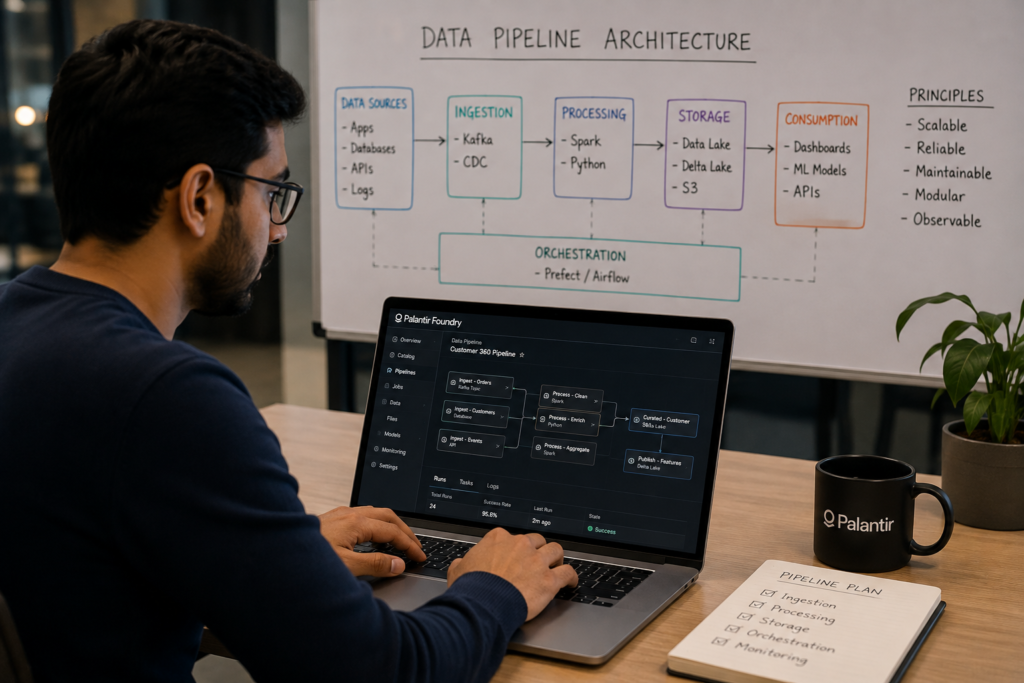
This guide breaks down what Palantir Foundry actually is, what a Data Engineer working on it really does day to day, the specific technical skills that show up consistently across real job postings, and — most usefully — the realistic paths people actually take to build a career around this platform, since very few of them start with an offer letter directly from Palantir itself.
If you’re a data engineer, a computer science student, or someone considering a pivot into this space, this guide is built to give you an accurate, grounded picture rather than recycled buzzwords.
Table of Contents
What Palantir Foundry Actually Is
Palantir Foundry is an enterprise data platform built by Palantir Technologies, designed to help large organizations integrate messy, scattered data from multiple systems into a single, governed, usable layer — and then build real operational applications and analytics on top of it. Rather than treating data engineering, analytics, and application-building as separate disciplines with separate tools, Foundry tries to unify them within one platform.
Foundry is used across a wide range of industries — manufacturing, healthcare, supply chain, financial services, and government operations among them — wherever an organization needs to pull together fragmented data (spreadsheets, legacy databases, sensor data, third-party feeds) and turn it into something both analysts and operational staff can actually use, often through custom-built internal applications rather than just dashboards.
The platform is genuinely broad, but at its center sits a concept that shapes almost everything a Foundry Data Engineer does: the Ontology — which we’ll unpack in more detail shortly, since understanding it is the single biggest thing separating a Foundry-literate engineer from a generic data engineer.
What a Palantir Foundry Data Engineer Does
Based on real job postings and Palantir’s own documentation, a Foundry Data Engineer’s core responsibilities typically include:
- Designing and maintaining data pipelines that ingest data from multiple source systems into Foundry, handling both batch and streaming data
- Writing transformation logic using Python, SQL, and PySpark/Spark to clean, validate, and reshape raw data
- Building and maintaining the Ontology layer — mapping raw data into semantic objects, relationships, and properties that represent real-world entities (a customer, a shipment, a piece of equipment, a case file)
- Ensuring data quality and governance across the pipeline lifecycle, including validation rules and health monitoring
- Collaborating closely with analysts, product owners, and domain experts to translate business or mission requirements into technical data models
- Building or supporting user-facing applications inside Foundry using low-code tools like Workshop, rather than only working behind the scenes
That last point is genuinely distinctive. Unlike a lot of traditional data engineering roles, which stop once the pipeline delivers clean data to a warehouse, Foundry Data Engineers are often pulled closer to the actual end-user application than typical backend data roles.
Foundry vs Palantir the Company: An Important Distinction
This is the single most useful clarification we can offer, because it changes how you should actually approach your job search.
Palantir Technologies is the company. Direct engineering roles at Palantir itself are notoriously selective, often involve unconventional interview processes, and represent a small fraction of the total “Palantir Foundry” job market.
Palantir Foundry is the software platform. Because Foundry is licensed to client organizations and deployed by systems integrators, the vast majority of “Palantir Foundry Data Engineer” job postings you’ll actually find are not roles at Palantir itself — they’re roles at:
- Consulting and systems integration firms (Deloitte, Accenture, Infosys, and similar) who deploy and customize Foundry for their clients
- Client organizations themselves — government agencies, manufacturers, healthcare systems, and enterprises that have licensed Foundry and need in-house engineers to run it
- Boutique Palantir implementation partners — smaller specialized consultancies that focus specifically on Foundry deployment work
This matters enormously for your job search strategy. If you’re targeting “Palantir Foundry Data Engineer” as a career direction, you have a meaningfully wider and more realistic set of employers to target than just Palantir’s own careers page.
The Core Skills Employers Actually Ask For
Pulling directly from real job postings and Palantir’s own role documentation, here’s what consistently shows up:
| Skill Category | Specific Skills |
|---|---|
| Programming | Python, SQL, PySpark/Spark |
| Foundry-specific tools | Pipeline Builder, Code Repositories, Contour, Quiver, Workshop, Ontology Manager |
| Data concepts | ETL/ELT pipeline design, data quality and validation, data governance |
| Modeling | Ontology design, semantic data modeling, entity-relationship thinking |
| Cloud | AWS and/or Azure, for underlying scalable storage and processing |
| Soft skills | Cross-functional collaboration with analysts, domain experts, and stakeholders |
Notice that most of the underlying technical skills — Python, SQL, Spark, cloud platforms, ETL design — are standard, transferable data engineering skills you’d need for almost any modern data role. Foundry-specific literacy is the differentiator, not a replacement for core data engineering competence.
Understanding the Ontology: Foundry’s Central Concept
If there’s one concept worth genuinely understanding before you claim “Foundry experience” anywhere, it’s the Ontology.
In Foundry, the Ontology is a semantic layer that sits on top of your raw, transformed data — representing real-world entities as objects (a customer, a machine, a shipment), with defined properties (attributes of that object), relationships (how objects connect to each other), and actions (operations that can be performed on or through that object, often triggering real-world workflows).
This is meaningfully different from a traditional data warehouse table structure. Rather than just storing clean, tabular data, the Ontology is designed to be a living, queryable representation of how an organization’s real operations actually work — which is also what allows Foundry’s low-code application layer (Workshop) to build genuinely functional operational tools on top of it, not just static dashboards.
Palantir’s own role documentation describes Data Engineers as being responsible for building the transformations that populate this Ontology reliably, and for collaborating closely with the people who design and manage its structure. Genuinely understanding this ontology-first mindset — not just knowing PySpark syntax — is what separates candidates who can speak credibly about Foundry from those who’ve only skimmed a job description.
The Realistic Ways People Enter This Career
Based on the pattern across real job postings, there are a few realistic entry routes:
- Join a consulting/systems integration firm that’s a Palantir partner. Firms like Deloitte, Accenture, and various boutique consultancies actively hire and train data engineers specifically for Foundry client work — often a more accessible entry point than applying directly to Palantir.
- Land a data engineering role at a company that already uses Foundry internally. Organizations across manufacturing, healthcare, and government have licensed Foundry and need engineers on staff, separate from Palantir’s own headcount.
- Build general data engineering skills first, then specialize. Since most of the underlying technical skills (Python, SQL, Spark, cloud) are standard data engineering fundamentals, building genuine competence there first, then layering Foundry-specific knowledge through free training, is a realistic path even without direct Foundry work experience yet.
- Apply directly to Palantir. This remains the most selective and competitive route, and typically involves a more rigorous, unconventional interview process than the other paths — worth pursuing, but not the only viable route into this space.
Salary Expectations: What’s Actually Verifiable
Based on publicly reported data, here’s what we can say with reasonable confidence, alongside honest caveats about what we can’t confirm:
- US-based Data Engineer roles directly at Palantir Technologies have been reported with a fairly wide base salary range, with figures spanning roughly the low-to-mid six figures depending on level and location, based on limited self-reported salary data.
- Consulting-firm and client-side “Palantir Foundry Data Engineer” roles (at firms like Deloitte, Accenture, or client organizations) tend to be benchmarked more closely to standard senior data engineering compensation at that specific firm, with Foundry skill as a premium add-on rather than a separate pay scale entirely.
- India-specific compensation data for this exact title is limited and inconsistent across sources — several Indian IT services and consulting firms (Infosys, L&T Technology Services, and similar) do list open “Palantir Foundry” roles, but we don’t have a verified, consistent India-specific salary figure to responsibly report here.
Our honest recommendation: treat any specific salary figure you see quoted for this role — especially for the India market — with real caution unless it’s confirmed directly in your own offer conversation. Given how few data points genuinely exist publicly, broad claims tend to be extrapolated far more confidently than the underlying data actually supports.
How to Actually Learn Foundry
Here’s genuinely good news for anyone trying to break into this space without an existing Foundry job: Palantir offers free, official training directly through Palantir Learn (learn.palantir.com), covering structured training tracks for different Foundry roles, including Data Engineering specifically.
A sensible learning path:
- Solidify your core data engineering fundamentals first — Python, SQL, and Spark/PySpark, since these form the backbone of virtually every Foundry Data Engineer posting.
- Work through Palantir Learn’s official training tracks, which are built directly by Palantir and specifically cover Foundry’s tools and the Ontology-first way of thinking.
- Build a small practice project, if you have access to a trial or training environment, applying ontology-style thinking to a dataset you understand well — even a personal project reframed around objects, properties, and relationships helps you internalize the mental model.
- Follow Foundry-specific use case content that Palantir publishes, to understand how the platform gets applied in real operational contexts, not just in the abstract.
This combination — real fundamentals plus official, free platform-specific training — is a genuinely credible path even for someone with zero prior Foundry work experience.
Building a Foundry-Relevant Resume
If you’re targeting this role specifically, a few adjustments matter:
- Lead with your core data engineering skills, since these are what most postings screen for first, before Foundry-specific experience.
- Explicitly name Foundry components you’ve used or trained on — Pipeline Builder, Contour, Workshop, Ontology Manager — rather than a vague “worked with Palantir Foundry” line.
- Describe your work in ontology-aware language where genuinely applicable — for example, framing a project around modeling entities and relationships, not just “built ETL pipeline,” if that’s an accurate description of what you did.
- Include any Palantir Learn training tracks you’ve completed, since this signals genuine, verifiable platform familiarity even without formal work experience on the platform.
Common Mistakes to Avoid
- Assuming every “Palantir Foundry” job posting is a role at Palantir itself. Most aren’t — they’re at consulting firms and client organizations, which is actually good news for your options.
- Overstating Foundry experience without understanding the Ontology. Interviewers who work with Foundry regularly can tell quickly whether a candidate genuinely understands ontology-first data modeling or is just repeating tool names.
- Neglecting core data engineering fundamentals in favor of platform-specific trivia. Python, SQL, and Spark competence remain the foundation — Foundry knowledge is additive, not a substitute.
- Trusting an unverified salary figure, especially for the India market, where consistent public data genuinely doesn’t exist yet for this specific role.
- Applying only to Palantir directly and ignoring consulting-firm and client-side roles. This significantly narrows your realistic opportunity set for no good reason.
- Skipping Palantir’s own free training. Palantir Learn is a legitimate, official resource, and ignoring it in favor of unofficial third-party content misses a genuinely credible way to build verifiable platform knowledge.
Expert Tips to Stand Out
- Learn to explain the Ontology in your own words, with a concrete example. Being able to walk through how you’d model a specific real-world scenario — a shipment, a patient record, a piece of equipment — as objects, properties, and relationships demonstrates genuine understanding far better than listing Foundry tool names.
- Target consulting and systems integration firms as your primary entry route, since they represent the majority of realistic hiring volume for this skill set, not just Palantir itself.
- Complete Palantir Learn’s official Data Engineering track and be ready to speak specifically about what you built or learned through it.
- Build genuinely strong Python, SQL, and PySpark fundamentals before worrying about Foundry specifics. A strong general data engineer who’s Foundry-aware will consistently outperform a Foundry-name-dropper with weak fundamentals in a real technical interview.
- Research the specific industry context of the role you’re applying for. Foundry deployments vary meaningfully between, say, a healthcare use case and a supply chain use case — showing you understand the specific domain, not just the platform, is a genuine differentiator.
- Be honest about your experience level. Given how selective and technical this space can be, overstating your Foundry depth tends to backfire quickly in a real technical conversation — genuine fundamentals plus honest platform familiarity is a stronger position than an inflated claim.
Frequently Asked Questions (FAQ)
1. What is Palantir Foundry?
It’s an enterprise data platform built by Palantir Technologies that integrates data from multiple sources into a governed, semantic layer (the Ontology) and enables both analytics and operational applications on top of it.
2. Do I need to work at Palantir itself to be a Palantir Foundry Data Engineer?
No. The majority of Foundry Data Engineer job postings are at consulting firms, systems integrators, and client organizations that license and use Foundry — not at Palantir Technologies directly.
3. What programming languages does a Foundry Data Engineer need?
Python, SQL, and PySpark/Spark are the most consistently required skills across real job postings for this role.
4. What is the Ontology in Palantir Foundry?
It’s Foundry’s semantic data layer, representing real-world entities as objects with properties, relationships, and actions, rather than just storing data in traditional tabular form.
5. How can I learn Palantir Foundry without a job that uses it?
Palantir Learn (learn.palantir.com) offers free, official training tracks covering Foundry’s tools and concepts, including a track specifically for Data Engineering.
6. What is the salary for a Palantir Foundry Data Engineer? US-based direct Palantir roles have been reported in the low-to-mid six figures based on limited self-reported data, while consulting-firm roles tend to align with that firm’s standard data engineering compensation. Reliable India-specific figures for this exact title are not well established publicly.
7. Is Palantir Foundry experience the same as general data engineering experience? No, but it builds on it. Core data engineering skills (Python, SQL, Spark, ETL design) remain foundational, with Foundry-specific tools and ontology-first thinking as an additional, differentiating layer.
8. Which companies hire for Palantir Foundry skills besides Palantir itself?
Major consulting and systems integration firms including Deloitte, Accenture, and Infosys, along with various client organizations across healthcare, manufacturing, government, and financial services that have licensed Foundry.
9. Is direct hiring at Palantir Technologies harder than other Foundry-related roles? Generally yes. Direct Palantir roles are widely described as highly selective with a rigorous interview process, whereas consulting-firm and client-side Foundry roles are comparatively more accessible entry points.
10. What’s the biggest mistake candidates make when targeting this role?
Overstating Foundry-specific knowledge without genuinely understanding ontology-first data modeling, or neglecting core data engineering fundamentals in favor of just naming Foundry tools.
Conclusion
A Palantir Foundry Data Engineer role is a genuinely interesting career direction, but it’s best approached with an accurate picture: most opportunities exist outside Palantir itself, core data engineering fundamentals still matter more than platform-specific trivia, and the Ontology-first way of thinking is the real differentiator worth understanding deeply. Build your Python, SQL, and Spark foundation first, work through Palantir’s own free training, and target the much wider set of consulting and client-side employers actually doing this hiring — not just Palantir’s own careers page.
For more practical, no-fluff career guidance, check out our Career Resources category page for regularly updated advice built for freshers and early-career professionals.
Suggested Internal Links
- Career Resources Category
- Skills Freshers Need in 2026
- ATS-Friendly Resume Guide 2026
- AI Job Search Trends 2026