
PM Internship Scheme 2026 is quietly one of the largest bridges India has ever built between a college degree and an actual paycheck — a government-backed program placing young Indians directly inside the country’s top 500 companies for genuine, paid, hands-on work experience. Unlike a typical two-month summer internship arranged through a college placement cell, this is a structured Ministry of Corporate Affairs initiative with a target of 1 crore internship opportunities over five years, running through a single official portal that connects candidates directly to real openings at firms across banking, oil and gas, automotive, FMCG, infrastructure, and hospitality.
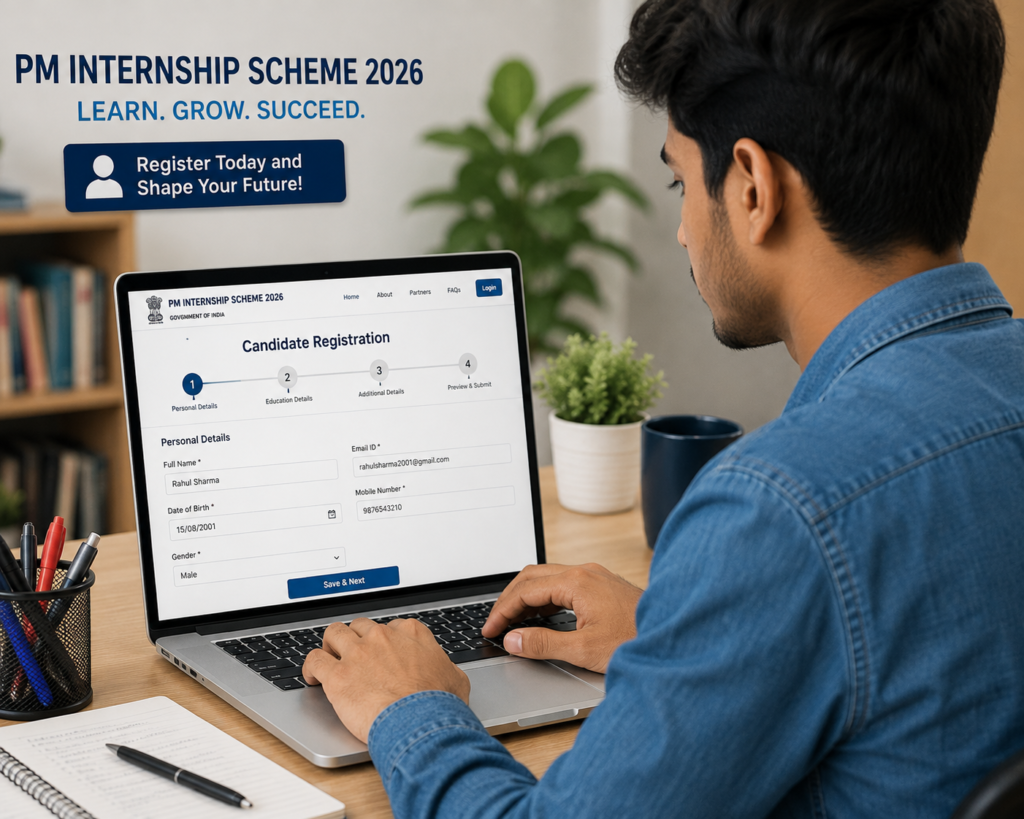
What makes this scheme genuinely different from most private-sector internship postings is who it’s designed for: it deliberately targets candidates without existing corporate networks — first-generation aspirants and those from tier-2 and tier-3 backgrounds — rather than only elite-institute graduates. This guide breaks down exactly who’s eligible, what stipend and duration to expect, how the online application actually works step by step, and the specific details worth double-checking before you apply, since this scheme has evolved through several eligibility revisions since its 2024 launch.
Table of Contents
What Is the PM Internship Scheme?
The Prime Minister’s Internship Scheme (PMIS) is a Government of India program, administered by the Ministry of Corporate Affairs (MCA), that places eligible young candidates into paid internships at India’s top 500 companies, ranked by CSR spending. It was announced in the Union Budget 2024-25, with a pilot phase launched on 3 October 2024, and the government has since extended the scheme with a target of 1 crore (10 million) internship opportunities over five years.
This is explicitly not a scholarship and not a classroom training program — it’s real, on-the-job work experience inside functioning corporations, spanning roughly 25 sectors including banking, oil and gas, automotive manufacturing, FMCG, infrastructure, and hospitality.
Who Runs It and Why It Exists
PMIS exists to solve a specific, well-documented problem: Indian employers consistently prefer candidates with prior work experience, but most fresh graduates and young job-seekers have no structured way to get that first experience. The scheme is jointly funded by the central government and participating companies, with each company required to draw its contribution from CSR (Corporate Social Responsibility) funds — meaning your stipend isn’t charity from the company, it’s a mandated CSR obligation paired with direct government support.
Eligibility Criteria
The following criteria reflect the scheme’s most consistently reported eligibility framework. Because PMIS has revised its rules across cohorts since 2024, treat these as a strong baseline and verify your specific eligibility bracket on the official portal before applying:
- Age: Most cohorts have used 21 to 24 years as the eligible age bracket at the time of application; some more recent reports describe a broadened range of 18 to 25 years for newer cohorts. Confirm the currently active bracket on the portal’s FAQ section.
- Citizenship: Must be an Indian citizen.
- Educational Qualification: Candidates who have completed Class 10, Class 12, an ITI certificate, a polytechnic diploma, or a graduate/postgraduate degree (BA, B.Sc., B.Com, BCA, BBA, B.Pharma, B.E./B.Tech, MA, M.Sc., M.Com, MCA, M.Tech, etc.) are eligible, depending on the specific role. Under expanded rules, final-year graduate and postgraduate students may also apply, typically with a No Objection Certificate from their college.
- Employment Status: Must not be in full-time employment or full-time education at the time of application. Candidates enrolled in online or distance learning programs remain eligible.
- Family Income: Your household’s annual income must fall below a specified cap — this has been reported as ₹8 lakh in earlier cohorts and up to ₹12 lakh in more recent reporting. Confirm the exact current threshold on the official portal, since your family income is auto-verified against your PAN where possible.
- Household Employment Status: In most cohorts, candidates from households where a family member currently holds a government job have not been eligible.
Who Is Excluded
The scheme deliberately excludes candidates from a small set of premier institutions and professional qualifications, since PMIS is structured to reach applicants who genuinely lack existing access to corporate networks:
- Graduates of premier institutes such as IITs, IIMs, and IISERs
- Holders of professional qualifications including CA (Chartered Accountancy), CMA, and MBBS
If you fall into one of these categories, this specific scheme isn’t designed for you — but numerous other internship and placement pathways remain available through your institution directly.
Stipend and Financial Support
The most consistently reported stipend structure across official and verified sources is:
| Component | Amount | Source |
|---|---|---|
| Monthly stipend (government share) | ₹4,500 | Direct Benefit Transfer (DBT) |
| Monthly stipend (company share) | ₹500 | Company CSR funds |
| Total monthly stipend | ₹5,000 | Combined |
| One-time joining/incidental grant | ₹6,000 | Released in tranches, government-funded |
Some more recent secondary sources report a higher figure (around ₹9,000/month) for newer cohorts, which may reflect a since-updated stipend structure. Given this inconsistency across sources, confirm the current stipend amount directly on pminternship.mca.gov.in before finalizing your decision to apply, rather than relying on any single secondary source, including this one.
Internship Duration
The scheme’s original and most widely confirmed structure runs internships for 12 months, full-time, with the first portion of the internship typically focused on job-environment orientation and the remainder on deeper professional exposure within the organization.
More recent reporting suggests some cohorts have moved toward a shorter 6-to-9-month duration, depending on the specific company and role. As with the stipend, confirm the exact duration listed for your specific internship posting on the portal, since this can vary both by cohort and by individual company listing.
Which Companies Participate
Partner companies are selected from India’s top 500 firms ranked by CSR spending, spanning sectors including banking, oil and gas, automotive, FMCG, infrastructure, and hospitality. In the pilot phase, roughly 280 companies offered approximately 1.27 lakh internship opportunities across around 25 sectors. Reported participating companies span major names across banking, energy, steel, and FMCG sectors, with region-specific opportunities available depending on where these companies operate manufacturing or regional offices.
Since the participating company list and open roles change with each cohort, check the live listings on the portal directly rather than relying on a static company list from any external source.
Step-by-Step: How to Apply
- Visit the official portal at pminternship.mca.gov.in — avoid any third-party or unofficial website claiming to offer PMIS registration.
- Browse before logging in. You can view basic listing details (qualification required, location, duration, benefits) without an account, though the full job description and Apply button remain locked until you register.
- Register by clicking Login/Register → New User/Register Now. Enter your mobile number, verify via OTP, and set a password meeting the portal’s complexity requirements (minimum 8 characters, including uppercase, lowercase, a digit, and a special character).
- Complete e-KYC by verifying your identity through Aadhaar OTP or DigiLocker. This step unlocks full internship descriptions and enables the Apply button.
- Complete your profile, entering your educational qualifications, location preference, sector interest, and family income details (auto-verified against your PAN where possible).
- Browse and shortlist internships matching your qualification, location, and sector preference.
- Apply to your selected openings. You can typically apply to a limited number of internships per cycle — check the portal’s current rules on how many applications you can submit simultaneously.
- Track your application status through your applicant dashboard as companies review and shortlist candidates.
Documents and Details You’ll Need
Keep the following ready before you begin registration:
- Aadhaar card (for e-KYC verification via OTP or DigiLocker)
- PAN card details (for family income auto-verification)
- Educational qualification certificates and mark sheets
- A No Objection Certificate from your college, if you’re a final-year student applying under the expanded eligibility rules
- Your mobile number and email ID for account registration and OTP verification
There is no registration or application fee anywhere in this process. Any website or individual charging a fee for “PMIS registration” is not legitimate — report or avoid such sources entirely.
Selection Process
Unlike a government exam-based recruitment, PMIS selection happens through direct company review of your profile and application against their specific role requirements. There’s no centralized written test — participating companies review candidate profiles for their listed openings and shortlist directly through the portal.
What Happens After Selection
Once selected and placed, your internship period begins with your monthly stipend disbursed via Direct Benefit Transfer, alongside your one-time incidental grant released in tranches (with the first portion typically arriving within a short window after joining). At the end of your internship period, you receive a completion certificate, which — combined with a genuine year of documented work experience inside a major Indian corporation — meaningfully strengthens your profile for future employment applications.
If you’re currently an active intern from an earlier round, note that some cohorts have required interns to log in and update specific details (such as insurance information) by a fixed deadline to avoid affecting stipend disbursement or coverage — always check your applicant dashboard for cohort-specific action items rather than assuming your enrollment is fully passive once selected.
Is the Stipend Taxable?
The PMIS stipend is generally classified as a government transfer payment rather than salary income. For most eligible candidates whose total annual income (including the stipend) falls below the basic exemption limit, it is typically not taxable. If your total income from all sources exceeds the applicable exemption threshold, consult a chartered accountant for guidance specific to your situation, since individual tax circumstances vary.
A Note on Recent Eligibility Changes
PMIS has evolved meaningfully since its 2024 pilot. Reported changes across recent cohorts include an expanded age bracket in some listings, a shift toward shorter internship durations for certain companies, a possibly revised family income cap, and expanded eligibility to include final-year students under specific conditions. Because these details vary across sources and cohorts — and because this scheme is explicitly portal-driven with rules that update between application rounds — the single most reliable source for your specific eligibility is the current FAQ section on pminternship.mca.gov.in, checked at the time you actually apply.
Common Mistakes to Avoid
- Applying through a third-party website or agent. PMIS has no offline mode and no legitimate third-party application route — apply only through pminternship.mca.gov.in.
- Paying any fee for registration. The scheme has zero application or registration fee anywhere in the process; any request for payment is a scam.
- Assuming a fixed stipend or duration without checking your specific cohort. Both figures have varied across reporting — verify current terms on the portal before making decisions based on older information.
- Skipping e-KYC and expecting to see full listings. Basic details are visible before verification, but the complete job description and Apply button remain locked until Aadhaar or DigiLocker verification is complete.
- Missing cohort-specific action deadlines if you’re an existing intern. Some rounds have required interns to update details like insurance information by a fixed date — check your dashboard regularly rather than assuming no action is needed.
- Applying despite falling under an excluded category. IIT/IIM/IISER graduates and CA/CMA/MBBS qualification holders are not eligible under this specific scheme.
- Providing inaccurate family income information. Since this is auto-verified against PAN records where possible, inaccurate declarations risk disqualification.
Expert Tips to Improve Your Chances
- Complete your e-KYC verification early, since this step is a gateway to viewing full internship descriptions and applying — don’t leave it until you’ve already found a listing you want.
- Set your location and sector preferences realistically broad rather than narrow, since PMIS operates across roughly 25 sectors and companies with openings in many regions — a narrow filter can hide otherwise-strong matches.
- If you’re a final-year student considering applying under expanded eligibility, secure your college’s No Objection Certificate early rather than waiting until you’ve been shortlisted.
- Treat your profile completion (educational details, sector interest) with the same care as a job application — companies are reviewing this directly to shortlist candidates, not a government committee applying a fixed formula.
- Regularly check your applicant dashboard even after applying, since cohort-specific updates, deadlines, or required actions are communicated there rather than through a single upfront notification.
- Don’t let uncertainty about the exact current stipend or duration stop you from applying — confirm the specific terms for the listing you’re interested in directly on the portal at the time you apply.
Frequently Asked Questions (FAQ)
1. What is the PM Internship Scheme 2026?
It is a Government of India program administered by the Ministry of Corporate Affairs that places eligible youth in paid internships at India’s top 500 companies, aiming to provide 1 crore internship opportunities over five years.
2. Who is eligible for PMIS?
Broadly, Indian citizens aged in the commonly reported 21–24 bracket (some cohorts report a broader 18–25 range), who have completed at least Class 10 and are not currently in full-time employment or education, subject to a family income cap. Always verify the current bracket on the official portal.
3. What is the stipend under PMIS?
The most consistently reported figure is ₹5,000/month (₹4,500 from government DBT plus ₹500 from company CSR funds), plus a one-time grant of ₹6,000. Some recent sources cite higher figures for newer cohorts — confirm the current amount on the official portal.
4. How long does the internship last?
Originally structured as a 12-month, full-time internship; some recent reports describe shorter 6-to-9-month durations depending on the company and role.
5. Is there an application fee?
No. PMIS has no registration or application fee at any stage. Any site or agent requesting payment for “PMIS registration” is not legitimate.
6. Who is excluded from applying?
Graduates of IITs, IIMs, and IISERs, and holders of professional qualifications like CA, CMA, or MBBS, are not eligible under this scheme.
7. Can final-year students apply?
Under expanded eligibility rules in more recent cohorts, final-year graduate and postgraduate students may apply, typically with a No Objection Certificate from their college.
8. Is the PMIS stipend taxable?
It’s generally treated as a government transfer payment rather than salary income, and is typically not taxable for candidates whose total annual income falls below the basic exemption limit. Consult a chartered accountant if your total income exceeds the applicable threshold.
9. Do I get a certificate after completing the internship?
Yes. Interns receive a completion certificate after finishing their internship period, which strengthens their profile alongside the documented work experience gained.
10. How do I apply for PMIS?
Register and apply entirely online at pminternship.mca.gov.in — create an account, complete Aadhaar-based e-KYC, fill in your profile, and apply to internship listings matching your qualification and preferences.
Conclusion
PM Internship Scheme 2026 remains one of the most substantial paid internship opportunities available to young Indians right now — a genuine year (or, in some newer cohorts, several months) of real corporate exposure at India’s top 500 companies, with government-backed financial support built in from day one. Because eligibility details, stipend figures, and duration have evolved across cohorts since the 2024 pilot, the single most important step before applying is confirming your specific eligibility and the current terms directly on pminternship.mca.gov.in — then applying promptly, since slots within any given round don’t wait.
For more verified internship opportunities across government and private sectors, check out our Internships category page for regularly updated, source-checked listings. And if you’re specifically interested in research-oriented internships, our guide on DRDO Internship 2026 covers another major pathway for engineering and science students.
Suggested Internal Links
- Internships Category
- DRDO Internship 2026: Best Guide to Apply
- CSIR NAL Walk-in Interview 2026: Best 89-Post Guide
- Resume Tips 2026: Land Your Dream Job Faster
Suggested External References (for fact-checking and updates)
- Official PM Internship Scheme Portal: https://pminternship.mca.gov.in
- Ministry of Corporate Affairs Official Website: https://www.mca.gov.in