
Best RRB Group D Preparation Strategy 2026 is the single most searched phrase among Level-1 railway aspirants right now, and for good reason: with the CBT-1 examination for CEN 09/2025 running across multiple shifts through August 2026 for 22,195 vacancies, the gap between candidates who clear the cutoff and those who don’t often comes down to how well the final 30 to 45 days were used — not how many months of preparation came before it. A strong start means little if the last stretch is spent passively re-watching classes instead of actively testing what’s actually stuck.
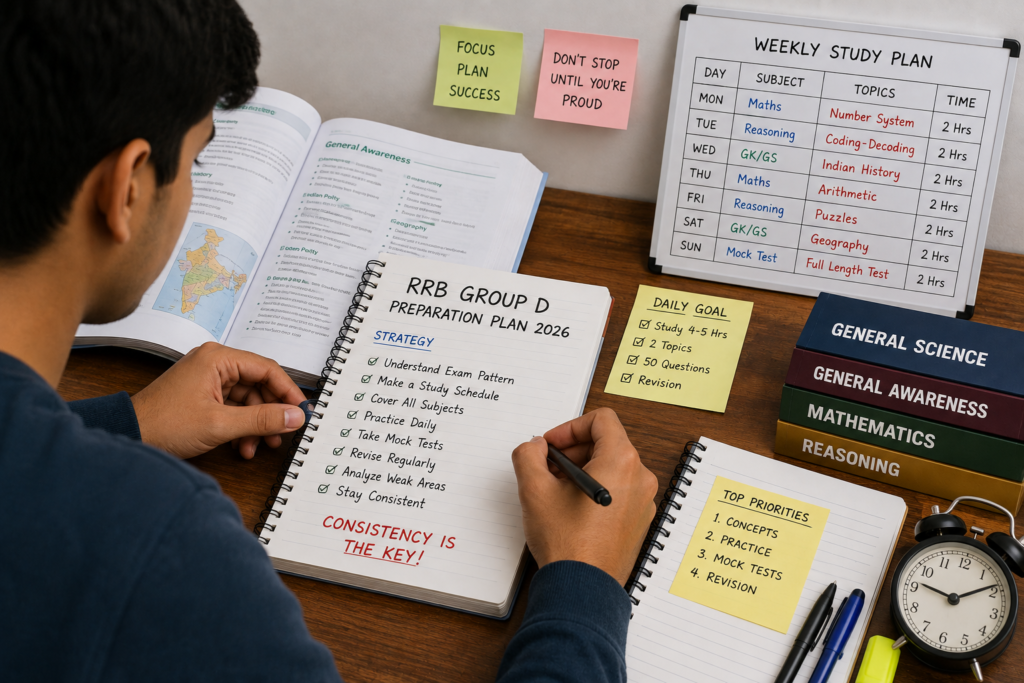
This guide lays out a complete, practical strategy for this final preparation window: how to structure your daily study time across Mathematics, Reasoning, General Awareness, and General Science, why mock tests matter more than most candidates realize, and a genuine topic-wise breakdown of where recent RRB Group D exams have concentrated their questions — so you know exactly where to focus your remaining hours for maximum return.
Table of Contents
Understanding the RRB Group D CBT-1 Exam Pattern
Before building any strategy, you need to know exactly what you’re preparing for:
| Section | Questions | Approx. Marks |
|---|---|---|
| Mathematics | 25 | 25 |
| General Intelligence & Reasoning | 30 | 30 |
| General Awareness | 20 | 20 |
| General Science | 25 | 25 |
| Total | 100 | 100 |
- Duration: 90 minutes
- Negative Marking: 1/3 mark deducted for every incorrect answer
- Nature: CBT-1 determines your final merit directly — the subsequent Physical Efficiency Test (PET) is qualifying only
- Minimum Qualifying Marks (indicative): approximately 40% for UR/EWS, 30% for OBC/SC, and 25% for ST candidates
Since negative marking applies and CBT-1 marks feed directly into your final selection, accuracy matters just as much as speed — guessing carelessly on unfamiliar questions can cost you more than leaving them unattempted.
Why the Last 30 Days Matter So Much
With CBT-1 for this cycle spread across multiple shifts through August 2026, different candidates get anywhere from roughly 27 to 45 days of runway depending on their allotted exam date. That’s a meaningfully short but genuinely usable window — provided it’s spent the right way.
The mistake most candidates make in this final stretch is treating it as “more of the same” — continuing to passively consume classes at the same pace as three months ago. The final 30-45 days need a different mode entirely: less new learning, dramatically more active practice, revision, and self-testing.
The Three Types of Candidates — and What Each Needs
Most aspirants at this stage fall into one of three categories, and the right strategy differs slightly for each:
- Well-prepared candidates: Already deep into revision and mock tests. Focus now on refining speed, accuracy, and time management across full-length tests rather than learning new content.
- Moderately-prepared candidates: Have covered most topics but haven’t consistently tested themselves. Focus on aggressive revision paired with topic-wise tests to convert passive knowledge into exam-ready recall.
- Late-starting candidates: Minimal structured preparation so far. Focus on high-weightage topics first (identified in the sections below), paired with topic-wise tests from day one rather than trying to cover the entire syllabus at equal depth.
Whichever category you’re in, the same core loop applies — it’s just the balance of time that shifts.
The Core Preparation Loop: Learn, Practice, Revise, Test
A genuinely effective final-stretch strategy rests on four repeated steps, not a single pass through the syllabus:
- Learn — go through the concept or topic once, through classes or study material.
- Practice — attempt multiple questions on that specific topic, more than once if needed. A concept heard once rarely survives contact with an exam-day question asked in an unfamiliar format.
- Revise — actively review what you learned and practiced, rather than assuming a single pass is enough. How many revision cycles you personally need varies — some candidates retain a topic after two passes, others need four or more. Know your own pattern and plan accordingly.
- Test — attempt mock exams, both topic-wise and full-length, to check whether what you’ve learned, practiced, and revised actually translates into correct answers under exam conditions.
Skipping the “test” step is the most common reason otherwise well-prepared candidates underperform — you can’t know whether a topic is genuinely exam-ready until you’ve been tested on it under time pressure.
Topic-Wise Weightage: Mathematics
Based on an analysis of recent RRB Group D shift-wise question papers, here’s roughly how frequently each Mathematics topic has appeared across recent exam cycles:
| Topic | Relative Frequency |
|---|---|
| Percentage | Highest |
| Time and Distance | Very High |
| Ratio and Proportion | Very High |
| Mensuration | High |
| Discount | High |
| Simplification | High |
| Time and Work | Moderate-High |
| Profit and Loss | Moderate |
| Number System | Moderate |
| Average | Moderate |
| Statistics (Mean/Median) | Moderate |
| Trigonometry | Moderate |
| Pipes and Cisterns | Moderate |
| Algebra | Lower-Moderate |
| Simple Interest | Lower-Moderate |
| Compound Interest | Lower-Moderate |
| Partnership | Lower-Moderate |
| Height and Distance | Lower-Moderate |
| Allegation & Mixture | Lower |
| LCM & HCF | Lower |
| Geometry & Coordinate Geometry | Lower |
| Linear Equations | Lower |
Percentage, Time and Distance, and Ratio and Proportion consistently top the list — if your Mathematics revision time is limited, these three topics deserve priority over less frequently tested areas.
Topic-Wise Weightage: Reasoning
Similarly, General Intelligence & Reasoning shows a clear concentration pattern across recent papers:
| Topic | Relative Frequency |
|---|---|
| Numerical Arrangement | Highest |
| Coding & Decoding | Very High |
| Seating Arrangement | Very High |
| Analogy | High |
| Mathematical Operations | High |
| Missing Number Series | High |
| Classification / Odd One Out | High |
| Syllogisms | Moderate-High |
| Ranking | Moderate |
| Mixed Series | Moderate |
| Blood Relation | Moderate |
| Direction Sense | Moderate |
| Puzzle Test | Moderate |
| Alphabet Series | Lower-Moderate |
| Alphabet Arrangement | Lower |
| Calendar & Clock | Lower |
| Equality/Inequality | Lower |
| Letter Series | Lower |
| Meaningful Word Formation | Lower |
| Word Formation | Lower |
Coding & Decoding, Numerical Arrangement, and Seating Arrangement are the heaviest-weighted reasoning topics — worth disproportionate revision time given their consistent frequency.
Topic-Wise Weightage: General Awareness and General Science
For General Awareness, recent papers have leaned heavily on:
- Government Schemes and Initiatives
- Banking and Economics
- Awards and Honours
For General Science, question distribution has been spread across Biology (cell biology, disease and health), and Ecology & Environment topics, alongside the standard Physics and Chemistry basics — so don’t neglect NCERT-level science fundamentals in favor of current affairs alone.
Building Your Daily Study Schedule
There’s no single “correct” time allocation across subjects — it depends entirely on your personal strengths and weaknesses. Some candidates are naturally strong in Mathematics but weak in General Awareness; others find Reasoning intuitive but struggle with Science recall. Before fixing a schedule:
- Take one full-length mock test to honestly assess where you currently stand in each section.
- Allocate more daily time to your weaker sections, without completely neglecting your stronger ones.
- Build in a fixed daily slot for revision — not just new learning — since this is the step most candidates skip under time pressure.
- Reserve time each day (or on alternating days) for either a topic-wise test or a full-length mock, especially as you get closer to your exam date.
A schedule that looks productive on paper but skips daily testing and revision will underperform one that’s less “complete” on paper but genuinely tests and revises consistently.
Why Both Topic-Wise and Full-Length Mock Tests Matter
These two types of tests serve different purposes, and skipping either one leaves a gap in your preparation:
- Topic-wise tests tell you whether you’ve genuinely mastered a specific concept in isolation — useful for confirming a topic is exam-ready before moving on.
- Full-length tests tell you something topic-wise tests can’t: how well you manage time across the entire 90-minute window, how your accuracy holds up under sustained pressure across all four sections, and how well you handle the psychological experience of a live-length exam.
In the final stretch specifically, prioritize attempting as many full-length mock tests as your schedule allows — this is where time-management skills and exam-day composure are actually built.
How to Actually Analyze a Mock Test
Taking a mock test without reviewing it afterward wastes most of its value. After every test, spend time specifically on:
- How many questions you got right, and how many you got wrong
- Why each wrong answer went wrong — a careless error, a genuine knowledge gap, or a misread question
- Which questions you left unattempted, and whether that was a good time-management call or a missed opportunity
- Whether your pacing across sections needs adjustment for the next attempt
This analysis step, done consistently after every mock test, is often what separates steady score improvement from a plateau.
Selection Process After CBT-1
Once you clear CBT-1, the remaining stages are:
- Physical Efficiency Test (PET) — qualifying in nature
- Document Verification
- Medical Examination
Since PET is qualifying only and final merit is based entirely on your CBT-1 score, the exam itself remains the single most decisive stage of this entire recruitment process — which is exactly why a focused final-stretch strategy matters so much.
Important Dates for This Cycle
| Event | Date |
|---|---|
| CBT-1 Examination Window | 3 August – 21 August 2026 (revised schedule extends select shifts to 25 August 2026) |
| Total Vacancies (CEN 09/2025) | 22,195 |
| Exam Mode | Computer-Based Test, multiple shifts daily |
| Admit Card / Exam City Slip | Released approximately 10 and 4 days before your individual exam date respectively |
Since your specific exam date, shift, and city are assigned individually, check your RRB’s official portal regularly for your personal Exam City Intimation Slip and e-Call Letter as your date approaches.
Common Mistakes to Avoid
- Only watching classes without practicing. Passive learning without active practice rarely survives exam-day recall — treat every class as step one of four, not the whole process.
- Skipping revision in favor of new content. Covering the full syllabus once means little if none of it is retained by exam day; build in dedicated revision time, especially in the final weeks.
- Avoiding full-length mock tests in favor of only topic-wise practice. Topic-wise tests build concept confidence, but only full-length tests build the time-management skill the actual exam demands.
- Not analyzing mock test mistakes. Simply noting your score without understanding why specific questions went wrong repeats the same errors on the next attempt.
- Ignoring negative marking during practice. Practicing without factoring in the 1/3 negative mark can lead to overconfident guessing habits that hurt you on exam day.
- Neglecting General Science in favor of only current affairs. Recent papers show meaningful weightage on core Biology, Ecology, and Environment topics — don’t let science basics slide.
- Waiting until the last week to start full-length mocks. Time-management skills built under pressure take repeated practice to develop — start well before your exam date, not days before it.
Expert Tips to Strengthen Your Preparation
- Prioritize high-frequency topics first if you’re short on time: in Mathematics, that’s Percentage, Time & Distance, and Ratio & Proportion; in Reasoning, it’s Coding & Decoding, Numerical Arrangement, and Seating Arrangement.
- Study previous years’ shift-wise question papers specifically to understand the examiner’s typical question style and difficulty calibration — this pattern recognition genuinely helps on exam day.
- Take at least one full-length mock test in exam-day conditions (same time of day, same 90-minute constraint, no pausing) in your final week to build genuine familiarity with the pressure.
- Track your section-wise accuracy across multiple mock attempts, not just your overall score — a rising overall score can still hide a persistently weak section that needs targeted attention.
- If you’re consistently strong in one section, don’t over-invest additional time there at the expense of a weaker section — diminishing returns set in quickly once a section is already solid.
- Keep your revision material condensed into short, reviewable notes for each high-weightage topic, so your final few days can focus on quick recall rather than re-reading full study material.
Frequently Asked Questions (FAQ)
1. What is the RRB Group D CBT-1 exam pattern?
100 objective-type questions across Mathematics (25), General Intelligence & Reasoning (30), General Awareness (20), and General Science (25), to be completed in 90 minutes, with 1/3 negative marking per wrong answer.
2. Is there an interview in RRB Group D selection?
No. Selection is based on CBT-1 (merit-deciding), followed by a qualifying Physical Efficiency Test, document verification, and a medical examination.
3. How many vacancies are there in this RRB Group D cycle?
22,195 vacancies under CEN 09/2025.
4. When is the RRB Group D CBT-1 exam being conducted?
Across multiple shifts from 3 August to 21 August 2026, with the revised schedule extending select shifts to 25 August 2026.
5. Which Mathematics topics carry the highest weightage?
Based on recent shift-wise paper analysis, Percentage, Time and Distance, and Ratio and Proportion have shown the highest frequency of questions.
6. Which Reasoning topics should I prioritize?
Coding & Decoding, Numerical Arrangement, and Seating Arrangement have consistently carried the heaviest weightage in recent papers.
7. How many mock tests should I take before the exam?
As many as your schedule genuinely allows, split between topic-wise tests (to confirm concept mastery) and full-length tests (to build time management and exam-day composure) — consistency matters more than a fixed number.
8. Is General Science limited to Physics and Chemistry?
No. Recent papers show meaningful weightage on Biology topics like cell biology and disease/health, along with Ecology and Environment, alongside standard Physics and Chemistry basics.
9. What is the minimum qualifying mark in CBT-1?
Indicatively around 40% for UR/EWS, 30% for OBC/SC, and 25% for ST candidates, though candidates should verify the exact current cutoff structure in the official notification.
10. What should late-starting candidates focus on with limited time left?
Prioritize the highest-weightage topics identified in the analysis above, and pair every learning session with immediate topic-wise testing rather than attempting comprehensive syllabus coverage at equal depth.
Conclusion
A strong RRB Group D Preparation Strategy 2026 for this final stretch isn’t about consuming more content — it’s about converting what you’ve already learned into exam-ready recall through consistent practice, genuine revision, and disciplined mock testing. Whether you have 45 days left or considerably fewer, the same loop applies: learn, practice, revise, test, and analyze — repeated consistently rather than attempted once. Focus your limited time on the highest-weightage topics identified here, take full-length mocks seriously as time-management practice, and review every mistake you make rather than just your score.
For more exam preparation strategies and verified recruitment updates, check out our Railway Exam Preparation category page for regularly updated study guides. And if you’re also tracking related railway openings, our detailed guide on RRB JE Recruitment 2026 covers another major technical-cadre opportunity currently open for application.
Suggested Internal Links
- Railway Exam Preparation Category
- RRB JE Recruitment 2026: 3,993 Posts, Apply
- RCF Apprentice Recruitment 2026: 734 Posts, No Exam
Suggested External References (for fact-checking and updates)
- Official RRB Application Portal: https://www.rrbapply.gov.in