Tech Layoffs 2026 search “how many tech jobs cut in 2026” and you’ll get a different answer depending on which article you land on. One tracker says roughly 92,000. Another puts it past 140,000. A third, updated within the last few days, shows over 209,000. None of these sources is lying — they’re measuring genuinely different things, and understanding why matters more than memorizing any single headline figure, especially if you’re trying to gauge how worried to actually be about your own role.
This is the single most consequential career story running through 2026, and it’s directly relevant whether you’re already employed in tech, actively job hunting, or a student trying to decide what to study next. This guide reconciles the conflicting numbers, breaks down exactly what’s happening company by company, and — more usefully than another scary headline count — lays out which specific roles are actually being eliminated versus which ones remain in genuine, well-paid shortage at the very same companies doing the cutting.
Table of Contents
Why the Headline Numbers Don’t Match
Before looking at any specific figure, it helps to understand what each tracker actually counts:
- Layoffs.fyi tracks self-reported and news-verified tech company layoffs specifically, and had recorded roughly 92,000 tech workers laid off as of late April 2026.
- TrueUp’s tracker, checked in early August, listed 520 technology layoff events affecting approximately 174,721 workers for the year to that point — a broader net than Layoffs.fyi, capturing more events across more company sizes.
- SkillSyncer’s live tracker, updated within the past few days, shows 365 events and over 209,000 workers affected, with roughly half of all 2026 layoff events explicitly citing AI, automation, or machine learning as a contributing factor.
- TechCrunch’s running list specifically isolates layoffs where companies cited AI as a factor, counting close to 140,000 across the year through late July, with Amazon, Oracle, Meta, and Microsoft alone responsible for nearly 50,000 of that total.
The gap between these numbers comes down to three things: which companies count (some trackers include only publicly traded tech firms; others include tech divisions within non-tech companies like Nike), what counts as “AI-related” (a company citing AI in its official statement versus a layoff that’s plausibly AI-driven but not officially attributed to it), and when the snapshot was taken, since this has been a continuously escalating story throughout the year rather than a single event. None of the trackers are wrong — they’re answering slightly different questions.
The Company-by-Company Picture
Rather than one aggregate number, here’s what’s actually been reported at the individual company level through 2026:
| Company | Reported Cuts | Context |
|---|---|---|
| Amazon | ~16,000 corporate roles (January), following 14,000 in October 2025; additional cuts to robotics (100+) and Selling Partner Services teams | Largest single contributor to 2026’s total; reported alongside 24% AWS growth, its fastest in 13 quarters |
| Oracle | Up to 30,000 positions, roughly 20% of global workforce | Concentrated in legacy database administration and on-premises support roles |
| Meta | 8,000 roles (10% of workforce), effective May 20; plus roughly 1,000-1,500 from its Reality Labs division separately | Recruiting and HR functions absorbed 35-40% of the cuts; freed capacity redirected toward AI investment |
| Microsoft | Contributed to a combined 20,000+ cuts alongside Meta reported in April | Part of a broader efficiency push tied to AI infrastructure spending |
| Intuit | ~3,000 jobs, about 17% of its workforce | Framed as reducing organizational complexity while reallocating toward AI |
| Cisco | Just under 4,000 jobs in Q4, including 471 in the Bay Area | Paired with continued investment in silicon, security, and internal AI tooling |
| ~875 employees, about 5% of staff | Reuters-reported restructuring | |
| Nike | ~1,400 employees, concentrated in its technology department | A reminder that tech-role cuts extend well beyond companies classified as “tech” |
| xAI | ~500 employees, from its Grok chatbot training team | Even AI-focused companies have cut roles tied to earlier-stage model training work |
The Number Nobody Puts in the Headline: Hiring Is Also Surging
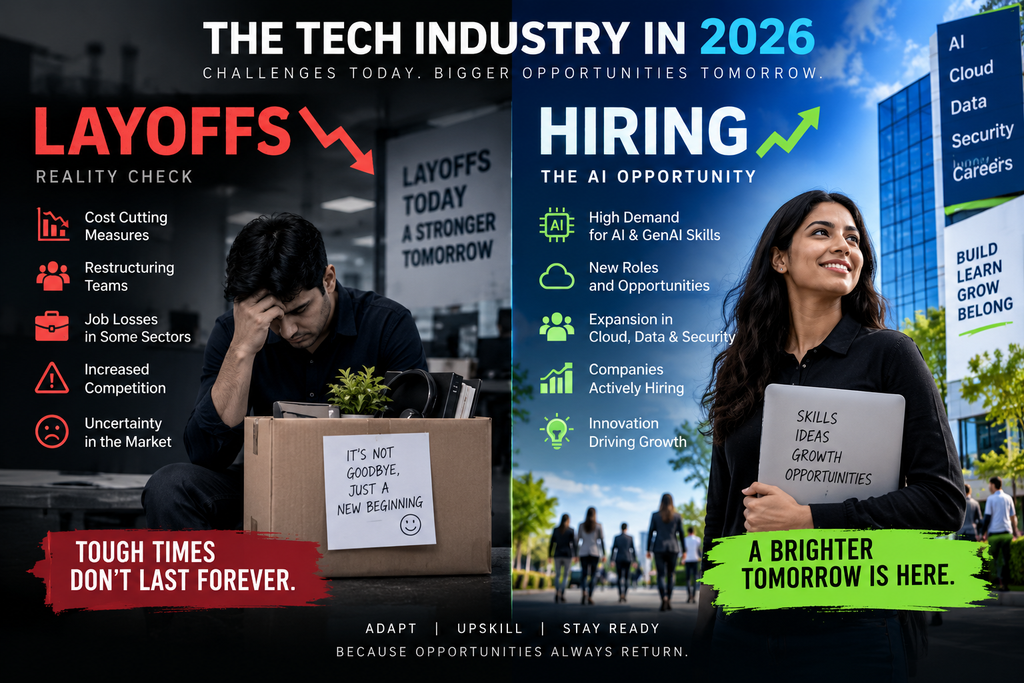
Here’s the part of this story that gets far less attention than the layoff counts,Tech Layoffs 2026 and it’s the genuinely useful piece if you’re trying to plan your own next move: at the same time these cuts were happening, roughly 275,000 AI-related job postings were open in the United States, with companies reporting a 92% increase in hiring specifically for AI-related roles in 2026, and a 56% wage premium attached to the highest-demand positions. The uncomfortable truth in this data is that the workers being laid off are overwhelmingly not the workers being hired. Customer support, quality assurance, content moderation, legacy database administration, on-premises IT support, and middle management are the categories seeing the heaviest cuts. Machine learning engineers, AI safety researchers, and data infrastructure specialists are in active shortage at the very same companies making those cuts.
This isn’t a story of “AI is destroying tech jobs” in a simple, uniform sense — it’s a story of a sharp bifurcation within the industry, where specific skill categories are being actively eliminated while an adjacent, often better-paid set of skills is in genuine shortage.
The Detail Most Coverage Leaves Out: Not All “AI Layoffs” Are Really About AI
This is worth stating plainly, because it changes how you should interpret company announcements: analysis from Bloomberg suggests that roughly half of AI-attributed layoffs eventually result in the same roles being rehired — either offshore, or at lower cost domestically — rather than the work genuinely disappearing because a machine now does it. In other words, when a company’s official statement cites “AI-driven efficiency” as the reason for a layoff, that framing is sometimes accurate in the literal sense (automation genuinely replaced the task), and sometimes a more palatable way of describing a cost-cutting or offshoring decision that would have happened anyway. This matters for how you evaluate your own role’s risk: the honest question isn’t just “can AI do parts of my job,” it’s also “is my role a cost center a company might want to relocate or restructure regardless of AI capability.”
What This Looks Like From the Worker’s Side
Separately from the raw layoff counts, Glassdoor’s Employee Confidence Index recorded the steepest year-over-year confidence drop of any industry in the tech sector, falling 6.8 percentage points to 47.2% by March 2026. Tech salaries have stayed largely flat compared to 2025, with a notable exception: specialized roles like AI engineers have continued seeing real wage growth even as broader tech compensation stalls. This combination — flat pay for most roles, rising anxiety, and a widening gap in outcomes between AI-adjacent and non-AI-adjacent positions — is arguably a more accurate picture of what’s happening in the industry than any single “X thousand jobs cut” headline captures on its own.
Which Roles Are Actually Most at Risk
Based on the pattern across this year’s confirmed cuts, roles facing the most consistent pressure include:
- Legacy database administration and on-premises infrastructure support — directly targeted in Oracle’s cuts, as cloud migration reduces demand for on-prem-specific skills
- Customer support, especially tier-1 and non-technical support — increasingly automated through AI-driven chat and ticket-resolution systems
- Content moderation — heavily automated through AI classification systems in recent years
- Recruiting and HR functions — Meta’s cuts specifically hit these functions hardest, partly reflecting AI-assisted recruiting tools reducing headcount needs
- Middle management layers — several companies have explicitly cited “reducing organizational layers” as a restructuring goal, independent of any specific AI tool replacing a task
Which Roles Remain in Genuine Shortage
At the same companies cutting elsewhere, active hiring and wage growth is concentrated in:
- Machine learning engineers and AI infrastructure specialists — the technical talent actually building the systems driving this transition
- AI safety and alignment researchers — a genuinely scarce, highly specialized skill set
- Data infrastructure and data engineering roles — supporting the massive data pipelines AI systems depend on
- Cloud architecture roles tied to AI workloads — reflected in continued strong growth at companies like Amazon’s AWS division, even amid corporate-wide layoffs elsewhere
- Specialized security roles, particularly around AI system security, as companies like Cisco have explicitly continued investing here even while cutting elsewhere
What This Means If You’re Currently Job Hunting
- Don’t read a single “X jobs cut” headline as a verdict on the entire industry. The aggregate numbers mask a genuine bifurcation — some skill categories are in crisis, others are in a genuine hiring boom, often at the same company simultaneously.
- If your current or target role sits in one of the at-risk categories above, treat upskilling as urgent, not optional. The wage premium data specifically rewards movement toward AI-adjacent skills, not just general “AI awareness.”
- Evaluate a company’s specific hiring patterns, not just its layoff headlines. A company announcing layoffs in one division may be simultaneously hiring aggressively in another — Amazon’s corporate cuts alongside AWS’s fastest growth in over a decade is the clearest example of this pattern.
- Be skeptical of “AI did it” as a complete explanation in any single layoff announcement. Given the reported rate at which cut roles reappear offshore or restructured, the actual cause is often a blend of automation and cost optimization rather than automation alone.
- If you’re choosing what to study or specialize in now, weight the shortage list above more heavily than the general “learn AI” advice circulating everywhere. Machine learning engineering, data infrastructure, and AI security specifically show sustained wage growth, not just job postings.
How This Compares to Previous Tech Layoff Waves
It’s worth situating 2026 against the tech industry’s last major layoff cycle, in 2022 and 2023, since the comparison reveals something genuinely different about what’s happening now. That earlier wave was largely a correction — companies had overhired dramatically during the pandemic-era boom, and rising interest rates forced a return to more disciplined growth models. It was, in essence, a reversal of a temporary excess. The 2026 wave has a different character: companies are cutting headcount while simultaneously increasing capital expenditure on AI infrastructure to record levels, with several firms reporting strong or even accelerating revenue growth in the exact same reporting period as their layoff announcements. Amazon’s AWS division posting its fastest growth in 13 quarters while the company cut 16,000 corporate roles is the clearest illustration of this — this isn’t a company in trouble cutting costs to survive, it’s a profitable, growing company deliberately reallocating where and how it spends on labor versus infrastructure. That distinction matters because it suggests this isn’t a temporary cyclical correction that reverses once growth returns — it reflects a more permanent shift in how these companies are choosing to structure their workforces going forward.
A Practical Framework for Assessing Your Own Risk
Rather than relying on industry-wide statistics alone, it’s worth running your own specific role through a short set of questions drawn from the patterns above:
- Is a significant part of your role routine, repeatable, and rules-based? Tasks that follow a predictable pattern — standard customer queries, routine data entry, template-based content review — are the most consistently automated categories across this year’s cuts.
- Does your role sit within a function companies have explicitly named as a cost center during restructuring? Recruiting, HR operations, tier-1 support, and legacy infrastructure maintenance have all been named directly in major companies’ own restructuring announcements this year.
- Could your specific tasks reasonably be performed by a smaller team elsewhere, at lower cost, without a significant quality trade-off? This is the offshoring-disguised-as-AI question — if the honest answer is yes, treat this as a genuine risk factor independent of AI capability specifically.
- Does your role require judgment calls, novel problem-solving, or building/maintaining the AI systems themselves? These are the categories showing sustained wage growth and active hiring across the same companies making cuts elsewhere.
If your honest answers to the first three questions lean toward “yes” and the fourth toward “no,” that’s a genuine signal to prioritize skill development now, while you have the runway to do so deliberately, rather than reactively after a restructuring announcement affects you directly.
Why This Matters Even If You’re Not in Tech
This story is easy to dismiss if you’re not working in a tech company directly, but the pattern extends further than the headlines suggest. Nike’s cuts specifically targeting its technology department is one clear example of a non-tech company restructuring its internal tech function the same way pure-play tech companies are. Retail, finance, and insurance companies have all announced comparable workforce reductions this year, often citing similar AI-driven efficiency reasoning. If your role touches internal software, data, IT support, or digital operations at a company that isn’t itself a “tech company,” the same underlying dynamics — automation pressure on routine tasks, cost scrutiny on support functions, growing premium on AI-adjacent skills — apply just as directly to you as they do to someone working at Meta or Amazon.
Common Mistakes to Avoid When Reading This Story
- Treating any single tracker’s number as the definitive count. Each measures a genuinely different scope — compare methodology before comparing numbers.
- Assuming your specific role is safe just because your company hasn’t announced layoffs yet. The pattern across 2026 has been continuous and escalating, not a single event that’s already fully played out.
- Assuming your role is doomed simply because it overlaps with an AI capability. Overlap with what AI can do isn’t the same as your specific role being scheduled for elimination — company-specific cost and strategic factors matter as much as raw technical feasibility.
- Ignoring the hiring side of this story entirely. A purely layoff-focused reading misses the genuinely actionable insight: specific skills are in real, well-paid shortage right now, at the same companies making headlines for cuts.
- Confusing “AI-cited” layoffs with layoffs where AI is the sole or even primary cause. Treat corporate statements about AI-driven efficiency with the same skepticism you’d apply to any other official corporate messaging.
- Assuming this trend is limited to companies formally classified as “tech.” As Nike’s example shows, internal tech functions at any large company face comparable pressure.
Frequently Asked Questions
How many tech jobs have actually been cut in 2026?
It depends on the tracker and methodology: Layoffs.fyi recorded roughly 92,000 by late April, TrueUp recorded about 174,721 across 520 events by early August, and SkillSyncer’s live tracker shows over 209,000 as of the most recent update — each measures a different scope of companies and events.
Is AI really the main cause of 2026’s tech layoffs?
It’s a significant factor in roughly half of this year’s layoff events by some trackers’ counts, but analysis suggests a substantial share of “AI-attributed” cuts are also tied to cost-cutting or offshoring, with the same roles sometimes reappearing elsewhere at lower cost.
Which company has cut the most jobs in 2026?
Amazon has been the largest single contributor, with approximately 16,000 corporate roles eliminated in January alone, following 14,000 cuts in October 2025, plus additional reductions in its robotics and Selling Partner Services teams.
Are any tech roles actually seeing job growth right now?
Yes — machine learning engineering, AI safety research, data infrastructure, and AI-focused cloud and security roles are all in active shortage with real wage growth, even at companies simultaneously announcing broad layoffs elsewhere.
Is it true that Nike laid off tech workers even though it’s not a tech company?
Yes, Nike announced roughly 1,400 layoffs concentrated specifically in its technology department, illustrating that this trend extends well beyond companies formally classified as tech firms.
What does the Glassdoor Employee Confidence Index show about the tech sector?
It recorded the steepest year-over-year confidence drop of any industry, falling 6.8 percentage points to 47.2% by March 2026, reflecting rising anxiety among tech workers broadly.
Should I avoid a career in tech because of these layoffs?
Not necessarily — the data shows a bifurcated market rather than a uniform decline. Roles adjacent to AI infrastructure, safety, and data engineering are seeing genuine growth and wage premiums even during this same period.
What roles are considered most at risk right now?
Legacy database administration, on-premises infrastructure support, tier-1 customer support, content moderation, recruiting/HR functions, and middle management layers have all seen concentrated cuts across multiple major companies this year.
The Bottom Line
The honest answer to “how bad are tech layoffs in 2026” isn’t a single number — it’s a genuinely uneven picture where hundreds of thousands of jobs in specific categories have been eliminated while a smaller, better-paid set of AI-adjacent roles remains in active, wage-premium shortage at many of the same companies. If you’re navigating a career decision around this, the useful move isn’t panicking at the biggest headline number you find — it’s checking specifically whether your current skills sit closer to the at-risk list or the shortage list above, and adjusting your upskilling priorities accordingly.
For more fact-checked coverage of trends affecting your career, check out our Trending category page for regularly updated analysis. And if you’re actively building toward one of the roles in genuine demand right now, our guide on AI Powered Software Engineer Preparation breaks down what’s actually worth learning versus what’s just noise.
Suggested Internal Links
- Trending Category
- AI Powered Software Engineer Preparation: Best 2026 Guide
- 12 Free AI Tools 2026: Which Ones Are Really Free
- Resume Tips for Experienced Candidates 2026: Best Guide
Suggested External References
- Layoffs.fyi Tracker: https://layoffs.fyi
- TrueUp Layoffs Tracker: https://www.trueup.io/layoffs
- Glassdoor Employee Confidence Index: https://www.glassdoor.com/research