
DRDO Internship 2026 is one of the most consistently valuable — and consistently misunderstood — opportunities available to Indian engineering and science students right now. Unlike a typical recruitment notification with one fixed application window, DRDO doesn’t run a single centralized internship drive. Instead, each of its specialised laboratories — from the Aeronautical Development Establishment in Bengaluru to the Defence Research and Development Laboratory in Hyderabad — independently opens its own Paid Internship Scheme throughout the year, each with its own dates, seat count, and application process. That structure is exactly why so many capable students miss out: they’re waiting for one big notification that never comes, while individual labs quietly open and close their windows lab by lab.
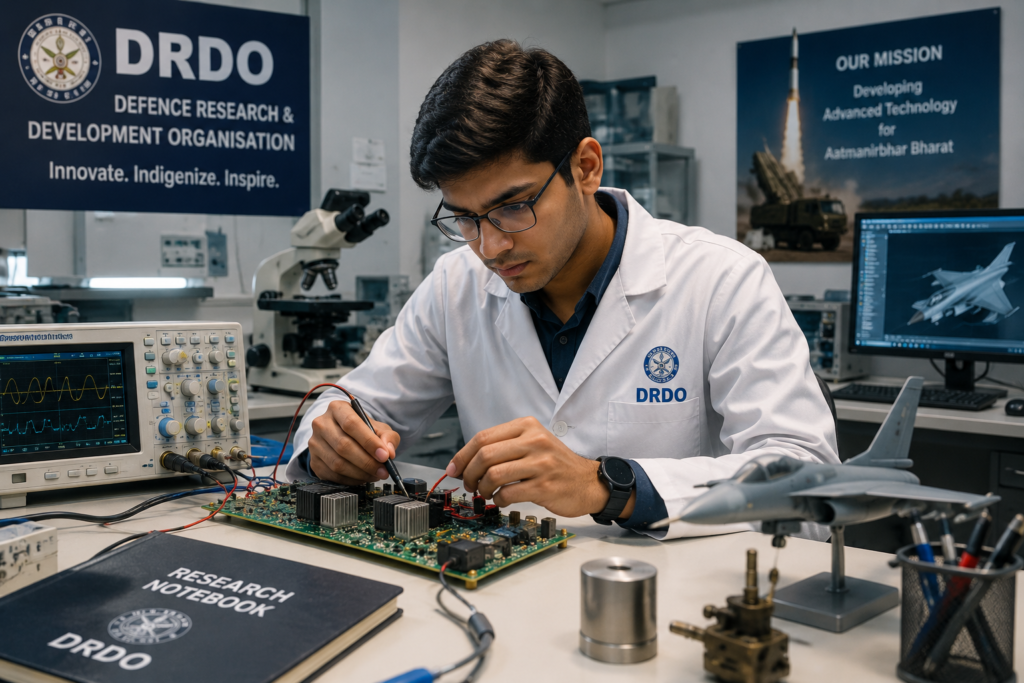
This guide breaks down what a genuine DRDO internship actually involves — which labs participate, who’s eligible, how the (often lab-specific) application process actually works, what stipend and duration to realistically expect, and the documents you’ll need ready before you approach any lab directly. If you’re serious about a future in defence research, PSU roles, or even strengthening your profile before GATE or a government exam, this is a credential worth pursuing correctly.
Table of Contents
What the DRDO Internship Actually Is
The Defence Research and Development Organisation (DRDO), functioning under India’s Ministry of Defence, runs internships through its individual laboratories rather than as one organisation-wide program. Each lab focuses on a specific research domain — aeronautics, life sciences, electronics, armaments, materials science, or defence communication systems — and offers structured, project-based exposure to students within that domain.
This means a “DRDO internship” isn’t a single, uniform product. An internship at the Aeronautical Development Establishment (ADE) in Bengaluru looks very different from one at the Defence Institute of Physiology and Allied Sciences (DIPAS) in Delhi, both in the nature of the work and in the specific application process.
Why There’s No Single “DRDO Internship Portal”
This is the detail that trips up the most students: there is no unified national portal where you submit one application and get matched to a lab. Each DRDO laboratory publishes its own advertisement — often under its own advertisement number — on its individual website or through DRDO’s central vacancy listings page, and each has its own opening date, closing date, and seat count for that particular cycle.
Practically, this means genuinely interested students need to actively track individual lab announcements rather than waiting for one large notification, since these paid internship schemes open on a rolling basis across the year at different labs.
Which DRDO Labs Offer Internships
DRDO conducts internships through numerous specialised laboratories and establishments across India, including:
| Lab | Location | Focus Area |
|---|---|---|
| Aeronautical Development Establishment (ADE) | Bengaluru | Aeronautics, UAV systems |
| Defence Research and Development Laboratory (DRDL) | Hyderabad | Missile systems |
| Research Centre Imarat (RCI) | Hyderabad | Missile guidance and control |
| Combat Vehicles Research & Development Establishment (CVRDE) | Chennai | Armoured vehicles |
| Defence Electronics Research Laboratory (DLRL) | Hyderabad | Electronic warfare systems |
| Defence Materials and Stores Research and Development Establishment (DMSRDE) | Kanpur | Materials science |
| Defence Institute of Physiology and Allied Sciences (DIPAS) | Delhi | Life sciences, physiology |
| Solid State Physics Laboratory (SAG) | Delhi | Cryptology, electronics |
| Defence Institute of Bio-Energy Research (DIBER) | Haldwani | Bio-energy research |
| Defence Institute of Advanced Technology and allied establishments | Various | Multiple domains |
This list isn’t exhaustive — DRDO operates over 50 laboratories nationwide, and internship availability at any given lab depends on current project needs and ongoing schemes at that specific time.
Eligibility Criteria
While exact requirements vary slightly by lab, the common eligibility framework across most DRDO internship schemes includes:
- Full-time enrollment in a B.E./B.Tech, M.E./M.Tech, M.Sc., or Ph.D. program at a recognised, AICTE/UGC-approved Indian institution
- Many labs specifically prefer candidates in their final year, pre-final year, or later stage of postgraduate study (commonly 7th/8th semester UG or 2nd year PG)
- Relevant discipline aligned with the lab’s research focus — engineering disciplines (Mechanical, Electrical, Electronics/ECE, Computer Science/IT, Aerospace, Chemical, Instrumentation) or science disciplines (Physics, Chemistry, Materials Science, Biotechnology, Mathematics)
- Indian citizenship
- A No Objection Certificate (NOC) or recommendation letter from your college, in most cases
Some labs additionally specify an age limit, commonly around 28 years — check the specific lab’s advertisement for confirmation, since this isn’t universal across every DRDO establishment.
Academic Performance Requirements
Academic performance thresholds vary by lab, but most DRDO internship schemes expect:
- A minimum of around 60% marks as a baseline requirement
- Several labs set the bar higher, requiring 75% or above (CGPA of 7.5/10 or higher), particularly for more competitive or specialised project areas
Since selection is typically based on academic performance rather than a written exam, a strong, consistent academic record genuinely matters more here than in many other recruitment processes.
Duration of a DRDO Internship
Internship duration varies by lab and by the level of study:
- Most internships run for a minimum of 4 to 6 months, aligned with a typical academic semester or project cycle
- Some labs structure internships around specific date ranges tied to the academic year — for instance, some 2026 cycles have specified periods running from July through December
- Postgraduate and doctoral-level internships or project engagements can sometimes extend longer, depending on the research scope agreed upon with the lab
Always confirm the exact duration in the specific lab’s advertisement, since this is one of the details that varies most between individual schemes.
Is the DRDO Internship Paid?
This varies genuinely by lab and scheme. Several DRDO laboratories explicitly run a “Paid Internship Scheme” — DMSRDE Kanpur, DIPAS Delhi, DIBT Mysuru, and SAG Delhi have all advertised paid internship schemes for the 2026-27 cycle, among others. That said, not every DRDO lab or every internship opportunity carries a stipend — some are structured as unpaid academic project engagements, particularly shorter or less formal arrangements.
Since stipend amounts and eligibility for payment vary by lab and aren’t published in one central, comparable format, always check the specific advertisement for the lab you’re applying to rather than assuming a fixed stipend applies across DRDO as a whole.
How the Application Process Actually Works
Unlike an online recruitment portal, most DRDO internship applications follow this general path:
- Identify a lab and open scheme relevant to your discipline, either through DRDO’s central vacancy/internship listing page or the individual lab’s own website.
- Prepare your application in the format specified in that lab’s advertisement — this is often a structured request letter from your college, rather than a standard online form.
- Route it through your college, in many cases — applications are frequently submitted through your institution’s Training and Placement (T&P) Cell, or sent directly to the Director or HR/Admin section of the specific DRDO lab, addressed appropriately.
- Attach supporting documents, including your NOC, academic transcripts, and a cover letter outlining your interest and relevant background.
- Await confirmation — since there’s no unified portal, response times and confirmation methods vary by lab; some labs publish shortlists or results directly on their website.
What Your Application Should Include
A complete DRDO internship application typically needs:
- A formal request letter or application, often on your college’s letterhead, specifying the internship period you’re requesting (for example, a specific start and end date matching the lab’s advertised scheme)
- Your enrollment number, current year/semester, branch, and institution name
- A No Objection Certificate (NOC) from your college confirming you’re a bonafide student eligible for the internship
- Academic transcripts or mark sheets demonstrating you meet the lab’s minimum percentage/CGPA requirement
- A brief statement of interest connecting your academic background to the lab’s specific research focus
The Role of Your College’s T&P Cell
Many DRDO labs specifically expect applications to be routed through your college’s Training and Placement Cell, rather than submitted individually as a walk-in application. This isn’t just a formality — it’s often how the NOC and formal request letter get generated and forwarded with the appropriate institutional backing. If you’re targeting a DRDO internship, looping in your T&P Cell or your department early is a practical first step, not an afterthought once you’ve already identified your preferred lab.
What You’ll Actually Work On
DRDO internships offer genuine, hands-on exposure to real defence research and development work, structured around ongoing projects at the specific lab. Depending on your discipline and the lab, this can include:
- Aeronautics and UAV systems research (ADE, Bengaluru)
- Missile systems design, guidance, and control (DRDL and RCI, Hyderabad)
- Electronic warfare systems and signal processing (DLRL, Hyderabad)
- Materials science and composite development (DMSRDE, Kanpur)
- Physiology and life sciences research relevant to defence applications (DIPAS, Delhi)
- Cryptology and advanced electronics (SAG, Delhi)
Because these are live, ongoing research environments rather than simulated training programs, the specific project you’re assigned depends on the lab’s current requirements at the time of your internship.
Selection Process
Selection for most DRDO internships is based primarily on academic performance and profile fit rather than a written examination or formal interview. Labs typically review:
- Your academic transcripts against their minimum percentage/CGPA threshold
- Relevance of your discipline and specialization to the lab’s current research focus
- Your application’s stated area of interest and any prior relevant project work
Since there’s no standardised written test, a strong, well-targeted application — one that clearly connects your specific coursework or project experience to the lab’s actual research domain — genuinely improves your chances more than generic applications sent to multiple labs simultaneously.
Benefits of a DRDO Internship
- Genuine exposure to India’s defence research ecosystem and real-world defence technology projects
- The opportunity to work alongside experienced DRDO scientists and researchers
- A completion certificate from a nationally recognised defence research organisation, issued after satisfactory completion of your project and submission of your assignment report
- A meaningfully strengthened academic and professional profile for future GATE preparation, PSU recruitment, or roles at organisations like ISRO, BARC, or HAL
- Practical, applied research experience that classroom coursework alone doesn’t provide
Common Mistakes to Avoid
- Waiting for a single, centralized DRDO internship notification. It doesn’t exist — opportunities open lab by lab, on a rolling basis, throughout the year.
- Applying without a College NOC ready. Most labs require this as a core part of your application package, not an optional extra.
- Sending a generic application to multiple labs without tailoring it. A request letter that clearly connects your specific coursework to that lab’s research focus performs meaningfully better than a copy-pasted generic application.
- Assuming every DRDO internship is paid. Stipend availability varies genuinely by lab and scheme — verify this in the specific advertisement rather than assuming.
- Skipping your college’s T&P Cell. Many labs expect applications routed institutionally, and your T&P Cell can often help you identify current openings you might otherwise miss.
- Applying too close to your intended start date. Since applications often route through your college and then the lab’s HR/Admin section, build in real lead time rather than applying at the last moment.
- Ignoring the specific academic percentage/CGPA cutoff. Some labs set this notably higher (75%+) than the commonly cited baseline of 60% — check the specific lab’s requirement before assuming you qualify.
Expert Tips to Improve Your Chances
- Regularly check DRDO’s central internship/vacancy listing page alongside the individual websites of labs relevant to your discipline, since opportunities appear and close on a rolling basis.
- Approach your college’s T&P Cell or your department head early to understand what institutional support (NOC issuance, forwarding letters) is available and how quickly it can be arranged.
- Target labs whose research focus genuinely aligns with your specific coursework, projects, or areas of technical interest — this alignment is what selection committees are actually assessing.
- If you’re in your final year or early postgraduate study, prioritize applying during the specific windows labs prefer (commonly final/pre-final year UG or early PG), since this matches most labs’ stated eligibility preference.
- Keep your academic transcripts and CGPA calculation ready and accurate, since this is the primary selection criterion at most labs.
- Once selected, treat the internship as a genuine research engagement — a strong project outcome and assignment report can meaningfully strengthen future references and applications to DRDO, ISRO, or other PSU roles.
Frequently Asked Questions (FAQ)
1. What is the DRDO Internship 2026?
It is a set of internship opportunities offered independently by various DRDO laboratories across India, giving engineering and science students hands-on exposure to defence research projects, typically through each lab’s own Paid Internship Scheme or similar arrangement.
2. Is there a single online portal to apply for all DRDO internships?
No. Each DRDO laboratory publishes its own advertisement and manages its own application process — there’s no unified, centralized application portal covering every lab.
3. What is the eligibility for a DRDO internship?
Full-time enrollment in a B.E./B.Tech, M.E./M.Tech, M.Sc., or Ph.D. program at a recognised institution, typically in your final or pre-final year, with a minimum academic performance of around 60% (some labs require 75% or higher).
4. Is the DRDO internship paid?
It depends on the lab and scheme. Several labs, including DMSRDE Kanpur, DIPAS Delhi, DIBT Mysuru, and SAG Delhi, have run explicitly Paid Internship Schemes, while other opportunities may be unpaid academic project engagements.
5. How long does a DRDO internship last?
Typically a minimum of 4 to 6 months, though this varies by lab and by whether you’re an undergraduate or postgraduate applicant.
6. How do I apply for a DRDO internship?
Applications are usually submitted through your college’s Training and Placement Cell, or sent directly to the Director or HR/Admin section of the specific DRDO lab, along with your NOC, academic transcripts, and a formal request letter.
7. Is there a written exam for DRDO internship selection?
No. Selection is typically based on academic performance and profile relevance rather than a written test or formal interview.
8. Do I get a certificate after completing a DRDO internship?
Yes. A completion certificate is awarded after satisfactory completion of your project or internship and submission of your assignment report, subject to evaluation by the concerned division head or scientist.
9. Can final-year students apply for DRDO internships?
Yes — many labs specifically prefer candidates in their final or pre-final year of undergraduate study, or early in their postgraduate program.
10. Which DRDO labs offer internships?
Numerous labs across India, including ADE Bengaluru, DRDL and RCI Hyderabad, CVRDE Chennai, DLRL Hyderabad, DMSRDE Kanpur, and DIPAS Delhi, among many others — availability depends on each lab’s current research needs and open schemes.
Conclusion
A DRDO Internship 2026 is a genuinely valuable credential for engineering and science students aiming at a future in defence research, PSU careers, or graduate study — but only if you approach it the right way. There’s no single notification to wait for; instead, success depends on actively tracking individual lab announcements, preparing your NOC and academic documents in advance, and targeting labs whose research focus genuinely matches your background. Start with your college’s T&P Cell, identify two or three labs aligned with your discipline, and apply with a tailored, well-prepared request rather than a generic one.
For more verified internship and government recruitment updates as they’re officially released, check out our Internships category page for regularly updated, source-checked opportunities. And if you’re also exploring walk-in interview routes into similar research institutions, our guide on CSIR NAL Walk-in Interview 2026 covers another currently active opportunity in aerospace research.
Suggested Internal Links
- Internships Category
- CSIR NAL Walk-in Interview 2026: Best 89-Post Guide
- Resume Tips 2026: Land Your Dream Job Faster
Suggested External References (for fact-checking and updates)
- Official DRDO Internship and Vacancy Listings: https://drdo.gov.in/drdo/en/search/node?keys=Internship
- Official DRDO Website: https://drdo.gov.in