
Resume Tips for Experienced Candidates 2026 need to solve a completely different problem than the advice aimed at freshers. A first-time job seeker’s biggest challenge is having too little to say; an experienced candidate’s biggest challenge is usually the opposite — ten, fifteen, or twenty years of work history, and no clear sense of what to cut, what to lead with, or how to make a hiring manager grasp your actual level of seniority in the six seconds they’ll spend scanning your resume before deciding whether to read further.
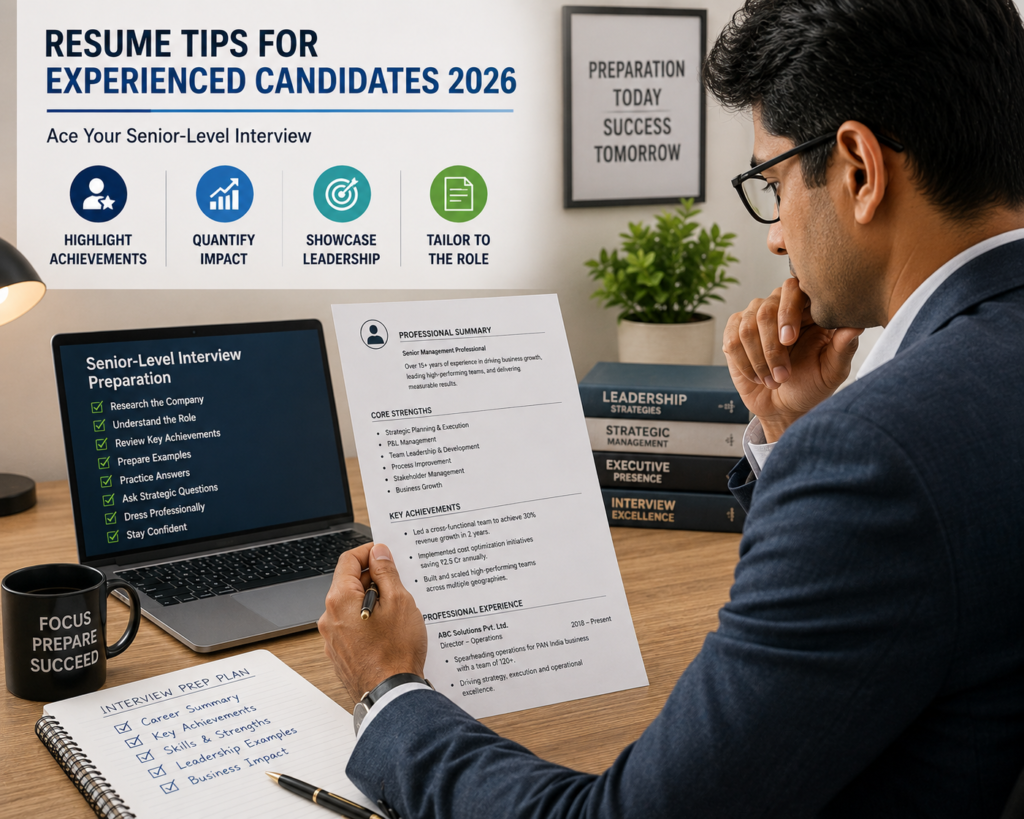
This guide is built specifically for candidates with real work history behind them — how to structure a career narrative instead of a flat job list, quantify leadership and business impact rather than just responsibilities, handle multiple job changes or a senior-level gap without raising red flags, and calibrate length and detail appropriately for how many years you’ve actually worked. If you’re applying at a mid-career or senior level and still using the same resume structure you used for your first job, this is exactly the recalibration you need.
Table of Contents
Why Experienced Resumes Need a Different Approach
A fresher’s resume is judged on potential — grades, projects, internships, and signs of promise. An experienced candidate’s resume is judged on evidence — what you actually did, what changed because of it, and whether your trajectory suggests you’re ready for the next level of responsibility. Recruiters reading an experienced candidate’s resume are asking a different question entirely: not “could this person do the job,” but “has this person already demonstrated they can do jobs like this, and grown while doing them.”
That shift changes almost everything about how the resume should be built — not just what you include, but how you frame it.
Reverse Chronological Is Still Right — But the Content Changes
The reverse chronological format — most recent role first — remains the right structural choice at any experience level, including senior ones. What changes is the depth and framing within each role:
- Early-career resumes describe duties. Experienced resumes describe outcomes.
- Early-career resumes list tools and skills. Experienced resumes demonstrate how those skills were applied to move a specific business result.
- Early-career resumes are relatively flat. Experienced resumes should visibly show increasing scope and responsibility as you move up through your work history.
Don’t switch to a functional or skills-based format just because you have more experience — this format actually works against experienced candidates by obscuring the career trajectory that’s your strongest asset at this stage.
Writing a Career Summary Instead of an Objective
A fresher’s resume often opens with an “objective” stating what they’re looking for. An experienced candidate’s resume should open with a career summary — three to four lines stating who you are professionally, framed around what you offer, not what you’re seeking. Compare:
- Weak (objective-style): “Seeking a challenging role in operations management where I can utilize my skills.”
- Strong (career summary): “Operations leader with 12 years managing multi-site manufacturing teams, with a track record of reducing production costs and improving on-time delivery across high-growth environments.”
The second version tells a recruiter your level, your domain, and your demonstrated strength within the first sentence — exactly what they need to decide whether to keep reading.
How Far Back Should Your Work History Go?
A common mistake experienced candidates make is including their entire career history in equal detail, going back 20+ years. A more effective approach:
- Detail your most recent 10-15 years of work history in full, with quantified achievements for each role.
- Summarize older roles briefly — job title, company, and dates, without extensive bullet points — or omit them entirely if they’re not relevant to the role you’re targeting.
- Drop graduation year from your education section once you have substantial work experience; it’s no longer the most relevant data point about you, and including it can occasionally invite unconscious age-based assumptions from screeners.
Recruiters evaluating a senior candidate care far more about your last decade of impact than what you did at the very start of your career.
Quantifying Impact at a Senior Level
Quantification matters at every career stage, but at a senior level, the scale and nature of what you quantify should shift to reflect genuine leadership and business impact, not task completion:
- Weak: “Managed a team and improved processes.”
- Strong: “Led a team of 14 across three regional offices, reducing average project delivery time by 30% through a restructured workflow adopted company-wide.”
Where possible, quantify:
- Team size and scope you managed or influenced
- Budget you owned or contributed to
- Revenue, cost savings, or efficiency gains tied to initiatives you led
- Cross-functional or organizational reach — how many departments, regions, or stakeholders your work touched
If you genuinely can’t attach a number to an achievement, describe the before-and-after change in concrete terms instead of leaving it as a vague responsibility statement.
Showing Career Progression, Not Just Job Titles
One of the most valuable signals in an experienced resume is visible growth — promotions, expanding scope, or increasing responsibility over time. If you’ve been promoted within the same company, make this explicit rather than listing each role as a flat, separate entry:
Example structure for internal promotions:
Company Name — City Senior Manager, Operations (2023–Present) Manager, Operations (2020–2023) Assistant Manager, Operations (2018–2020)
List achievements under each title tier, so the progression itself becomes visible evidence of your trajectory — this is a stronger signal than almost anything else on an experienced resume, and burying it by treating each role as a separate, unconnected entry wastes it.
How Long Should an Experienced Resume Be?
- 5-10 years of experience: One to two pages, depending on the complexity and breadth of your roles.
- 10+ years of experience, particularly in leadership roles: Two pages is standard and appropriate — don’t artificially compress two decades of relevant achievement into one page just to follow fresher-level advice.
- Beyond two pages: Generally avoid this, even at a very senior level. If your draft runs longer, the issue usually isn’t that you’ve done too much — it’s that older, less relevant roles need summarizing rather than full detail.
The right length is genuinely a function of relevant depth, not a fixed rule — but “two pages, tightly edited” is the realistic target for most genuinely experienced candidates.
Handling Multiple Job Changes
If your work history includes several shorter tenures, address this proactively rather than hoping it goes unnoticed:
- Where a short tenure was due to a layoff, company closure, or acquisition, a brief factual note (without excessive detail) can preempt an unfavorable assumption.
- Group short-term contract or consulting roles under a clear heading (e.g., “Independent Consulting, 2021-2023”) rather than listing each individual client engagement as a separate job entry, if that better reflects the nature of the work.
- Focus your bullet points on what you accomplished in each role, even a short one — a well-defined contribution in 8 months reads very differently than an unexplained 8-month gap in an otherwise stable history.
Explaining a Career Gap at a Senior Level
A gap in an experienced professional’s history draws more scrutiny than the same gap for a fresher, simply because there’s more career history to compare it against. Address it directly and briefly:
- A short, factual line covering the reason (further study, caregiving responsibilities, a health matter, or a deliberate career break) is generally received better than an unexplained gap that looks concealed.
- If you used the gap productively — a certification, freelance work, volunteering in a relevant capacity — include it as a genuine line item, not an excuse.
- Don’t over-explain. One clear sentence is sufficient; extensive justification can read as more defensive than the gap itself.
What to Cut as You Gain Seniority
As your resume gets longer with each passing year, more editing discipline — not just addition — becomes necessary. Consider cutting or condensing:
- Entry-level roles and internships from early in your career, once you have substantial professional experience
- Skills that were relevant a decade ago but aren’t part of your current professional value (outdated software, superseded methodologies)
- Overly granular task-level bullet points under older roles — summarize these into one or two lines rather than five or six
- A “References available upon request” line — this is assumed and takes up space without adding information
Certifications and Continued Learning
For experienced candidates, a certifications section signals that you’re staying current in your field rather than coasting on earlier credentials. Include:
- Professional certifications directly relevant to your target role (project management, technical certifications, industry-specific qualifications)
- Recent, relevant continued education — particularly anything completed in the last 2-3 years, which signals active engagement with your field’s evolution
- Leadership or management training, if you’re applying for or already in a people-management role
Avoid listing outdated certifications no longer relevant to your current career direction, since these can dilute the section rather than strengthen it.
Tailoring for Leadership vs Individual Contributor Roles
Experienced candidates sometimes apply to both people-leadership roles and senior individual contributor (IC) roles, and the resume framing should shift accordingly:
- For leadership roles: Emphasize team size, mentorship, cross-functional influence, and organizational impact.
- For senior IC roles: Emphasize technical depth, complexity of problems solved, and the scope of your individual ownership — team size matters less here than demonstrated expertise and independent judgment.
Using the same resume framing for both types of roles usually undersells you in one direction or the other — tailor the emphasis to match what the specific role is actually evaluating.
Aligning Your Resume with LinkedIn
For experienced candidates specifically, recruiters very commonly cross-check your resume against your LinkedIn profile before or during the interview process — inconsistencies here are more noticeable and more consequential than at the fresher level, where LinkedIn profiles are often sparse anyway. Keep your job titles, dates, and core achievements consistent across both. This doesn’t mean duplicating content word-for-word, but the factual backbone — where you worked, when, and in what capacity — should match exactly.
Common Mistakes to Avoid
- Using a fresher-style resume structure at a senior level. An “objective” statement, unquantified duty lists, and a flat one-page format all undersell genuine experience.
- Giving equal depth to your entire 20-year work history. Detail your recent, relevant roles; summarize or omit older, less relevant ones.
- Listing promotions as separate, disconnected job entries. This buries your strongest signal — visible career growth within an organization.
- Compressing two decades of achievement into one page just to follow generic length advice. Two pages is appropriate and expected at a genuinely senior level.
- Leaving job-hopping or gaps unaddressed. A brief, factual explanation is far better received than an unexplained pattern a recruiter is left to guess about.
- Letting your resume and LinkedIn profile drift out of sync. Recruiters routinely cross-check both for experienced candidates specifically.
- Using the same resume for leadership and individual-contributor applications. Each needs a different emphasis to land correctly with what the role is actually assessing.
- Including an outdated “References available upon request” line, or a full page of decade-old certifications no longer relevant to your current direction.
Expert Tips to Strengthen Your Resume
- Build a comprehensive “master resume” documenting your entire career history and every achievement you can quantify, then trim a tailored, role-specific version from it for each application — don’t try to write from scratch each time.
- For every bullet point under your recent roles, ask: “What changed because I did this?” If you can’t answer with a number or a clear before-and-after, either find that detail or rewrite the bullet until the impact is genuinely clear.
- Read your resume as a stranger would, top to bottom, in under 15 seconds — if the seniority and domain of your most recent role isn’t obvious in that time, your summary and top bullet points need tightening.
- When targeting a role at a slightly higher level than your current title, frame your existing achievements around the scope and impact expected at that next level, not just your literal current job description.
- Have a trusted colleague or mentor at a similar or more senior career stage review your resume specifically for whether it reads as “ready for the next level” — this is a different, more useful check than a general proofread.
- Revisit and refresh your resume every 6-12 months even while employed, so you’re never scrambling to reconstruct achievements from memory when an opportunity comes up unexpectedly.
Frequently Asked Questions (FAQ)
1. How is a resume for experienced candidates different from one for freshers?
It should emphasize quantified outcomes and career progression rather than duties and potential, open with a career summary rather than an objective, and reflect the increased scope and responsibility gained over time.
2. How long should an experienced professional’s resume be?
One to two pages depending on years of experience — two pages is standard and appropriate for candidates with 10+ years of relevant, complex work history.
3. How far back should my work history go on my resume?
Detail your most recent 10-15 years fully; summarize or omit older roles that are less relevant to your current career direction.
4. Should I include my graduation year if I have significant work experience?
It’s generally fine to omit it once your work history is substantial — your recent professional achievements are more relevant than your graduation date at this stage.
5. How do I handle multiple short job tenures on my resume?
Address the pattern proactively with brief, factual context where relevant (layoffs, acquisitions, contract work), and focus each entry’s bullet points on genuine accomplishments rather than just duration.
6. How should I explain a career gap as an experienced candidate?
With a brief, honest, factual line — further study, caregiving, health, or a deliberate break — rather than leaving it unexplained, which tends to invite more scrutiny at a senior level than at an entry level.
7. Should I use the same resume for leadership and individual contributor roles?
No. Leadership-focused applications should emphasize team size and organizational impact; individual contributor applications should emphasize technical depth and scope of independent ownership.
8. Do recruiters actually check my resume against my LinkedIn profile?
Yes, commonly, especially for experienced candidates. Keep job titles, dates, and core achievements consistent across both to avoid raising unnecessary questions.
9. Should I list every certification I’ve ever earned?
No. Prioritize certifications directly relevant to your target role and anything completed recently; drop outdated credentials that no longer reflect your current career direction.
10. What’s the biggest resume mistake experienced candidates make?
Using a fresher-style format and framing — unquantified duty lists, a flat structure, no visible progression — that undersells the depth and trajectory their actual experience demonstrates.
Conclusion
Resume Tips for Experienced Candidates 2026 ultimately come down to one shift in mindset: stop listing what you did, and start demonstrating what changed because of it. Structure your resume to make your career progression visible, quantify impact at the scale appropriate to your seniority, edit older or less relevant roles down rather than including everything at equal depth, and keep your resume and LinkedIn profile in sync. Done well, an experienced resume doesn’t just describe a career — it makes the case for why you’re ready for the next one.
For more career guidance and resume strategies, check out our Resume Tips category page for regularly updated, practical advice. And if you’re specifically preparing documents for a government or PSU application, our guide on Resume Tips for Government Jobs 2026 covers the very different format expectations those applications require.
Suggested Internal Links
- Resume Tips Category
- Resume Tips 2026: Land Your Dream Job Faster
- Resume Tips for Government Jobs 2026: Best Guide
- TCS Virtual Internship 2026: Best Free IT Program
Suggested External References (for fact-checking and updates)
- National Career Service Portal (India): https://www.ncs.gov.in