
Resume Tips for Freshers 2026 usually start from the wrong place: most advice out there assumes you already have something to trim down. A fresher’s actual problem is the opposite. You’re staring at a blank page, wondering how a semester project and a two-week internship are supposed to fill a document that recruiters expect to look “professional.” That gap between what you actually have and what you think you’re supposed to show is where most first resumes go wrong.
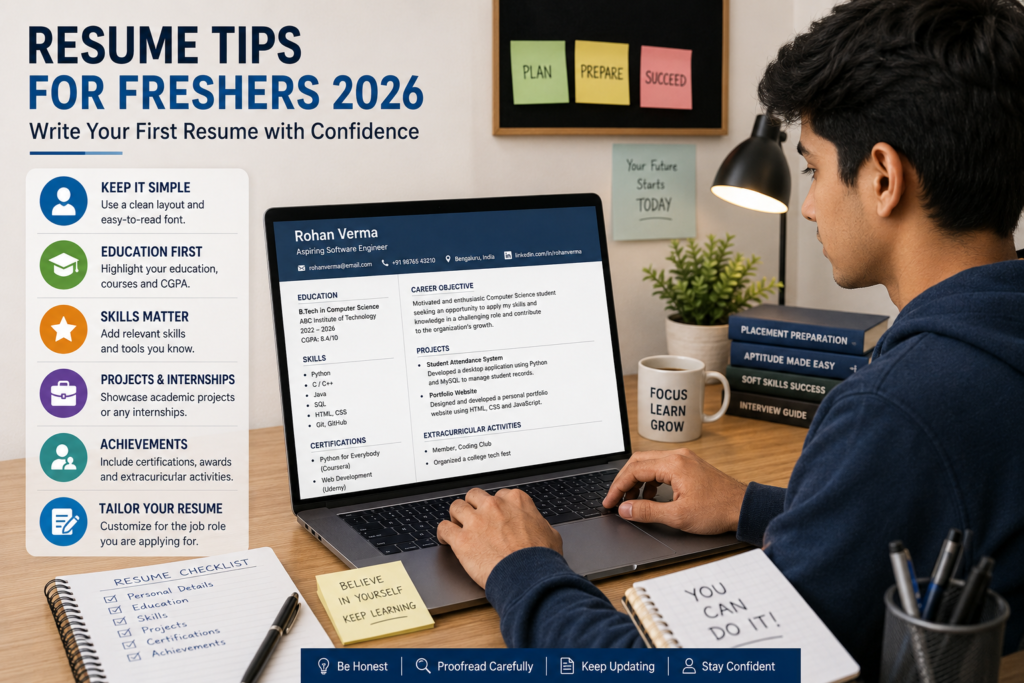
The good news is that recruiters hiring freshers already know you don’t have five years of work history. Nobody is expecting that. What they’re actually checking for is whether you can present what little experience you do have clearly, honestly, and in a way that shows you understand the basics of how a workplace document should look. That’s a much smaller bar than most students think, and it’s entirely within reach. This piece walks through how to build a first resume around projects, internships, coursework, and skills — and how to avoid the handful of mistakes that quietly sink otherwise decent applications.
Table of Contents
Start With What You Actually Have
Before opening a resume template, sit down and actually list out everything from your college years that could conceivably count as experience. This includes:
- Any internship, even a short or unpaid one
- Academic projects, especially ones with a clear deliverable — a working app, a research paper, a design, a dataset you analyzed
- Coursework that’s directly relevant to the job you’re applying for
- Part-time work, even if it wasn’t in your field
- Volunteering, student clubs, or organizing college events
- Online courses or certifications you actually completed, not just enrolled in
Most students have more here than they initially think. The problem usually isn’t a lack of material — it’s not recognizing that a group project or a college fest you helped organize is legitimate resume content when it’s framed the right way.
Choosing a Format That Doesn’t Work Against You
Stick with a straightforward, single-column layout. Skip the heavily designed templates with sidebars, icons, and colour blocks — they look impressive on Pinterest but cause real problems once your resume gets uploaded to a company’s application system, which often can’t read text placed inside graphic elements properly. A plain layout with clear section headings (Education, Experience, Projects, Skills) will get read correctly every time, which matters more than looking clever.
Reverse chronological order still applies even with limited experience — list your most recent internship or project first within each section.
The Objective Statement Debate
You’ll see two schools of thought here, and both have a point. Some recruiters still expect a short, two-line summary at the top explaining who you are and what you’re looking for. Others consider it filler that wastes valuable space on a one-page resume.
A reasonable middle ground: if you’re applying to a specific role and can write something genuinely specific — not “seeking a challenging opportunity to utilize my skills,” which says nothing — a two-line summary can work. Something closer to: “Final-year Computer Science student with hands-on experience in Python and machine learning through two academic projects and a data analytics internship at [Company].” If you can’t get more specific than the generic version, skip the section entirely and let your projects and skills speak for themselves.
Turning College Projects Into Real Resume Content
This is where most freshers leave value on the table. A project section shouldn’t just name the project — it needs to explain what you actually built and what skill it demonstrates.
Weak: “Built a college management system as a final year project.”
Better: “Developed a college management system using Java and MySQL, handling student records, attendance tracking, and grade reports for a simulated user base of 500 students.”
Notice the second version tells a recruiter the tools you used, the scale you worked at, and what the system actually did. That’s the difference between a line that gets skimmed past and one that gets a recruiter to pause. If your project solved a specific technical problem, name that problem directly — it shows you understand not just how to code something, but why it mattered.
Making an Internship Sound Like Actual Work
Even a short internship, two or three weeks, contains real content if you think it through properly. Don’t just write “Completed internship at [Company].” Say what you actually did:
- What team or department you worked with
- What specific task or project you contributed to
- Any tool, software, or process you learned to use
- Anything measurable, even small — “reduced manual data entry time by preparing an Excel template used by the team,” for instance
If your internship genuinely didn’t involve much beyond observation and basic tasks, be honest about that scope rather than inflating it — but frame what you did observe and learn in concrete terms rather than vague ones. “Shadowed the marketing team and assisted with social media content scheduling for two client accounts” is honest and still sounds like something happened.
What Goes in Your Skills Section
List skills you can genuinely defend in an interview, not everything you’ve briefly touched. A common mistake is padding this section with software or languages you used once in a tutorial video — if someone asks a follow-up question and you can’t answer it, that’s worse than not listing the skill at all.
Group skills sensibly rather than dumping everything into one long line: technical skills (programming languages, software, tools) separate from soft skills (communication, teamwork) if you include soft skills at all — though frankly, showing communication skills through how your project descriptions are written is more convincing than simply listing the word “communication.”
Your Education Section: More Than Just a College Name
As a fresher, your education section carries more weight than it will later in your career, so don’t reduce it to just your degree and college name. Include:
- Your CGPA or percentage, if it’s reasonably strong — if it isn’t particularly strong, you can choose to omit it, though be consistent about whether you include this across every application
- Relevant coursework, especially subjects directly tied to the role you’re applying for
- Any academic honors, scholarships, or notable class rank
- Your expected or actual graduation date
Extracurriculars and Leadership — When They Actually Help
Being part of a college club or committee is worth including, but only if you can describe a specific role or contribution rather than just membership. “Member, Coding Club” adds little. “Organized a 100-participant coding competition as Technical Lead of the college Coding Club, managing logistics and problem-setting for three rounds” tells a recruiter you can take ownership of something and see it through — a genuinely transferable signal, especially when you have limited formal work history to draw on otherwise.
Should You Add a Photo?
For most private-sector resumes in India, a photo isn’t required and doesn’t add value — skip it unless a specific application explicitly asks for one. Government job applications and biodata formats are a different situation entirely, where a photograph is often a required, specifically placed element — but that’s a separate format from a standard private-sector resume, and the two shouldn’t be confused.
One Page Is Genuinely the Right Length
With limited work history, there’s rarely a good reason for a fresher’s resume to run past one page. If your draft is spilling onto a second page, the fix usually isn’t cutting content you’re proud of — it’s tightening the wording. Long, wordy bullet points can almost always be shortened to a single clean sentence without losing the actual information. Read through your draft and ask, for each line, whether it could say the same thing in fewer words. It usually can.
Getting Your Contact Details Right
This sounds too basic to mention, but it causes real problems: use a professional email address, not something left over from school days. A LinkedIn profile link is worth including if your profile is reasonably complete and up to date — an empty or half-filled LinkedIn profile linked on your resume can do more harm than including no link at all, since it’s the first thing many recruiters check.
Common Mistakes to Avoid
- Leaving projects vague. “Built a project on machine learning” tells a recruiter almost nothing — name the tools, the scale, and what problem it solved.
- Padding the skills section with things you can’t actually discuss. A shorter, honest list beats a long one that falls apart under a single follow-up question.
- Using a heavily designed template that breaks when uploaded. Simple and readable beats visually elaborate almost every time at this stage.
- Writing a generic objective statement that says nothing specific. Either make it genuinely specific to the role, or leave it out.
- Undervaluing extracurricular leadership. A specific, well-described contribution to a club or event is legitimate resume content when you have limited formal experience.
- Letting the resume run to two pages out of a mix of everything you’ve ever done. Trim ruthlessly — a tight one-page resume reads better than a padded two-page one.
- Linking an incomplete LinkedIn profile. Either finish it properly first, or leave the link off.
- Inconsistent formatting — mismatched fonts, uneven spacing, inconsistent date formats between sections. Small, but noticeable to anyone reading carefully.
Expert Tips to Stand Out
- Tailor your project and skills emphasis slightly for each application — if a job posting mentions specific tools or requirements, and you genuinely have relevant experience with them, make sure that experience is visible near the top of your resume, not buried at the bottom.
- Ask someone outside your immediate friend group — a senior, a professor, or an alum working in your target field — to read your resume and tell you honestly what’s unclear. You’re often too close to your own projects to notice what doesn’t make sense to an outsider.
- Keep a running document of everything you do throughout college — projects, small wins, extracurricular roles — so you’re not trying to reconstruct two years of activity from memory the week before applications open.
- If you genuinely have very little to show, prioritize getting one solid project or short internship done over polishing the wording of a thin resume. No amount of good writing fully compensates for having almost nothing underneath it.
- Proofread out loud, not just silently — reading your bullet points aloud catches awkward phrasing and typos your eyes tend to skip over on a silent read-through.
Frequently Asked Questions (FAQ)
1. What should a fresher’s resume include if there’s no work experience?
Academic projects, internships (even short ones), relevant coursework, extracurricular leadership roles, and a clear skills section — real experience doesn’t have to mean a formal job.
2. Should a fresher include an objective statement?
Only if it’s genuinely specific to the role you’re applying for. A generic objective that could apply to any job adds nothing and is better left out.
3. How long should a fresher’s resume be?
One page. With limited work history, there’s rarely a legitimate reason to go longer.
4. Should I include my CGPA on my resume?
If it’s reasonably strong, yes. If it isn’t, you can leave it off, but stay consistent about that choice across every application you send.
5. How do I describe a short internship that didn’t involve much responsibility?
Be honest about the scope, but describe what you did observe or contribute to in specific, concrete terms rather than a vague one-line summary.
6. Do I need a photo on my resume?
Not for most private-sector applications in India. Government job biodata formats are a separate case that often does require one — check the specific application’s requirements.
7. Should I list every skill I’ve ever come into contact with?
No. List only skills you can genuinely discuss and defend if asked a follow-up question in an interview.
8. How do I make a college project sound impressive without exaggerating?
Describe it in specific, factual terms — the tools used, the scale, and the problem it solved — rather than inflating the description. Specificity does more work than exaggeration.
9. Is a template with colours and icons a bad idea?
Generally yes, for most standard applications. These can break when a resume is uploaded or scanned by an application system, and a plain, well-organized layout is read more reliably.
10. Should I include extracurricular activities on my resume?
Yes, if you can describe a specific role or contribution rather than just listing membership — this is genuine, legitimate content when you have limited formal work history.
Conclusion
Resume Tips for Freshers 2026 really come down to one shift: stop worrying that you don’t have “real” experience, and start presenting the experience you actually do have with more specificity and honesty. A well-described project, a short internship framed clearly, and a skills section you can genuinely back up in an interview will beat a padded, vague resume every time. Keep it to one page, keep the format simple, and make sure every line says something a recruiter can actually picture.
For more resume guidance across every career stage, check out our Resume Tips category page for regularly updated advice. And once you land that first interview, our guide on Resume Tips for Government Jobs 2026 is worth a look too if you’re applying to public-sector roles that expect a different application format entirely.
Suggested Internal Links
- Resume Tips Category
- Resume Tips 2026: Land Your Dream Job Faster
- Resume Tips for Experienced Candidates 2026: Best Guide
- TCS Virtual Internship 2026: Best Free IT Program
Suggested External References (for fact-checking and updates)
- National Career Service Portal (India): https://www.ncs.gov.in