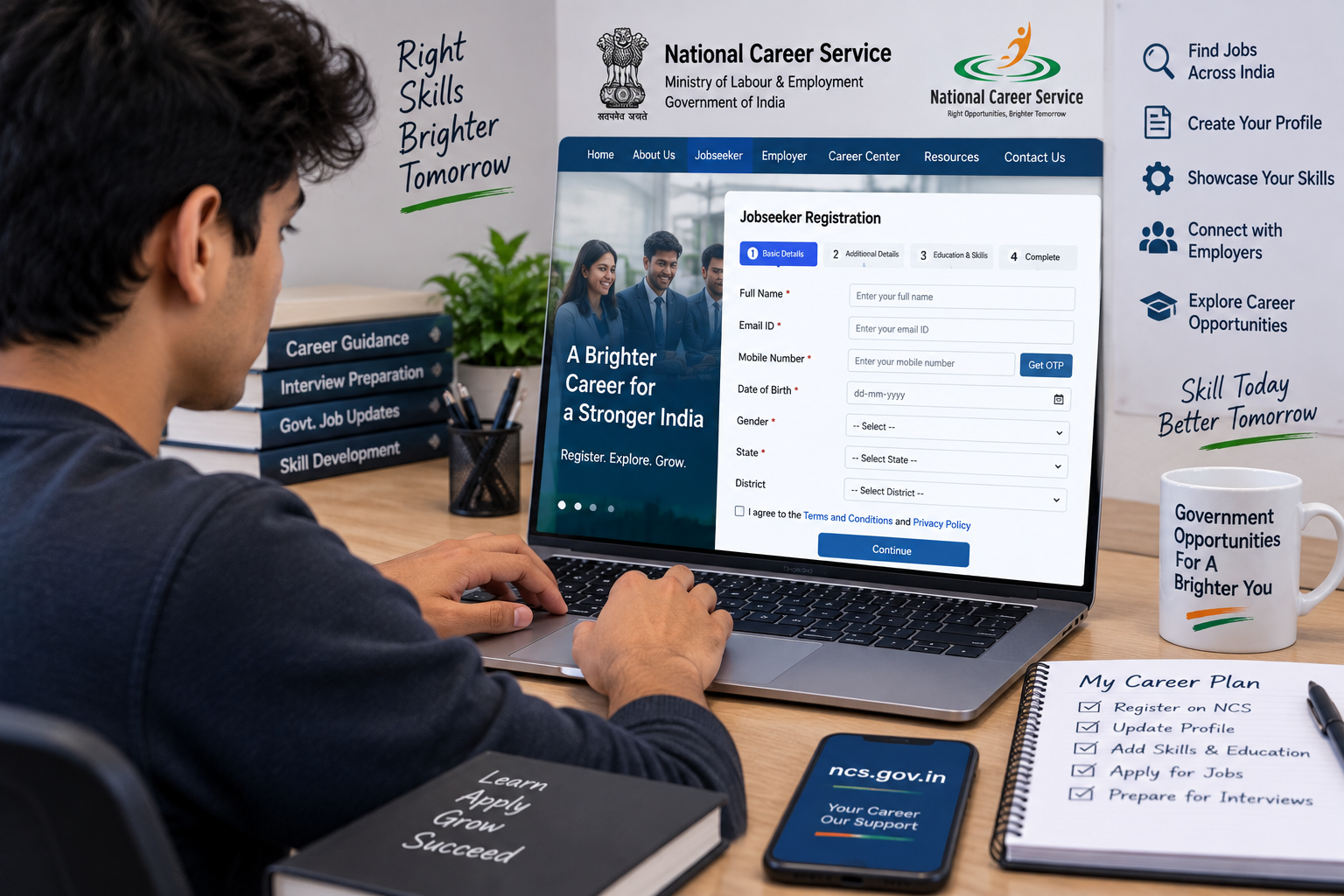
Search for “Skill India Digital Hub” and you’ll find dozens of articles calling it a “one-stop shop” for free courses, certificates, and job listings. What almost none of them explain clearly is how this platform actually relates to the National Career Service portal — a genuinely different government resource covered in detail elsewhere on this site. If you’ve registered on NCS already and are wondering whether Skill India Digital Hub (SIDH) is a separate thing you now also need to sign up for, or whether it’s redundant with what you already have, the honest answer is neither: SIDH is a larger umbrella platform that specifically integrates NCS within it, alongside several other government skilling and employment schemes, rather than being a rival or a replacement.
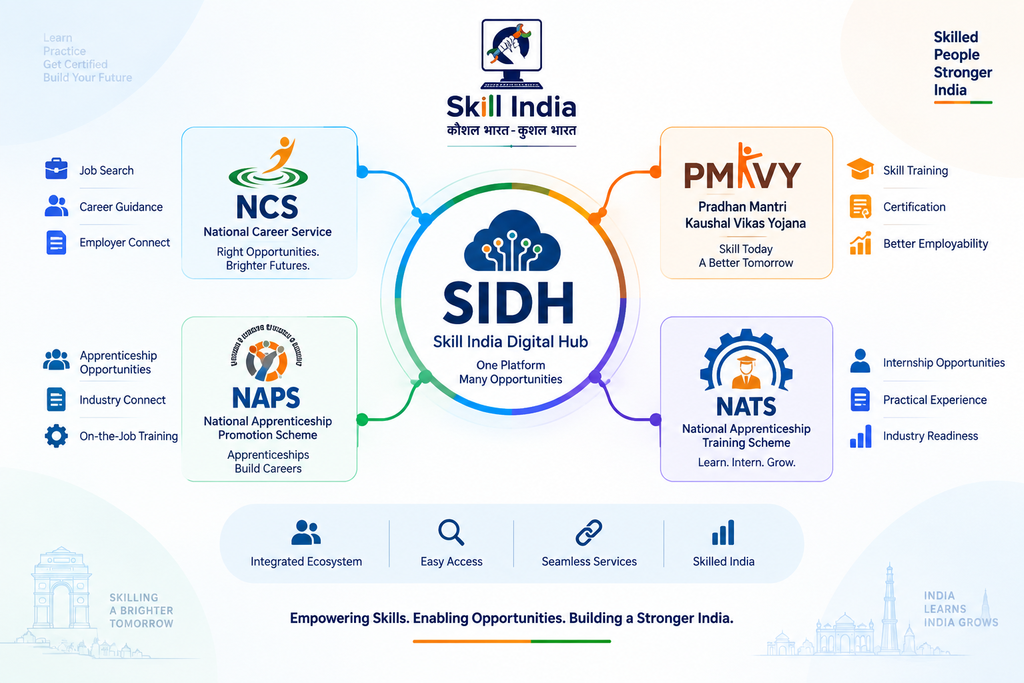
Understanding this relationship — and knowing which specific pieces of SIDH are genuinely useful versus which are just aggregated links to programs you could access directly anyway — matters more than another generic “how to register” walkthrough, which is what most existing coverage of this platform amounts to. This guide clarifies exactly what SIDH is, how it fits together with NCS, PMKVY, and the other schemes it pulls in, and what specifically to do once you’re registered.
What Skill India Digital Hub Actually Is
Skill India Digital Hub (SIDH) is a digital platform launched in September 2023 by the Ministry of Skill Development and Entrepreneurship (MSDE), designed to aggregate skill development, education, employment, and entrepreneurship opportunities into a single access point. Rather than building its own standalone content from scratch, SIDH’s core function is integration: it pulls together courses, certifications, and services from multiple existing government schemes so users don’t need to separately navigate each one.
The Schemes SIDH Actually Integrates
This is the part worth understanding clearly, since it directly answers the “is this the same as X” question for several other government platforms you may have encountered:
- PMKVY (Pradhan Mantri Kaushal Vikas Yojana): The government’s flagship vocational skill training scheme, now in its 4.0 iteration, providing free skill training with government-recognized certificates. PMKVY has already trained more than 1.4 crore Indians.
- NCS (National Career Service): The job search, career counselling, and employment matching portal — covered in detail in our separate guide — is integrated within SIDH rather than existing as a competing platform. If you’ve registered on NCS directly, that registration and profile aren’t wasted or duplicated; SIDH’s job search functionality specifically draws on NCS.
- NAPS and NATS: The National Apprenticeship Promotion Scheme and National Apprenticeship Training Scheme, covering apprenticeship opportunities for ITI/diploma holders and degree/diploma engineering graduates respectively.
- DDU-GKY (Deen Dayal Upadhyaya Grameen Kaushalya Yojana): A rural skilling program specifically targeting youth from poor rural families.
- ASEEM and eKaushal: Additional labor market information and skilling-demand mapping tools feeding into the broader platform.
In practice, this means SIDH functions less like a single new service and more like a directory and single sign-on layer sitting on top of programs that, in many cases, already existed independently. If you’ve directly used NCS, PMKVY, or NAPS before, you’re not missing out by not having used SIDH specifically — but SIDH can save you from needing to separately register and navigate each of these platforms one at a time going forward.
What’s Actually New: The Course Catalog and AI Recommendations
Where SIDH does add something genuinely beyond just linking to existing schemes is its course catalog and recommendation layer. The platform aggregates more than 7,500 free courses drawn from PMKVY and partner platforms, and layers an AI-based recommendation system on top, suggesting courses based on your profile, stated interests, and uploaded educational background. Completed courses can result in NCVET-verified digital certificates — NCVET (National Council for Vocational Education and Training) verification is a genuine quality marker, since it means the certification is recognized under India’s formal vocational education framework, not just an internal platform badge.
What Courses Are Actually Popular Right Now
Based on aggregated course engagement patterns reported across multiple sources covering the platform in 2026, the most searched and enrolled course categories include:
- Artificial Intelligence and Machine Learning — consistently the highest-demand category, reflecting broader market trends
- Programming and web development — covering both beginner and intermediate skill levels
- Cybersecurity — a growing category given rising demand for security-literate professionals across sectors
- Data analytics — covering data handling, reporting, dashboards, and business analytics fundamentals
- Soft skills, interview preparation, and personality development
- Entrepreneurship, accounting, and business management — relevant for learners considering self-employment paths
Is It Genuinely Free?
Yes, for the large majority of the platform’s course catalog. Access, video lectures, and course materials are free, and many (though not universally all) courses issue a certificate on completion at no charge. It’s worth checking each specific course’s certificate policy individually before assuming every course results in a certificate, since availability can vary by specific program within the aggregated catalog.
Eligibility: Who Can Actually Use SIDH
The platform is built around genuinely inclusive eligibility rather than a narrow qualifying criterion:
- Open to students, freshers, job seekers, and working professionals
- No strict age restriction for the large majority of courses
- No specific minimum educational qualification required to register, though some advanced or specialized courses may carry their own prerequisite requirements
- Indian citizens generally eligible, consistent with the platform’s role as a national skilling initiative
How to Register: Step-by-Step
- Visit the official Skill India Digital Hub portal directly.
- Create an account using a personal, actively-monitored email address — avoid informal or rarely-checked email accounts, since course updates and certificate notifications are communicated this way.
- Complete your profile with accurate educational background and stated career interests, since this directly feeds the platform’s AI-based course recommendation system.
- Optionally upload your educational certificates to unlock recommendations for more advanced or specialized course tracks.
- Browse the course catalog, either through direct search or the personalized recommendations generated from your profile.
- Enroll in courses matching your specific career goals — resist the temptation to enroll broadly across many unrelated categories, since focused completion tends to be more valuable than scattered partial enrollment.
- Complete course modules at your own pace, and download your NCVET-verified certificate upon completion where applicable.
- Use the platform’s integrated job and apprenticeship search (drawing on NCS) once you’ve built out relevant skills and certifications.
A Genuine Word of Caution About Secondary Coverage
It’s worth being direct about something noticed while researching this platform: a significant number of websites currently covering “Skill India Digital Hub 2026” appear to republish very similar, generic content — the same broad claims, the same FAQ structure, sometimes from the same publisher under slightly different URLs and titles. This doesn’t mean the underlying platform isn’t legitimate — it clearly is, as an official MSDE initiative — but it does mean you should be cautious about which secondary source you rely on for specific, actionable details like registration steps or eligibility specifics, since much of what’s circulating reads as generated from the same template rather than independently verified. When in doubt, cross-check any specific claim against the platform’s own official page directly rather than a secondary aggregator.
Building a Learning Plan That Actually Leads Somewhere
Having access to 7,500+ free courses is only useful if you approach it with a plan rather than browsing reactively. A practical way to structure your use of the platform:
- Start with a clear target role or skill gap, not a general desire to “learn something.” Identify one or two specific roles you’re aiming toward, and work backward to the skills those roles actually require, rather than starting from the course catalog and picking whatever looks interesting.
- Sequence foundational courses before specialized ones. If you’re new to data analytics, for instance, complete a foundational data handling course before jumping to an advanced dashboard-building or business analytics course, even if the advanced course looks more immediately impressive on a certificate.
- Set a completion timeline for yourself. Since these are self-paced courses with no external deadline pressure, it’s genuinely easy to enroll broadly and finish little. Give yourself a specific target date for each course you start, even an informal one, to counter this.
- Revisit your profile and recommendations periodically. As you complete courses and your stated interests or uploaded qualifications change, the AI recommendation system adjusts what it suggests — checking back every few weeks, rather than only at initial registration, keeps your suggested learning path current.
The Entrepreneurship Support Angle
Beyond courses and job matching, SIDH also connects users to entrepreneurship and self-employment support, reflecting its role as an aggregator for the broader Skill India Mission rather than purely a training platform. This includes pathways toward self-employment loans and entrepreneurship-focused guidance for learners who complete relevant business, accounting, or trade-specific courses and want to pursue self-employment rather than traditional job placement. This is a genuinely underused part of the platform in most coverage, which tends to focus almost entirely on the job-seeker angle — if self-employment or starting a small business is part of your own career thinking, it’s worth exploring this specific feature rather than assuming the platform is purely built around traditional employment outcomes.
SIDH vs SWAYAM vs NPTEL: A Quick Clarification
Since these three platforms are often mentioned in the same breath, and confusion between them is common, here’s the practical distinction:
| Platform | Ministry | Primary Focus |
|---|---|---|
| Skill India Digital Hub (SIDH) | Ministry of Skill Development and Entrepreneurship | Vocational and job-ready skill training, aggregating PMKVY/NCS/NAPS and more |
| SWAYAM | Ministry of Education | Academic and technical courses from IITs, IIMs, IGNOU, and central universities |
| NPTEL | Ministry of Education (IIT-led) | Engineering and technical higher-education courses, largely feeding into SWAYAM |
SWAYAM specifically has crossed 56 million enrollments with more than 5.2 million certificates issued, offering over 2,000 free courses — genuinely complementary to SIDH rather than competing with it, since SWAYAM leans toward deeper academic/technical coursework while SIDH leans toward practical, job-ready vocational skills. Using both together — SWAYAM to strengthen foundational knowledge, SIDH/PMKVY for practical, market-ready skill certification — is a genuinely reasonable combined strategy rather than a choice between the two.
What to Actually Do With a SIDH Certificate
Once you’ve earned an NCVET-verified certificate through the platform, its practical value depends on how you use it, not just having earned it:
- Add it explicitly to your resume’s certifications section, naming the specific course and the issuing body (NCVET/PMKVY), not just “completed an online course”
- Feature it on your LinkedIn profile, since recruiters and platforms increasingly search for specific, verifiable credentials rather than generic skill claims
- Use it as evidence of initiative during interviews, particularly for entry-level roles where formal work experience is limited — a genuinely completed, verifiable certification demonstrates follow-through in a way a resume line alone doesn’t
- Pair it with the platform’s own job/apprenticeship search (via its NCS integration) to apply directly for roles matching your newly certified skill
Why the Government Is Consolidating Platforms Like This
It’s worth understanding the broader pattern behind SIDH’s existence, since it explains why this kind of consolidation keeps happening across Indian government digital services generally. Before initiatives like SIDH, a citizen looking to build job-ready skills and then find employment had to separately discover, register for, and navigate PMKVY for training, NCS for job matching, and NAPS or NATS for apprenticeships — each with its own registration process, its own login, and often, little awareness that the others even existed. This fragmentation genuinely reduced how many eligible citizens actually benefited from these schemes, since discovering one program didn’t naturally lead you to the others. SIDH represents a deliberate policy shift toward single sign-on, integrated digital government services — a pattern also visible in other consolidation efforts across Indian e-governance more broadly. For you as a user, the practical takeaway is that this kind of integration is likely to keep deepening over time, so registering on the umbrella platform (SIDH) rather than only on individual constituent schemes is a reasonable way to stay ahead of future integration rather than needing to migrate your profile and history later.
Common Mistakes to Avoid
- Assuming SIDH replaces NCS, PMKVY, or NAPS entirely. It integrates them — your existing registration or familiarity with any of these individual platforms isn’t wasted.
- Registering with an informal or rarely-checked email address. Course and certificate notifications go through your registered email — use one you actually monitor.
- Enrolling broadly across many unrelated course categories at once. Focused completion in a career-relevant area is more valuable than partial progress spread across too many courses.
- Assuming every course results in a certificate automatically. Certificate availability varies by specific course — check this before assuming.
- Relying on a single secondary site’s claims without cross-checking, given how much near-duplicate content currently circulates about this specific platform.
- Treating a completed certificate as the end goal rather than a tool. The real value comes from actively featuring it on your resume/LinkedIn and using it to support actual job or apprenticeship applications, not from simply holding it.
Frequently Asked Questions
Is Skill India Digital Hub the same as the National Career Service portal?
No, they’re different platforms with different core purposes — but SIDH integrates NCS within it, meaning SIDH’s job search functionality draws on NCS rather than duplicating or competing with it.
Do I need to register separately for NCS if I’m already using SIDH?
Not necessarily — SIDH’s integration with NCS means you can access NCS-linked job search functionality through SIDH, though maintaining a direct NCS profile as well is not harmful and may be useful depending on your specific needs.
Is Skill India Digital Hub genuinely free?
Yes, the large majority of its 7,500+ course catalog is free to access, with many courses also offering free certificates upon completion.
What is an NCVET-verified certificate, and does it matter?
NCVET (National Council for Vocational Education and Training) verification means a certificate is recognized under India’s formal vocational education framework — a genuine quality marker beyond an informal platform badge.
What’s the difference between SIDH and SWAYAM?
SIDH focuses on practical, job-ready vocational skills under the Ministry of Skill Development and Entrepreneurship; SWAYAM focuses on academic and technical higher-education courses under the Ministry of Education, taught by faculty from IITs, IIMs, and other central institutions.
Is there an age limit to register on SIDH?
No strict age restriction applies to the large majority of courses on the platform.
Can I access job listings directly through SIDH?
Yes, through its integration with NCS, the platform includes job and apprenticeship search functionality alongside its course catalog.
Should I trust every article I find online about Skill India Digital Hub?
Exercise some caution — a significant amount of currently circulating coverage appears templated or duplicated across multiple sites. Cross-check specific claims against the platform’s own official page when precision matters.
What are the most in-demand courses on the platform right now?
AI and machine learning, programming and web development, cybersecurity, and data analytics are consistently reported as the highest-engagement categories in 2026.
Does SIDH replace PMKVY?
No, PMKVY is one of the schemes integrated into SIDH — PMKVY continues to exist as a distinct program, accessible both directly and through the SIDH aggregation layer.
The Bottom Line
Skill India Digital Hub is best understood not as a brand-new, standalone learning platform, but as the government’s attempt to unify several genuinely useful but previously scattered schemes — PMKVY’s vocational training, NCS’s job matching, NAPS/NATS apprenticeships, and more — into a single, AI-assisted access point. If you’ve used any of these individual platforms before, nothing about that effort is wasted; SIDH simply makes discovering and combining them easier going forward. Register with an email you actually monitor, focus your course selections around a genuine career direction rather than enrolling broadly, and treat your earned certificates as tools to actively feature on your resume and LinkedIn profile, not just credentials to collect.
For more verified career resources and free skilling opportunities, check out our Career Resources category page for regularly updated coverage. And if you’re building out your resume alongside your new certifications, our guide on the National Career Service Portal covers the job-matching side of this same broader government ecosystem in detail.
Suggested Internal Links
- Career Resources Category
- National Career Service Portal: The Free Tool You Skip
- Free ATS Resume Builder Tools 2026: 7 Tested
- HCLTech Freshers Hiring 2026: What Each Round Tests
Suggested External References
- Skill India Digital Hub Official Portal: https://www.skillindiadigital.gov.in
- Ministry of Skill Development and Entrepreneurship: https://www.msde.gov.in
- SWAYAM Official Portal: https://swayam.gov.in