
CTC vs In-Hand Salary 2026 Every year, thousands of freshers and job-switchers open their first payslip and feel a jolt of confusion: the CTC on their offer letter said one figure, and the amount actually credited to their bank account is meaningfully lower. This gap has always existed — CTC and in-hand salary have never been the same thing — but in 2026, there’s a genuine, additional reason your take-home might be lower than you’d calculate using last year’s logic: India’s new labor codes have changed the rules for how “wages” are defined, specifically requiring basic pay to make up at least 50% of your total CTC. If your employer previously kept your basic salary low to reduce statutory contributions (a common, widespread practice), your salary structure is likely being restructured right now, and that restructuring itself shifts money from your take-home pay into PF and gratuity, even though your total CTC stays exactly the same.
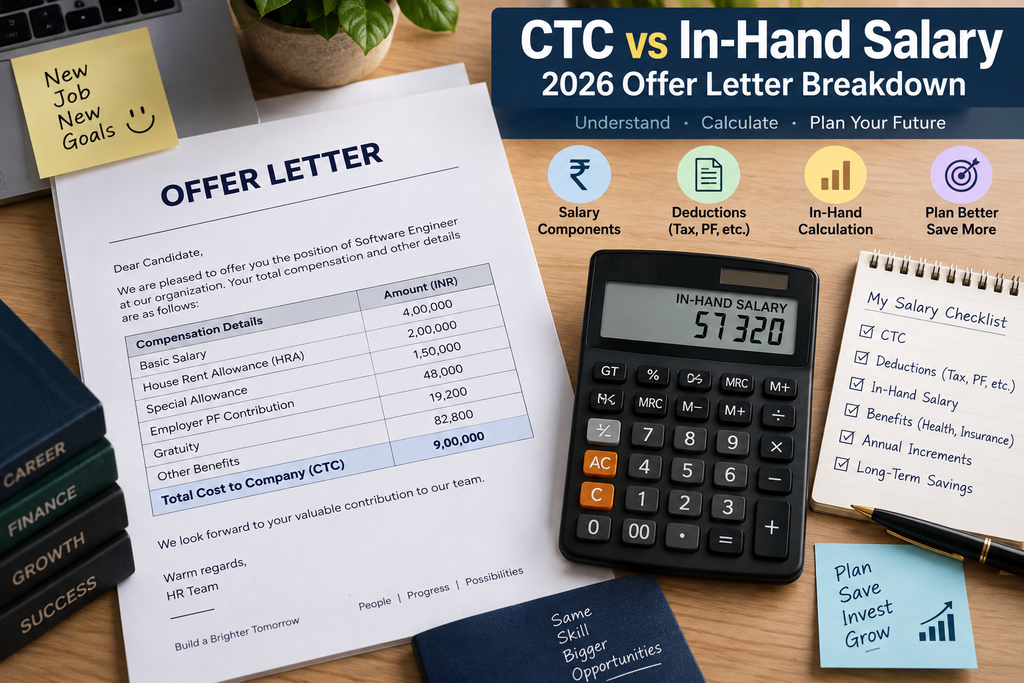
This guide breaks down exactly what CTC actually includes, why in-hand pay is always lower, what specifically changed under the new labor codes, and — since the rollout timeline itself is genuinely inconsistent across sources — an honest picture of where implementation actually stands right now.
Table of Contents
What CTC Actually Means
Cost to Company (CTC) is the total annual cost your employer bears for employing you — not the amount you receive in your bank account. It bundles together several genuinely different types of components:
- Basic Salary — the core fixed component your other benefits are typically calculated against
- Allowances — House Rent Allowance (HRA), conveyance/transport allowance, special allowance, and similar fixed monthly additions
- Employer’s PF Contribution — money your employer puts into your Provident Fund, which is part of your CTC but not part of your monthly take-home
- Gratuity Accrual — a retirement/long-service benefit your employer sets aside on your behalf, payable to you under specific eligibility conditions, not part of monthly pay
- Variable Pay / Bonus — performance-linked components that may or may not be paid in full, depending on your and the company’s performance
- Other Benefits — health insurance premiums, meal cards, or similar benefits your employer pays for, which have real value but don’t appear as cash in your account
The critical thing to understand: CTC is what your employer spends on you in total. In-hand salary is only the portion that actually reaches your bank account each month, after mandatory deductions.
Why In-Hand Salary Has Always Been Lower Than CTC
Even before any recentCTC vs in-hand salary 2026 confusion just got a real cause — a new labor code rule on basic pay. Here’s why your take-home may be lower this year. regulatory changes, in-hand salary was always lower than CTC, for straightforward reasons:
- Employee PF contribution is deducted from your salary before it reaches your account (typically 12% of basic pay)
- Professional tax, where applicable in your state, is deducted
- Income tax (TDS) is deducted based on your applicable tax slab
- Employer’s PF contribution and gratuity accrual are part of CTC but never appear in your monthly pay at all — they’re paid into your PF account or held as gratuity, accessible under specific conditions (withdrawal rules, resignation, retirement)
This gap between CTC and in-hand has always existed. What’s different in 2026 is a new regulatory force actively changing how large certain pieces of this calculation are.
What Actually Changed: The New Labor Codes and the 50% Rule
India consolidated 29 existing labor laws into four unified codes — on Wages, Social Security, Industrial Relations, and Occupational Safety. The single most consequential change for your salary specifically is a new, precise definition of “wages”: under the Code on Wages, wages (Basic Pay + Dearness Allowance + Retaining Allowance) must constitute at least 50% of your total CTC.
Here’s why this matters practically: for years, many Indian employers structured salaries with basic pay kept deliberately low — often just 30-40% of CTC — with the rest packaged as various allowances (HRA, special allowance, and similar categories). Since statutory contributions like PF and gratuity are calculated as a percentage of basic pay, keeping basic pay low kept these employer costs lower too. The new rule specifically closes this practice: if your allowances exceed 50% of your total remuneration, the excess amount is now treated as “wages” for statutory calculation purposes — meaning it gets pulled into the base used to calculate your PF, gratuity, and bonus.
Why This Can Lower Your Take-Home Even at the Same CTC
This is the part that confuses people, so it’s worth being precise: your total CTC doesn’t change under this restructuring. What changes is the allocation between your monthly take-home cash and your statutory contributions. Since PF is calculated on a percentage of basic pay, and basic pay is now higher (to meet the 50% threshold), your PF deduction increases in absolute terms — both your own contribution and your employer’s. Since PF money doesn’t land in your bank account monthly (it accumulates in your PF account instead), a higher basic pay effectively converts money that might previously have shown up in your monthly in-hand into a higher PF and gratuity accumulation instead.
In plain terms: your monthly take-home may look smaller, but you’re accumulating more in retirement savings and gratuity for the same total CTC. This isn’t your employer shortchanging you — it’s a structural, government-mandated shift toward stronger long-term social security protection, at the direct cost of monthly liquidity.
A Genuinely Confusing Timeline — Here’s the Honest Picture
This is worth flagging directly rather than glossing over: sources currently covering this topic report meaningfully different effective dates for the new labor codes. Some describe the codes as having taken effect from 21 November 2025. Others describe 1 April 2026 as the target for full operational enforcement. Still others emphasize that implementation is genuinely staggered by state — since states must separately notify their own rules under India’s federal structure, an employee in a state that has finalized its rules faces immediately mandatory compliance, while an employee in a state still in draft stage may see a delayed practical rollout, even though the underlying central code is the same.
The most accurate, honest summary given this inconsistency: the substantive provisions are live and being actively implemented in 2026, but the exact date your specific employer’s payroll fully reflects these changes depends on your state’s notification status and your employer’s own compliance timeline. If your salary slip hasn’t changed yet, it doesn’t necessarily mean the law doesn’t apply to you — it may simply mean your employer’s restructuring hasn’t been completed yet.
Other Genuine Changes Worth Knowing
Beyond the 50% wages rule itself, a few other specific changes under the new codes are worth understanding:
- Gratuity for fixed-term (contract) employees: Previously, gratuity required 5 years of continuous service to qualify. Under the new code, fixed-term employees are eligible for pro-rata gratuity for the actual duration of their contract, regardless of whether it reaches 5 years. This does not apply to permanent employees, who still generally require the standard qualifying period — this specific change is targeted at contract and fixed-term work arrangements.
- Full and Final (F&F) settlement timeline: Previously, employers often took 30-45 days to process final dues after an employee’s resignation, termination, or retrenchment. Under the new rules, employers must complete F&F settlement within two working days. This is a genuinely significant, practically useful change if you’re planning a job switch, since it meaningfully shortens how long you might wait for your final dues.
- 4-day work week flexibility: The new framework permits employers to structure a 4-day work week, provided the total weekly working hour limit (48 hours) is maintained — meaning longer individual working days in exchange for a shorter overall week, at an employer’s discretion, not a guaranteed employee entitlement.
How to Actually Read Your Offer Letter Now
Given all of this, a few specific things are worth checking when you receive a new offer letter or review your current payslip in 2026:
- Check whether your basic pay is at or above 50% of your total CTC. If it already was, this specific change affects you minimally. If it wasn’t, expect restructuring, and understand that your take-home may shift even without your total CTC changing.
- Don’t panic if your in-hand figure looks lower than a friend’s identical CTC offer from a year or two ago. The math genuinely works differently now — compare the components, not just the bottom-line number.
- Ask your HR team directly for a full breakdown, not just the total CTC figure, before accepting an offer — specifically ask what portion is basic pay, what portion is allowances, and what the resulting monthly in-hand estimate looks like.
- Use a current CTC-to-in-hand calculator that specifically accounts for the new wage rule, rather than an older tool or a rough personal estimate based on outdated assumptions about typical basic-to-CTC ratios.
- If you’re on a fixed-term or contract arrangement, ask specifically about your gratuity eligibility under the new pro-rata rule, since this is a genuine, new entitlement you may not know to ask about otherwise.
A Worked Example
Consider two hypothetical scenarios at the same ₹6 lakh annual CTC:
| Component | Old-Style Structure (Basic ~35% of CTC) | New-Style Structure (Basic 50%+ of CTC) |
|---|---|---|
| Basic Pay (Annual) | ~₹2,10,000 | ~₹3,00,000 |
| Employee PF (12% of Basic) | ~₹25,200 | ~₹36,000 |
| Approximate Annual In-Hand Impact | Higher monthly cash, lower PF accumulation | Lower monthly cash, higher PF accumulation |
The total CTC in both scenarios remains ₹6 lakh. What shifts is how much of that value you receive monthly in cash versus how much accumulates in your PF account for the long term. Neither structure is “better” universally — it depends on whether you value monthly liquidity or long-term retirement accumulation more, though under the new rules, you no longer have as much choice in this trade-off, since the 50% basic pay floor is now a compliance requirement rather than a design choice your employer makes freely.
Gross Salary vs Net Salary: One More Layer of Terminology
Since offer letters and payslips often use several overlapping terms, it’s worth clarifying one more distinction that frequently gets confused alongside CTC and in-hand pay. Gross salary typically refers to your total salary before deductions like PF, professional tax, and income tax — but importantly, gross salary is usually a smaller figure than CTC, since it excludes the employer’s own PF contribution and gratuity accrual (which are part of CTC but aren’t part of what’s calculated as your personal gross earnings). Net salary is what actually lands in your account after all deductions from gross — functionally the same thing as “in-hand salary” in most everyday usage. So the general hierarchy, from largest to smallest, typically runs: CTC (includes employer contributions and benefits) → Gross Salary (your earnings before your own deductions) → Net/In-Hand Salary (what actually reaches your bank account). Keeping these three terms distinct in your own mind makes it considerably easier to have an informed conversation with HR, or to correctly interpret any salary calculator’s output, since different tools and offer letters don’t always use this terminology consistently.
What This Means for Different Career Stages
The practical impact of this change lands differently depending on where you are in your career. For freshers receiving their first offer letter, the good news is there’s nothing to compare against personally — your first job’s structure simply reflects the new rules from day one, so there’s no jarring “why is this lower than before” moment, just a need to understand the breakdown correctly from the start. For employees already mid-career whose existing salary structure is being restructured, the transition itself can feel like a pay cut even though it isn’t one in total-compensation terms — if your monthly in-hand drops while your CTC stays the same, that’s the restructuring at work, not a demotion or a company-specific cost-cutting measure. For anyone close to retirement or planning to change jobs soon, the increased PF and gratuity accumulation under the new basic-pay rules is a genuine, tangible long-term benefit, even if the short-term monthly cash impact feels like a loss.
Common Mistakes to Avoid
- Assuming a lower in-hand figure than expected means your employer made an error. In many cases in 2026, it reflects the new mandatory basic-pay restructuring, not a mistake.
- Comparing your current offer’s in-hand estimate to an older job’s in-hand at the same CTC without accounting for this change. The underlying calculation logic has genuinely shifted.
- Not asking for a full salary breakup before accepting an offer. A single CTC number tells you very little about your actual monthly take-home — always request the complete breakdown.
- Assuming this rule has definitely taken effect in your specific state and company. Implementation is genuinely staggered — check your own state’s notification status and your employer’s compliance timeline rather than assuming uniform, immediate nationwide effect.
- Overlooking the new fixed-term gratuity entitlement if you’re on a contract role. This is a genuine, new right that doesn’t require 5 years of service to activate, unlike the rule for permanent employees.
- Not knowing about the 2-day F&F settlement rule when planning a resignation. This is directly useful information for timing your job switch and understanding when to expect your final dues.
Frequently Asked Questions
What is the difference between CTC and in-hand salary?
CTC is the total annual cost your employer bears for employing you, including allowances, employer PF contributions, and gratuity accrual. In-hand salary is only the amount that actually reaches your bank account monthly, after deductions.
Why is my in-hand salary lower in 2026 than I expected for my CTC?
India’s new labor codes require basic pay to be at least 50% of total CTC. If your employer previously kept basic pay lower, your salary is being restructured, shifting money from monthly take-home into PF and gratuity, without changing your total CTC.
When did the new labor codes actually take effect?
Sources report different dates — some cite 21 November 2025, others cite an April 2026 target for full enforcement, and implementation is genuinely staggered by state since each state must separately notify its own rules.
Does this rule apply to every employee in India?
The central code applies broadly, but practical implementation depends on your specific state’s notification status and your employer’s compliance timeline, which can vary.
Does my total CTC change because of this new rule?
No, your total CTC generally stays the same — what changes is the allocation between monthly take-home cash and statutory contributions like PF and gratuity.
Do contract or fixed-term employees now get gratuity without 5 years of service?
Yes, fixed-term employees are now eligible for pro-rata gratuity based on their actual contract duration, regardless of whether it reaches 5 years. This specific change does not apply to permanent employees.
How long does an employer now have to process my final settlement after I resign? Two working days, down from the previous common practice of 30-45 days.
Can my employer switch me to a 4-day work week without asking?
The framework permits a 4-day work week structure, provided the 48-hour weekly limit is maintained, but this is an employer option, not a guaranteed employee entitlement.
How can I check what my actual in-hand salary will be for a given CTC offer?
Request a full salary breakdown from HR before accepting, specifically the basic pay percentage, and use a current CTC-to-in-hand calculator that accounts for the 50% wages rule rather than outdated assumptions.
Is a lower in-hand salary under the new rules actually bad for me?
Not necessarily — while monthly liquidity is lower, your PF and gratuity accumulation is higher for the same CTC, which strengthens your long-term retirement and long-service benefits.
The Bottom Line
CTC vs In-Hand Salary confusion isn’t new, but 2026 has added a genuine, structural reason for the gap to look different than it used to: a new labor code rule requiring basic pay to be at least 50% of your total CTC, which shifts money from your monthly take-home into PF and gratuity even when your total compensation package hasn’t changed. Before accepting any offer this year, ask for the complete salary breakdown, not just the headline CTC figure, and understand that a smaller in-hand number than you expected may reflect stronger long-term retirement savings rather than a lower actual package.
For more career and job-offer guidance, check out our Career Resources category page for regularly updated coverage. And if you’re currently evaluating multiple offers, our guide on Resume Tips for Experienced Candidates covers how to negotiate and present your value effectively once you understand what you’re actually being offered.
Suggested Internal Links
- Career Resources Category
- Resume Tips for Experienced Candidates 2026: Best Guide
- HCLTech Freshers Hiring 2026: What Each Round Tests
- Cognizant Service Desk Recruitment 2026: Best 3-Year Degree Guide
Suggested External References
- Ministry of Labour and Employment, Government of India: https://labour.gov.in
- Employees’ Provident Fund Organisation (EPFO): https://www.epfindia.gov.in
- Code on Wages, 2019 (Official Text): https://labour.gov.in/sites/default/files/codeonwages.pdf