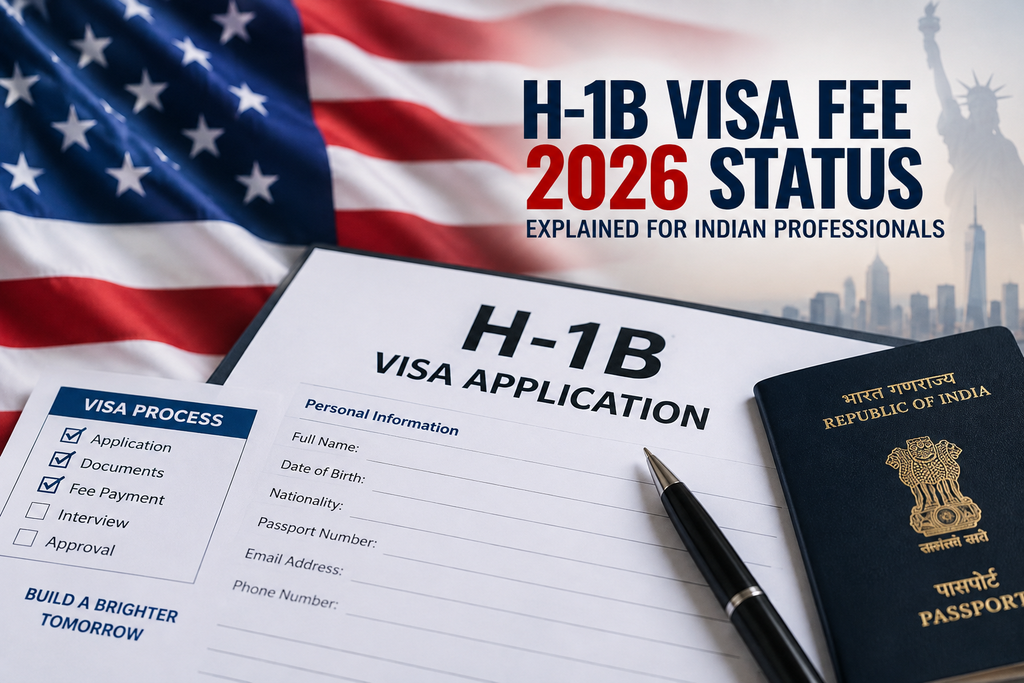
H-1B Visa Fee 2026 a US federal court ruled the $100,000 H-1B visa fee unlawful in June 2026. If you stopped reading there, you’d reasonably conclude the fee is gone. It isn’t. As of this writing, the fee remains fully in effect, being charged on new H-1B petitions exactly as before the ruling — because the government appealed, and a higher court paused the original ruling while that appeal plays out. On top of this, a separate, even larger fee proposal — $103,265 — is currently sitting in a public comment period that closes September 24, 2026, just weeks away, with a final decision possible by year’s end.
If you’re an Indian IT professional, a student on OPT, or someone whose employer relies on H-1B sponsorship, this genuinely confusing legal back-and-forth has real, practical consequences for your career planning, and getting the actual current status right matters more than either panicking based on the headline fee number or dismissing it because a court “struck it down.” This guide walks through the real timeline, what’s actually true right now, the new proposal specifically, and what all of this means for how Indian tech talent is likely to be hired going forward.
The Confusing Part, Explained Plainly
Here’s the sequence, laid out in order, since the sequence itself is what makes this confusing:
- September 2025: President Trump signed a proclamation imposing a flat $100,000 fee on new H-1B visa petitions — a massive jump from the previous $2,000-5,000 range, effective from 21 September 2025.
- June 2026: A US District Court in Massachusetts ruled against the agency guidance used to implement that $100,000 payment, effectively finding it unlawful.
- The government appealed that ruling to the US Court of Appeals for the First Circuit, and asked for the lower court’s ruling to be paused while the appeal is heard.
- July 24, 2026: The First Circuit rejected the government’s request to pause the ruling in its favor — but here’s the critical part most casual coverage gets backward: the stay that keeps the original $100,000 fee policy operative remained in place, meaning the fee continued being charged despite the underlying ruling against it. DHS stated it disagreed with the court’s decision but would comply with the order while considering its next legal steps, and separately indicated that if the court order is eventually lifted, it still intends to collect the payment.
- August 2026: DHS proposed a new, separate, standalone fee of $103,265 for H-1B petitions subject to the annual cap — not a revision of the original proclamation, but a fresh attempt to move this payment from a temporary executive policy into permanent federal regulation.
The practical bottom line: as of today, if you’re filing a new, cap-subject H-1B petition, the $100,000-range payment is functionally still part of the cost, regardless of the June court ruling against it, because the appeals process has kept the original policy operative in practice.
What This Fee Does NOT Apply To
This is worth stating clearly,H-1B Visa Fee 2026 since a lot of anxiety around this story comes from people assuming it applies more broadly than it actually does:
- Existing H-1B holders already working in the US are not affected. The fee applies specifically to new petitions, not to people already on H-1B status.
- Visa renewals are not affected. This is specific to new petitions, not extensions of existing status.
- Re-entries into the US on an existing valid H-1B are not affected.
This distinction, clarified by the White House after the original proclamation caused initial confusion, meaningfully narrows who’s actually impacted — but for companies whose business model depends on continuously bringing new employees onto H-1B status (which describes much of the traditional Indian IT services delivery model), it’s precisely the group most affected, since new hiring is exactly how these companies have historically deployed fresh talent onsite.
The New $103,265 Proposal: What’s Actually Different
The newly proposed $103,265 fee, announced in August 2026, isn’t simply a continuation of the original $100,000 proclamation — it’s DHS’s attempt to convert what has so far been an executive-branch policy (and one already tangled up in litigation) into a formally adopted federal regulation, which would make it considerably harder to challenge or reverse through the courts going forward. The proposal is explicitly framed as intended to recover immigration system costs and prioritize domestic labor. Critically, this is not yet a final rule — DHS opened a 30-day public comment period, with comments due by September 24, 2026. After reviewing public comments, the department will decide whether to finalize the rule, with that decision possible by the end of 2026.
Why This Matters Disproportionately for India
Indian professionals account for the largest single share of H-1B beneficiaries by a wide margin — commonly cited figures put this at roughly 70-75% of all H-1B visas issued annually. This isn’t incidental to the policy’s design; it means whatever happens with this fee, in either its current stayed form or its proposed permanent form, lands more heavily on Indian tech talent and the Indian IT services companies that depend on H-1B mobility than on any other nationality or industry by a significant margin.
How This Is Already Reshaping Hiring Patterns
Beyond the legal status itself, industry analysts and company responses point to a genuine structural shift already underway, independent of how the final legal outcome resolves:
- Onsite deployment is concentrating on senior talent. With the visa cost this high, companies are increasingly reserving H-1B sponsorship for senior-level professionals, project managers, and subject matter experts whose value to a client clearly justifies the expense — rather than the traditional model of sending large numbers of relatively junior engineers onsite for client-facing delivery work.
- Global Capability Centres (GCCs) are absorbing more of the work instead. Rather than routing entry-level work through the US visa pathway, companies are increasingly building out capability centers within India itself, or hiring talent directly within the US, reducing overall reliance on the H-1B pipeline for routine delivery work.
- AI is compounding the pressure on entry-level roles specifically. The same category of routine coding, testing, and debugging work that used to justify sending junior developers onsite is increasingly handled by AI-assisted tools, meaning the economic case for expensive visa sponsorship of entry-level talent is weakening from two directions simultaneously — visa cost and automation — rather than from the visa policy alone.
What This Means If You’re an Indian IT Professional or Student
- If you’re already on H-1B status or hold a valid visa, this specific fee doesn’t directly affect you — but it’s worth understanding that the broader hiring environment around you is shifting, since your employer’s overall appetite for new H-1B sponsorship (for colleagues, for your own future renewals or amendments if your role changes) is affected by this environment.
- If you’re on OPT (Optional Practical Training) hoping to transition to H-1B, understand that this pathway has genuinely tightened — some analysis projects a meaningful drop in OPT-to-H-1B transitions specifically because of the compounding cost and selection pressure this fee structure creates.
- If you’re earlier in your career and hoping for onsite US deployment through an Indian IT services company, recognize that the traditional “train in India, deploy onsite as a junior engineer” pathway is under real structural pressure — building specialized, senior-level skills, or skills specifically valuable within GCC-based delivery models, may be a more realistic long-term strategy than counting on traditional onsite rotation.
- If your plans depend heavily on this specific pathway, build a plan B. Given the fee is tied up in ongoing litigation and a not-yet-final new regulation, the situation could shift again — in either direction — before the year is out, and treating any single current status as permanent is a planning risk.
Common Misconceptions Worth Correcting
- “The fee was struck down, so it doesn’t apply anymore.” Incorrect as of this writing — the ruling against it exists, but a stay keeps the original policy operative while the government’s appeal proceeds.
- “This affects all H-1B visa activity.” It specifically targets new, cap-subject petitions — existing holders, renewals, and re-entries are not affected by this specific fee.
- “The $103,265 figure is the same policy as the original $100,000 fee, just adjusted for inflation.” It’s a separate, standalone regulatory proposal, not an amendment to the existing proclamation, and specifically aims to convert a contested executive policy into a more durable federal regulation.
- “Nothing can be done about this — it’s already decided.” The new $103,265 fee is explicitly not final; it’s in a public comment period through September 24, 2026, and a final decision hasn’t been made.
- “This is purely a US policy issue with no relevance to entry-level Indian job seekers who aren’t planning to go abroad.” The downstream hiring pattern shifts — GCC growth, reduced entry-level onsite deployment, AI absorbing routine coding work — affect the broader Indian IT job market’s structure, not just people directly seeking US visas.
- “Since India accounts for most H-1B recipients, this is specifically targeted at Indians by design.” The policy is written as nationality-neutral in its formal language, applying to all new cap-subject petitions regardless of the applicant’s country of origin — India’s disproportionate impact is a function of India supplying the largest share of H-1B applicants overall, not a nationality-specific provision within the rule itself. This distinction matters for understanding the policy’s actual legal structure, even though its practical, real-world impact undeniably falls hardest on Indian applicants and the companies that employ them.
What History Suggests About How This Plays Out
It’s worth noting that dramatic shifts in US visa fee policy are not entirely without precedent, and looking at how the industry adapted to smaller cost increases in the past offers a useful, if imperfect, guide to what’s likely ahead. Indian IT services companies have historically responded to rising visa costs and tightening H-1B selection criteria not by abandoning US operations, but by structurally shifting how they deliver work — leaning more heavily on local hiring within the US for certain roles, expanding delivery capacity from India itself, and reserving cross-border mobility for the specific roles where it’s genuinely difficult to substitute. The scale of the current fee proposal is larger than past increases, which makes a bigger structural shift plausible, but the general pattern — adaptation through delivery model changes rather than wholesale retreat from the US market — is consistent with how this industry has responded to previous immigration policy tightening.
Understanding “Stayed Pending Appeal” — Why This Legal Mechanic Matters
Since the core confusion in this story hinges on a specific piece of legal procedure, it’s worth explaining plainly for readers without a legal background. When a lower court rules against a government policy, that ruling doesn’t automatically and immediately end the policy nationwide — the losing party (here, the government) can ask a higher court to “stay” the ruling, meaning the higher court temporarily pauses the effect of the lower court’s decision while a full appeal is heard. This is a routine part of how contested federal policy disputes play out, not a sign of legal irregularity, but it does produce exactly the kind of situation currently applying to the H-1B fee: a policy that’s been ruled unlawful by one court, yet remains fully operative in practice because a higher court has paused that ruling’s effect. This mechanic is common enough in major policy disputes — immigration, environmental regulation, and healthcare policy have all seen similar stay-pending-appeal situations in recent years — that it’s worth understanding generally, not just in this specific H-1B context, since it explains why “a court ruled against X” and “X is still happening” can both be true statements about the same policy at the same time.
How to Track This Story Going Forward
Given how unsettled this situation genuinely is, relying on a single article — including this one — for an indefinitely current status isn’t realistic. A few practical ways to stay updated as this develops:
- Watch for the September 24, 2026 comment period close, since that’s the next concrete, dated milestone in this story, after which DHS moves toward a final decision on the new $103,265 proposal.
- Follow USCIS’s official policy manual and announcements page directly, rather than relying solely on news aggregation, since official guidance updates are the definitive source for what’s actually enforceable at any given time.
- If you or your employer are directly affected, consult an immigration attorney for guidance specific to your situation rather than relying on general news coverage, since individual circumstances (visa category, petition timing, employer type) can matter significantly for how any given policy change applies to you specifically.
- Treat any single news headline on this topic with appropriate skepticism until you’ve checked whether it’s describing the original $100,000 policy’s current stayed status, or the separate, still-pending $103,265 proposal — conflating the two, as much casual coverage does, is exactly the source of the confusion this article has tried to untangle.
Frequently Asked Questions
Is the $100,000 H-1B fee currently in effect?
Functionally yes, as of this writing — a court ruled against the guidance implementing it, but that ruling has been stayed pending the government’s appeal, keeping the original fee policy operative in practice.
What is the new $103,265 proposal, and is it final?
It’s a separate DHS proposal to make a similar fee a permanent federal regulation, announced in August 2026. It is not yet final — it’s in a public comment period through September 24, 2026, with a possible final decision by the end of 2026.
Does this fee affect current H-1B holders?
No, it applies specifically to new, cap-subject petitions — not to renewals, re-entries, or people already working in the US on H-1B status.
Why does this affect Indian professionals more than other nationalities?
Indian nationals receive roughly 70-75% of all H-1B visas issued annually, making any change to this program’s cost structure disproportionately impactful for Indian tech talent specifically.
Is this fee paid by the employee or the employer?
The employer sponsoring the worker pays the fee, on top of existing H-1B filing costs.
How is this affecting Indian IT companies’ hiring patterns?
Reports indicate companies are concentrating onsite H-1B deployment on senior talent, increasingly building out Global Capability Centres in India instead of relying on the visa pathway for entry-level work, and using AI tools to absorb routine coding tasks that previously justified junior-level onsite placement.
What happens after the September 24, 2026 comment period closes?
DHS will review the submitted public comments and decide whether to finalize the $103,265 fee as a permanent regulation, a decision that could come by the end of 2026.
Could this fee situation change again before the year ends?
Yes — between the ongoing appeal over the original fee and the pending decision on the new proposed regulation, the legal and policy status remains genuinely unsettled and could shift in either direction.
Does this affect the H-1B annual cap itself?
No, the H-1B program’s annual cap of 85,000 new visas (65,000 regular plus 20,000 for advanced-degree holders from US universities) is a separate structural element, unaffected by this specific fee dispute.
Should students currently on OPT be worried?
It’s reasonable to factor this into planning — some analysis projects a meaningful reduction in OPT-to-H-1B transitions given the compounding cost pressure, making it worth having a realistic backup plan rather than assuming a smooth transition.
The Bottom Line
The honest, current answer to “is the H-1B fee in effect” is genuinely uncomfortable to summarize in a single sentence: a court ruled against it, but it’s still being charged, because of a stay pending appeal — and a separate, larger, not-yet-final fee proposal is moving through public comment right now, with a decision due within months. If your career planning touches this pathway in any way, the useful move isn’t picking whichever headline sounds most reassuring or most alarming — it’s tracking the actual status directly, understanding precisely who this fee does and doesn’t apply to, and building your plans around the genuine structural shift already underway in how Indian IT talent gets hired and deployed, regardless of how the legal dispute itself eventually resolves.
For more fact-checked coverage of trends affecting your career, check out our Trending category page for regularly updated analysis. And if you’re building your skills toward roles less exposed to this kind of policy volatility, our guide on AI Powered Software Engineer Preparation covers the technical fundamentals worth prioritizing regardless of how global visa policy shifts.
Suggested Internal Links
- Trending Category
- Tech Layoffs 2026: Why the Numbers Don’t Match
- AI Powered Software Engineer Preparation: Best 2026 Guide
- HCLTech Freshers Hiring 2026: What Each Round Tests
Suggested External References
- US Citizenship and Immigration Services (USCIS) H-1B Program: https://www.uscis.gov/working-in-the-united-states/h-1b-specialty-occupations
- Department of Homeland Security: https://www.dhs.gov
- Federal Register (for tracking the official rulemaking and comment process): https://www.federalregister.gov