Cover Letters 2026, Ask a room full of recruiters whether they can tell when a cover letter was written by AI, and a majority will confidently say yes — one widely cited 2026 survey puts the figure at 67%, another at 74%. Now actually test that claim under blind conditions, without telling recruiters which letters are which, and the picture flips dramatically: a large-scale blind test found 82% of recruiters were unable to correctly identify all the AI-written letters in front of them. Confidence and accuracy, it turns out, are two very different things — and this gap matters enormously for how you should actually think about writing a cover letter in 2026, rather than panicking about detection or assuming it doesn’t matter at all.
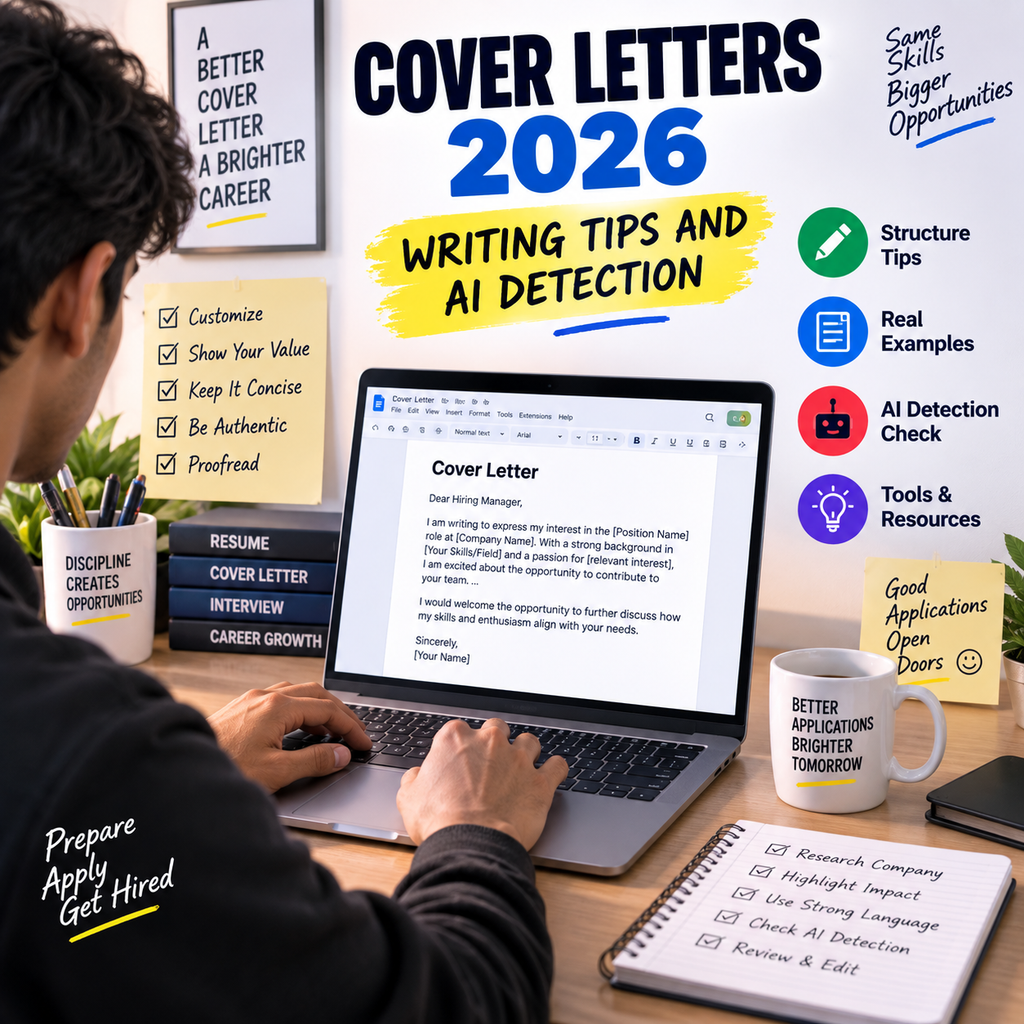
There’s a second, more serious issue buried in this same research that almost no cover letter advice mentions, and it’s directly relevant if English isn’t your first language: the same AI-detection tools recruiters and platforms increasingly rely on show a 23% false-positive rate for non-native English speakers, compared to just 4% for native speakers. That means a cover letter you wrote entirely yourself — in careful, correctly structured, formally taught English — is meaningfully more likely to get incorrectly flagged as AI-generated than the same quality of writing from a native speaker. This guide covers what the contradictory detection data actually means, why this fairness gap exists, whether you still need a cover letter at all in 2026, and how to write one that survives both human skepticism and flawed detection tools.
Table of Contents
Do You Even Need a Cover Letter Anymore?
The honest, current answer is genuinely split, and worth stating plainly rather than picking one side: roughly half of companies no longer require a cover letter as a default part of the application. At the same time, research from LinkedIn found that job applications with personalized, story-driven cover letters get a 40% higher response rate than generic ones, and a separate analysis found personalized letters boost interview chances by 53%. Resume Genius reports that 83% of hiring managers read most cover letters they receive; a separate 2026 survey from Novoresume found 51.7% of recruiters never read them at all.
Reconciling this: cover letters have moved from a default expectation to a situational tool. Write one when it’s explicitly required, when you have a genuine story to tell (a career change, a gap in your work history, a referral, or authentic enthusiasm for that specific company), or when the role is competitive enough that a strong letter could realistically be your differentiator. Skip it, or keep it minimal, for high-volume applications where a generic letter would add nothing beyond what your resume already shows.
Why the Detection Statistics Contradict Each Other
The gap between recruiters’ claimed detection ability and their actual, tested detection ability comes down to a specific distinction worth understanding: recruiters aren’t detecting “AI” as a technology — they’re detecting the absence of specific, verifiable detail. A cover letter that says all the expected things (enthusiasm for the role, relevant skills, interest in the company) but contains nothing a generic template couldn’t also contain reads as hollow, whether or not AI was actually involved in writing it. One hiring manager’s account, cited in recent 2026 coverage, describes tossing a “robot-like” letter that read perfectly but offered nothing specific, then being won over by a 200-word letter that named a specific campaign and cited a precise conversion lift. The second letter wasn’t necessarily human-written from scratch — it was simply loaded with concrete, verifiable specifics the first one lacked.
This is the actual mechanism behind both the high claimed-detection numbers and the failed blind test: recruiters are pattern-matching against genericness, not against AI usage directly, which is why a heavily-AI-assisted letter full of real specifics can pass undetected, while a slightly awkward, entirely human-written letter that happens to sound generic gets mentally filed as “probably AI” even when it isn’t.
The Fairness Problem Worth Taking Seriously
This is the detail most cover letter advice skips entirely, and it deserves direct attention here: AI detection tools — the kind some platforms and recruiters now run applications through — have been documented showing a 23% false-positive rate for non-native English speakers, compared to roughly 4% for native speakers. The likely mechanism is that non-native speakers who learned English formally, through structured grammar instruction, often produce more consistently “correct,” less colloquially varied sentence structures — which is exactly the kind of pattern these detection tools are trained to associate with AI-generated text, since AI models themselves tend to default toward grammatically correct, moderately formal output.
Practically, if you’re writing in your second or third language, this means your genuinely own writing carries a real, structurally unfair risk of being misjudged, through no fault of your own writing quality. There’s no way to fully eliminate this risk, but understanding it changes what’s actually worth doing: rather than trying to write more “perfectly” (which pushes you further toward the pattern detectors flag), deliberately incorporating natural variation — genuinely varied sentence length, the occasional contraction, a specific personal detail that no template would include — both makes your letter more compelling to an actual human reader and less likely to trip a flawed detection pattern.
What ATS Actually Does (It’s Not This)
This is worth clarifying directly, since it’s a common and understandable point of confusion: your Applicant Tracking System is not the tool checking whether AI wrote your cover letter. ATS platforms are built to parse resumes and applications for keyword matches, relevant skills, and job title alignment — organizing and filtering high application volume for recruiters, not analyzing writing style for AI authorship. Any AI-detection scrutiny your cover letter faces comes from a human recruiter’s own judgment, or occasionally a separate specialized tool layered on top of the hiring process — not from the standard ATS software handling your resume. Don’t conflate the two systems; optimizing your resume for ATS keyword parsing and writing a genuinely compelling cover letter are separate tasks with separate audiences.
The Actual Length That Works
Across current 2026 guidance, the consistent recommendation is genuinely shorter than what most job seekers assume: roughly 150 to 250 words, across three tight paragraphs. Recruiters typically skim only the first two or three sentences, with an entire cover letter getting under 30 seconds of attention in most cases. A common, still-persistent mistake is writing a 400-word essay under the belief that more detail demonstrates more effort — in practice, this works against you, since the content most likely to actually get read is concentrated in the opening lines, and a long letter dilutes rather than strengthens that impact.
A workable three-paragraph structure:
- Why this specific role — stated directly and specifically, not a generic opening about your enthusiasm for “opportunities to grow”
- One concrete proof point — a specific achievement, project, or outcome that directly supports your fit for this particular role
- A clean, direct close — restating interest and inviting the next step, without padding
How to Write One That Survives Both Human and Algorithmic Scrutiny
- Name something specific to the company or role, not a generic compliment. A recent product launch, a specific initiative the team is known for, or a detail from the job posting itself signals genuine engagement in a way no template can replicate.
- Include at least one number or named specific from your own experience. “Improved team efficiency” is forgettable; “reduced onboarding time from three weeks to eight days for a twelve-person team” is not, and it’s also exactly the kind of concrete detail that reads as authentic regardless of how much drafting assistance you used.
- Read the entire letter aloud, exactly as written. If you stumble on a sentence, or if it’s something you genuinely wouldn’t say in a professional conversation, that’s a sign of stiff or unnatural phrasing worth revising — your ear catches patterns your eye tends to skip past.
- Ask someone who knows you well to read it without telling them you used any AI assistance, and simply ask, “does this sound like how I actually talk?” Genuine hesitation in their answer is useful signal that the letter needs more of your actual voice.
- Vary your sentence length and structure naturally. Overly uniform, consistently well-formed sentences are exactly the pattern both human skepticism and automated detection tools key on — natural writing has more rhythm variation than a smoothed-out, uniformly polished draft.
- If a job posting explicitly states not to use AI for application materials, follow that instruction directly. Beyond specific instructions like this, the practical risk isn’t a secret detection technology — it’s submitting something that reads as polished but genuinely empty of real content.
When Skipping a Cover Letter Is the Right Call
Given how split the current data is, it’s worth being equally direct about when not writing one is the reasonable choice: for high-volume applications to roles with hundreds of applicants, where a generic letter would add nothing your resume doesn’t already convey, spending an hour crafting a cover letter that a recruiter may glance at for ten seconds — or never open at all — is a genuinely questionable use of your time relative to spending that same hour tailoring your resume more precisely or applying to additional roles. The exception is any of these specific situations, where a cover letter’s marginal value rises considerably: the posting explicitly requires one, you have a referral within the company worth mentioning by name, you’re navigating a career change or employment gap that benefits from brief context, or you have genuine, specific enthusiasm for that particular company that a generic application wouldn’t otherwise convey.
A Practical Middle Ground: The Short-Form Letter
If you’re unsure whether to write a full cover letter or skip it entirely, a reasonable middle path — increasingly common in 2026 hiring practice — is a genuinely short, 3-4 sentence note rather than a full three-paragraph letter: a single specific reason you’re interested in this particular role, one concrete proof point, and a brief closing line. This respects the reality that most cover letters get only seconds of attention, while still providing the specific, personalized signal that a bare resume submission lacks entirely. This format is particularly well-suited to applications submitted through a simple text box rather than an attached document, which is increasingly how many application platforms are structured.
What This Means Specifically for Indian Job Seekers
Given the false-positive gap described above, this is worth a direct, dedicated note for readers of this site specifically. Many Indian candidates learned English through formal, grammar-heavy schooling, often producing precise, structurally correct sentences — exactly the pattern that overlaps with what AI detection tools are trained to flag. This doesn’t mean you should deliberately write worse English; it means two things are worth doing consciously. First, let your genuine voice come through rather than defaulting to the most formally “correct” phrasing you can construct — a slightly more conversational tone, provided it’s still professional, is not just acceptable but genuinely protective here. Second, lean even harder into the specific-detail strategy covered above, since concrete, verifiable specifics are the single strongest signal of authenticity regardless of grammatical style, and they help counteract a detection bias you can’t otherwise directly control.
Tailoring Efficiently Without Starting From Scratch Every Time
A practical concern worth addressing directly: if you’re applying to multiple roles, writing a fully unique cover letter for each one is genuinely time-consuming, and the situational approach recommended throughout this guide doesn’t require that level of repeated effort. A workable middle ground is maintaining one well-written base letter — with your core proof point and professional narrative solidly built — and treating only the opening and closing lines as the parts you customize per application, specifically naming the role, company, and one detail unique to that posting. This keeps your effort proportional to how many applications genuinely warrant a cover letter in the first place, while still avoiding the fully generic, copy-pasted letter that both human readers and the underlying detection concerns in this guide are most likely to catch.
Common Mistakes to Avoid
- Assuming a cover letter is always required or always pointless. Both extremes are wrong — treat it as situational, based on the specific posting and your specific circumstances.
- Writing a long, generic letter that restates your resume. This is exactly the pattern that reads as hollow to a human reader, regardless of whether AI was involved in drafting it.
- Believing AI detection is purely about the technology used to write the letter. What actually gets flagged is genericness and a lack of verifiable specifics — the antidote is concrete detail, not avoiding AI assistance entirely.
- Over-polishing your writing into uniformly “correct” sentence structures, particularly if English is your second or third language. This pattern is exactly what flawed detection tools associate with AI-generated text.
- Confusing ATS with an AI-writing detector. ATS parses for keywords and job-fit signals; it isn’t checking whether your cover letter was drafted with AI assistance.
- Ignoring an explicit “no AI” instruction in a job posting. If stated directly, follow it — this is a different situation from the general ambiguity covered in this guide.
- Padding a cover letter to 400+ words to seem thorough. Given how little attention most letters receive, concise, front-loaded content performs better than length.
Frequently Asked Questions
Do I still need to write a cover letter in 2026?
It’s genuinely situational now rather than a default requirement — write one when explicitly required, when you have a specific story or referral to mention, or when the role is competitive enough that a strong letter could differentiate you; skip it for high-volume, generic applications.
Can recruiters actually detect AI-written cover letters?
The data is contradictory: recruiters claim high detection confidence (67-74% in surveys), but blind testing found 82% unable to correctly identify all AI-written letters — suggesting recruiters detect genericness more than AI usage specifically.
Why do AI detection tools flag non-native English speakers more often?
Documented research shows a 23% false-positive rate for non-native English speakers versus roughly 4% for native speakers, likely because formally-taught, grammatically consistent writing patterns overlap with patterns AI models themselves tend to produce.
Does the ATS check whether my cover letter was written with AI?
No, ATS software is built to parse resumes and applications for keyword and job-fit matching, not to detect AI authorship — any such scrutiny comes from a human recruiter’s judgment or a separate specialized tool.
How long should a cover letter be in 2026?
Roughly 150 to 250 words across three tight paragraphs, since most recruiters skim only the first few sentences and give the entire letter under 30 seconds of attention.
What actually makes a cover letter seem AI-generated to a recruiter?
Genericness and the absence of specific, verifiable detail — not the underlying drafting tool itself. A letter with concrete numbers and named specifics tends to read as authentic regardless of how it was drafted.
Is it safe to use AI to help write my cover letter?
Generally yes, provided you add genuine, specific personal detail and read the final version aloud to check it sounds like your authentic voice — the risk lies in stopping at a generic AI draft, not in using AI as a starting point.
What should I do if a job posting explicitly says not to use AI for my application?
Follow that instruction directly — this is a specific, stated exception to the general ambiguity around AI assistance in cover letters.
Is a short 3-4 sentence note an acceptable substitute for a full cover letter?
Yes, particularly for applications submitted through a simple text box rather than an attached document — a short, specific note often performs better than a padded, generic full-length letter.
Should I write a completely different cover letter for every single application?
At minimum, tailor the specific role and company reference in each letter — a fully generic letter reused across applications is exactly the pattern most likely to read as hollow, regardless of length or polish.
The Bottom Line
Cover Letters 2026 sit in a genuinely contradictory moment: recruiters confidently claim they can spot AI-written letters, yet fail to do so reliably under actual testing, while a documented fairness gap means non-native English speakers face real, undeserved risk from flawed detection tools. The practical response isn’t to obsess over AI detection in either direction — it’s to write (or edit an AI-assisted draft into) something genuinely specific, concrete, and recognizably your own voice, kept to roughly 150-250 words, and reserved for situations where it can actually add value rather than sent as a generic afterthought to every application.
For more career and job-application guidance, check out our Resume Tips category page for regularly updated advice. And if you’re building out your resume alongside your cover letter strategy, our guide on Free ATS Resume Builder Tools 2026 covers how to get your resume itself genuinely ATS-compatible.
Suggested Internal Links
- Resume Tips Category
- Free ATS Resume Builder Tools 2026: 7 Tested
- LinkedIn Profile Tips 2026: Old Advice Now Hurts You
- How to Answer Tell Me About Yourself: Best 3-Step Guide
Suggested External References
- LinkedIn Talent Solutions Recruiter Insights: https://business.linkedin.com/talent-solutions
- Jobscan (ATS and application screening research): https://www.jobscan.co
- National Career Service Portal (India): https://www.ncs.gov.in