If you searched “Google Summer of Code 2026” hoping to apply, there’s something worth knowing immediately: that window shut on 31 March 2026, and the coding period for selected contributors ran through the Indian summer break into August. If you’re reading this in September, that cycle is done. What isn’t done, and what genuinely deserves your attention right now, is GSoC 2027 — and counterintuitively, this is close to the ideal moment to start working toward it, months before the actual application window opens.
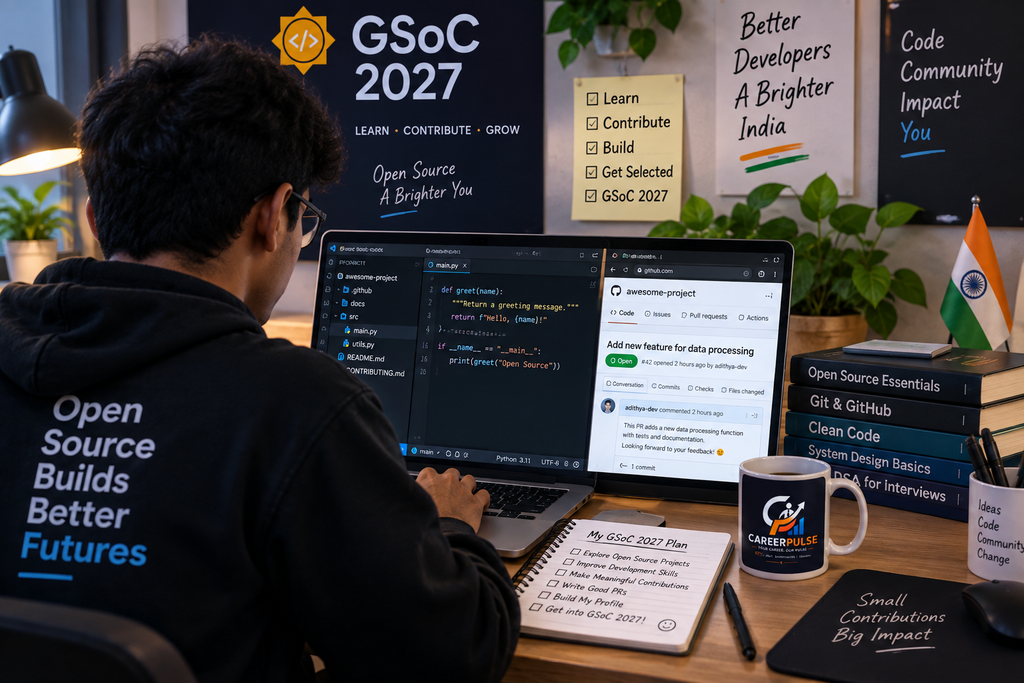
This isn’t generic “start early” advice. One detailed breakdown of the program specifically for Indian students puts it plainly: serious preparation should begin roughly seven months before applications open, because the compressed six-week window between when the organization list drops and when proposals are due leaves almost no room to build genuine open-source credibility from scratch. If you wait until February to start, you’re not preparing — you’re scrambling. September is when the actual preparation work happens.
Table of Contents
What Google Summer of Code Actually Is
GSoC is a global, fully remote program, now in its 22nd year, that pairs students and beginner open-source contributors with established open-source organizations for a mentored coding project. You’re not writing throwaway practice code — your contributions go directly into public, live repositories used by real projects, under the guidance of an experienced mentor from that organization. Google funds a stipend, the organization selects and mentors you, and at the end, you have a public, verifiable body of work any future employer can actually inspect.
The Numbers From the Cycle That Just Closed
The 2026 cycle drew 15,245 applicants worldwide, of whom 1,141 were ultimately selected — an acceptance rate hovering around 7.5%. That’s genuinely competitive, on par with or tighter than many selective internship programs, and it’s the single biggest reason “starting in February” leaves most applicants without a real shot: you’re competing against people who’ve been building contribution history and relationships with mentoring organizations for months before the formal window even opens.
What Indian Contributors Actually Earn
Stipend figures reported across different sources show some variation — one puts the Indian contributor range at ₹71,250 to ₹2.85 lakh, another cites ₹60,000 to ₹2.5 lakh. The discrepancy likely reflects different program tiers (the standard versus extended project duration) or slightly different reporting periods, so treat the wider range as the honest picture rather than anchoring to a single figure. What’s consistently confirmed: the stipend is tax-free for Indian contributors, paid in installments after your midterm and final evaluations rather than as one lump sum, which means your actual payment schedule is tied directly to demonstrated project progress, not just initial selection.
Eligibility, Stated Plainly
- You must be 18 years or older
- You need to be new to Google Summer of Code specifically — this program is deliberately structured to bring fresh contributors into open source, not to be a repeat program for the same people year after year
- There’s no formal degree or institutional requirement beyond age — students and non-student beginners to open source are both eligible
Why the Timeline Genuinely Punishes Late Starters
Here’s the actual mechanical sequence, based on how the 2026 cycle ran: the list of participating mentoring organizations — 184 of them in 2026 — is published in mid-February. Applications then close about six weeks later, at the end of March. Inside that six-week window, you’re expected to have already explored organizations, picked a couple that match your skills, made real contact with their communities, and written a specific, credible project proposal — arguably the single most important document in your entire application.
Trying to compress “discover open source, learn to navigate an unfamiliar codebase, build a relationship with a mentoring organization, and write a compelling technical proposal” into six weeks is a genuinely difficult ask. Contributors who start engaging with organizations well before the list is even formally published — during exactly this kind of September-to-January runway — walk into February with existing familiarity and, often, an existing relationship with the community they’re applying to.
What “Preparing Now” Actually Looks Like
This is the part most casual coverage skips past with a vague “start early” line. Concretely, from September through the list’s mid-February release, useful preparation looks like:
- Build basic Git and GitHub fluency if you don’t already have it. Forking a repository, making a clean commit, opening a pull request — these need to be second nature before you’re trying to make a real contribution under time pressure.
- Browse this year’s list of mentoring organizations even though next year’s hasn’t dropped yet. Organizations that participated in 2026 frequently participate again, and getting a sense of the kind of projects — from major infrastructure tools to smaller, more approachable community projects — gives you a real head start on narrowing your interests before the official list appears.
- Make small, genuine contributions to open-source projects now, independent of GSoC specifically. Fixing a documentation typo, resolving a minor bug, or improving a small feature in a project you’re genuinely interested in builds exactly the track record that makes a February proposal credible rather than speculative.
- Read the program’s own Contributor Guide and proposal-writing advice thoroughly, ideally more than once, since these documents change slightly year to year and reflect what Google and mentor organizations are actually looking for.
- Pay attention to how the program is evolving. Google has specifically published guidance for 2026 contributors on using AI tooling within GSoC projects — worth understanding now, since expectations around what’s acceptable AI assistance versus what undermines the point of the program are an active, evolving conversation, not settled once and forgotten.
Picking the Right Duration for Your Academic Calendar
GSoC now offers flexible project durations, typically ranging from a standard 12 weeks up to an extended 22-week track. This flexibility is genuinely useful, but it interacts with the Indian academic calendar in a way worth planning around deliberately. The coding period generally overlaps with the Indian summer semester break (roughly May through August), which lines up well with a standard-length project. The back half of an extended 22-week track, however, can run into the start of your next semester — a collision that’s easy to underestimate when you’re excited about taking on a bigger project in February, and much harder to manage once you’re actually juggling coursework and a live open-source commitment simultaneously. For most Indian students, the standard-length track is the more realistic choice precisely because of this calendar overlap, even if the extended track looks more impressive on paper.
The Domains Getting More Attention in Recent Cycles
Recent GSoC cycles have shown an expanded focus specifically on AI, security, and machine learning-adjacent projects — described as some of the highest-value tracks for long-term career building, given how much industry demand currently sits in exactly these areas. If your academic or personal interests already lean toward these domains, it’s worth prioritizing organizations working in this space specifically, since the skills you’d build align directly with where technical hiring has been concentrating, independent of GSoC itself.
How to Actually Reach Out to a Mentoring Organization
Since real contact before the formal window matters so much here, it’s worth being specific about how this typically works rather than leaving it vague. Most organizations list their preferred contact method directly on the GSoC site or their own project page — commonly a Discord or Slack channel, a mailing list, or an issue tracker where beginner-friendly tasks are specifically labeled. The advice worth taking seriously: reach out immediately once you’ve identified an organization that interests you, rather than waiting until you feel “ready.” Early, genuine conversation with a project’s community — asking thoughtful questions, working through a small starter task, introducing yourself clearly — is exactly the kind of visible engagement that makes your eventual proposal land differently than a cold submission from someone the organization has never interacted with.
What a Strong Proposal Actually Requires
Google’s own guidance is direct about this: your written project proposal is your single most critical deliverable in the entire application process. A strong proposal isn’t a vague statement of interest — it’s a specific, technically grounded plan describing what you intend to build or fix, why it matters to the project, and a realistic sense of how you’d approach the work across your chosen project duration. This is genuinely difficult to write convincingly without having already spent real time in the codebase and talked to the community, which circles back to why the September-through-January preparation window matters so much — a proposal written cold in the final week before the deadline reads very differently from one grounded in weeks of actual engagement.
A Realistic Way to Think About Your Odds
Given the roughly 7.5% acceptance rate from the most recent cycle, it’s worth setting expectations honestly rather than either assuming an easy path or writing off the program as unrealistic. GSoC selection isn’t purely about technical skill in isolation — genuine, demonstrated engagement with a specific organization’s community, a well-scoped and specific proposal, and starting early enough to build real familiarity all meaningfully shift your odds relative to someone submitting a generic proposal in the final week. Treating this as a months-long preparation project, rather than a single application you fill out in March, is the single biggest lever you actually control.
Quick Answers
Is GSoC 2026 still open for applications?
No, that window closed on 31 March 2026, and the coding period for selected contributors has already concluded.
When will GSoC 2027 applications open?
Google hasn’t published exact 2027 dates yet; based on the program’s consistent annual pattern, expect the mentoring organization list around mid-February 2027 and the application deadline roughly six weeks later, though the official calendar typically isn’t confirmed until later in the preceding year.
Do I need to be a computer science student to apply?
No, the eligibility requirement is being 18 or older and new to GSoC specifically — there’s no formal degree or major requirement.
Is the stipend actually tax-free for Indian contributors?
Yes, this is consistently confirmed across sources covering the program’s terms for Indian participants.
Should I choose the 12-week or 22-week project track?
For most Indian students, the standard 12-week track fits the academic calendar more realistically, since the extended 22-week option can run into the start of the following semester.
What’s the single most important thing to do between now and February?
Make genuine, small open-source contributions and build real contact with a mentoring organization’s community — this is what makes your eventual proposal credible rather than speculative.
If you’re building toward GSoC 2027 or any open-source-adjacent career path, pairing this kind of hands-on project experience with solid interview preparation matters too — our guide on AI Powered Software Engineer Preparation covers the technical fundamentals worth prioritizing alongside genuine project work like this.
Suggested Internal Links
- Internships Category
- AI Powered Software Engineer Preparation: Best 2026 Guide
- Free ATS Resume Builder Tools 2026: 7 Tested
- TASK Telangana: Free Skilling You Might Be Missing
Suggested External References
- Official GSoC Website: https://summerofcode.withgoogle.com
- Google Open Source Blog: https://opensource.googleblog.com
- GSoC Program Timeline (Google for Developers): https://developers.google.com/open-source/gsoc/timeline