
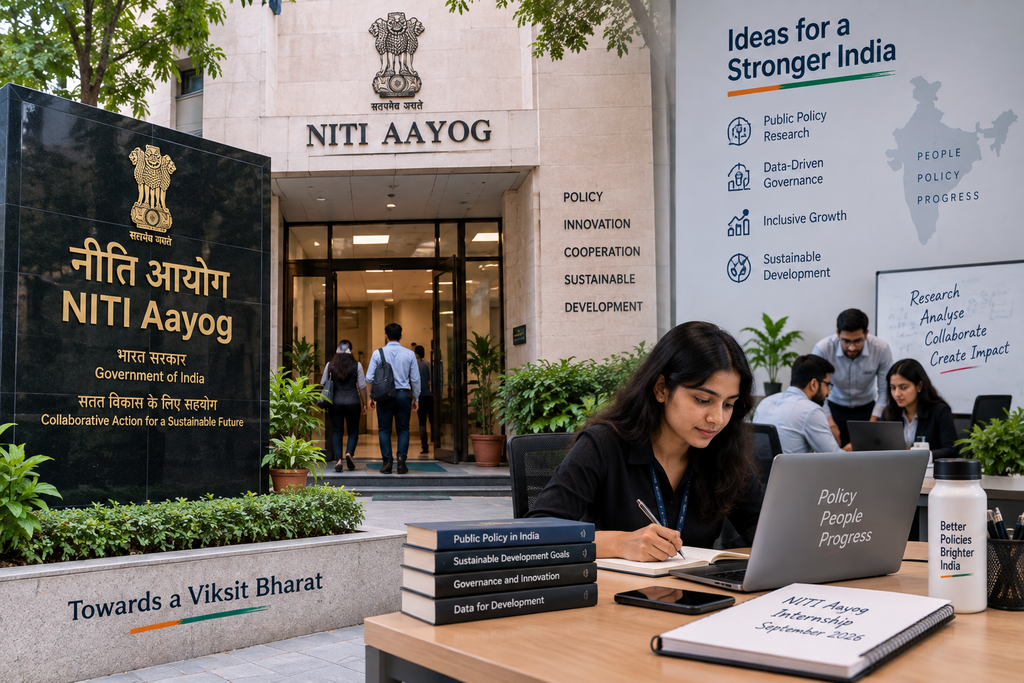
NITI Aayog Internship September 2026 window closes on the 10th. Check eligibility, documents, and the application steps before this cycle shuts.If you’ve been meaning to apply for the NITI Aayog Internship Scheme and keep telling yourself you’ll get to it “this week,” this is the week that matters. NITI Aayog doesn’t run one internship intake a year — it runs one every single month, but only opens its portal for ten days at a time, from the 1st through the 10th. The September 2026 cycle is open right now, and once the 10th passes, the window shuts completely until October 1st. There’s no late submission, no grace period, and no way to apply mid-month.
This is worth knowing not just for this specific deadline but for how you plan around this internship going forward — because most students discover NITI Aayog’s rolling structure by accident, usually a few days after a window has already closed. This guide covers exactly how the monthly cycle works, the eligibility rules (including a percentage requirement that gets reported inconsistently across other sites, which is worth clearing up), what the internship actually involves, and the specific documents and steps to get your application in before this window closes.
Table of Contents
Why NITI Aayog Runs Monthly Instead of Once a Year
NITI Aayog — the National Institution for Transforming India, the Government of India’s central policy think tank — accepts interns on a continuous, rolling basis rather than through a single annual recruitment cycle.NITI Aayog Internship September 2026 window closes on the 10th. Check eligibility, documents, and the application steps before this cycle shuts. Applications open on the 1st of every calendar month and close on the 10th. If you miss a given month’s window, you haven’t missed your only chance for the year — you’ve missed that specific ten-day slot, and another one opens on the 1st of the next month.
This structure is genuinely different from most internship programs covered on this site, which typically have one seasonal window per year. It means NITI Aayog internships are something you can realistically plan for on short notice, provided you know the pattern and have your documents ready in advance — which is exactly the gap this guide is meant to close.
What NITI Aayog Actually Is
NITI Aayog replaced the Planning Commission in 2015 as India’s premier policy think tank, working directly with government ministries, state governments, and international bodies on national development strategy. Interns are placed within specific Verticals, Divisions, and Units of the organization, working alongside policy researchers and government experts on live projects — not simulated coursework, but the same research and analysis work that feeds into actual government policy formulation.
Is It Paid? Setting Expectations Correctly
No — the NITI Aayog Internship Scheme is explicitly unpaid, as stated in the organization’s own official guidelines. There’s no stipend, and no side compensation of any kind. What you get instead is direct exposure to government policy work at a level most students don’t otherwise access, along with an official experience certificate carrying real weight for graduate school applications, competitive exam preparation, and future job applications specifically because it’s signed by the Adviser of the actual Division you interned with, not a generic HR signature.
If your primary need right now is income, this isn’t the internship for that. If your priority is credibility and policy-sector exposure specifically, it’s one of the more respected options available to Indian students.
Eligibility: Clearing Up a Genuine Discrepancy
Here’s something worth flagging directly, since it isn’t consistent across the sites currently covering this internship: the exact minimum academic percentage required for undergraduate applicants is reported differently depending on the source. Based on language closely tracking NITI Aayog’s own official guidelines, the requirement for undergraduate students is:
- Completed or appeared in the term-end exams of the 2nd year / 4th semester of your bachelor’s degree
- Scored not less than 85% (or equivalent) in Class 12th
Some secondary sources report a lower, more general “70% or equivalent CGPA” threshold instead. Given the inconsistency, treat 85% in Class 12 as the figure to plan around, and confirm your specific eligibility directly on the application portal before assuming you qualify based on a lower reported number elsewhere.
Beyond the Class 12 percentage, broader eligibility includes:
- Undergraduate students: Having completed at least 2 years of study in a recognized course (Economics, Law, Engineering, Management, Social Sciences, and other eligible disciplines)
- Postgraduate students: Enrolled in a full-time PG program, having completed or appeared in term-end exams of the 1st year / 2nd semester, with a strong academic record
- Research scholars: PhD candidates in policy, economics, or closely related domains
- Recent graduates: Candidates who completed their degree within the last 6 months, including those awaiting admission to a higher program
- Enrollment at any recognized university or institution, within India or abroad
Duration and Domains
The internship runs for a minimum of 6 weeks and a maximum of 6 months, with the exact duration typically agreed upon between you and your assigned Division based on project needs. NITI Aayog offers roughly 25 different domain areas to choose from during application, spanning Economics, Law, Data Management, Engineering, Management, Social Sciences, and several other policy-adjacent fields — you select your preferred area directly during the application process, so think through which domain genuinely matches your academic background before you start filling the form.
Where You’d Work
The internship is conducted on-site in New Delhi — this isn’t a remote or hybrid program. If you’re applying from outside Delhi, factor in accommodation and travel arrangements as part of your decision, since NITI Aayog doesn’t provide relocation support alongside an unpaid internship.
The Attendance Rule That Can Cost You Your Certificate
This is a detail worth taking seriously rather than treating as fine print: NITI Aayog requires a minimum 75% attendance to issue your completion certificate. If your attendance falls below this threshold, there is no extension available to make up the shortfall — you simply don’t receive the certificate, regardless of how strong your actual project work was. Since the certificate is arguably the single biggest value driver of this unpaid internship, treat the attendance requirement as a hard commitment from day one, not a flexible guideline.
Documents to Prepare Before You Start Your Application
Given the ten-day application window, having these ready in advance — rather than scrambling to gather them mid-window — meaningfully improves your chances of submitting a complete, error-free application:
- College ID proof or Bonafide Certificate
- Updated resume, including academic history and any relevant project details
- Letter of Recommendation, if available (not always mandatory, but strengthens your application)
- A recent photograph and your signature, in the specified digital format
- A scanned copy of your Aadhaar card or another valid government ID
- A signed No Objection Certificate (NOC) from your current college or institution
The NOC specifically is worth requesting early, since it depends on your institution’s own processing time, which you don’t control and which can easily eat into your ten-day application window if you wait until the window is already open to ask for it.
How to Apply: Step-by-Step
- Visit the official NITI Aayog Internship Management System at workforindia.niti.gov.in.
- Register with your basic personal details if you’re a first-time applicant.
- Log in and complete your profile: personal information, academic history, grades, and institution details.
- Select your preferred domain from the roughly 25 options available, choosing the one that best matches your academic background and interests.
- Upload a Statement of Purpose (SOP), typically expected to run between 500 and 1,000 words, explaining specifically why you want to intern with NITI Aayog and what you hope to contribute or gain.
- Upload all required supporting documents, including your signed NOC.
- Review your complete application carefully — since this is a competitive, high-volume program, a rushed or generic application is a common and avoidable reason for rejection.
- Submit before the window closes on 10 September 2026 — don’t wait until the final day, since portal traffic tends to spike as the deadline approaches.
What Happens After You Apply
Selection is handled by the specific Division or Unit whose domain you applied under, and shortlisted candidates are typically contacted through their registered email. Given how many students apply for a limited number of intern positions across NITI Aayog’s various units, a well-written, specific SOP genuinely matters here — a generic statement of purpose that could apply to any government internship is one of the more common reasons strong-on-paper candidates don’t get shortlisted.
Why This Is Worth Applying to Even Though It’s Unpaid
For students specifically interested in public policy, economics, law, or governance-adjacent careers, few unpaid internships carry this level of institutional credibility. Alumni of this program have gone on to roles in think tanks, consultancies, research organizations, and have used the experience as meaningful preparation for civil services examinations. The value here isn’t measured in stipend — it’s measured in the specific kind of access and credibility that comes from a signed government experience certificate tied to real policy work, at one of the most visible institutions shaping actual national policy direction.
Common Mistakes to Avoid
- Missing the ten-day window because you didn’t know it was monthly. If you miss September, the next window opens 1 October — mark the recurring 1st–10th pattern somewhere you’ll actually see it.
- Waiting until the portal opens to request your college NOC. This depends on your institution’s own timeline, which you can’t control — request it as early as possible.
- Submitting a generic, copy-paste Statement of Purpose. With a genuinely competitive applicant pool, a specific, well-reasoned SOP tied to your actual academic interest is a real differentiator.
- Assuming your attendance can dip below 75% without consequence. There’s no extension for a shortfall — this directly determines whether you receive your certificate at all.
- Choosing a domain that doesn’t match your actual academic background. Selection committees within each Division evaluate fit against their specific work — a mismatched domain choice weakens an otherwise strong application.
- Relying on a lower, unverified percentage requirement you saw on another site. Confirm your eligibility against the 85% Class 12 threshold directly on the portal rather than assuming a lower bar applies.
Frequently Asked Questions
When does the NITI Aayog Internship application window open and close?
The portal opens on the 1st of every month and closes on the 10th — this September 2026 cycle follows the same pattern.
Is the NITI Aayog Internship paid?
No, it is explicitly unpaid according to NITI Aayog’s own official guidelines. Interns receive an official experience certificate instead of a stipend.
What is the minimum Class 12 percentage required for undergraduates?
85% or equivalent, based on language closely matching NITI Aayog’s official guidelines — though some other sources report a lower figure, so confirm directly on the application portal.
How long does the internship last?
Between a minimum of 6 weeks and a maximum of 6 months, depending on your specific placement.
Is this internship remote or in-person?
On-site in New Delhi — there is no remote or hybrid option.
What happens if my attendance falls below 75%?
You will not receive the completion certificate, and there is no extension available to make up the attendance shortfall.
Can final-year students or recent graduates apply?
Yes, students in their final exams or who completed graduation/PG within the last 6 months, including those awaiting admission to a higher program, are eligible.
Do I need a Letter of Recommendation to apply?
It strengthens your application but isn’t always mandatory — check the specific requirement for your chosen domain on the application portal.
How many subject domains can I choose from?
Approximately 25 different domain areas, spanning fields like Economics, Law, Data Management, Engineering, Management, and Social Sciences.
What if I miss this month’s window?
The next application window opens on the 1st of the following month and runs through the 10th, following the same recurring monthly pattern.
The Bottom Line
If you meet the eligibility criteria and have even a passing interest in policy, governance, economics, or public-sector research, the NITI Aayog Internship Scheme is worth building into your recurring internship-application routine, not just chasing once and forgetting about. This particular September 2026 window closes on the 10th — if you’re reading this before then, get your NOC requested and your SOP drafted today rather than tomorrow. If you’re reading this after the 10th, the next window opens on the 1st of next month, and now you know exactly how the cycle works.
For more verified internship opportunities across government and private sectors, check out our Internships category page for regularly updated listings. And if you’re preparing your application materials, our guide on Free ATS Resume Builder Tools 2026 can help you get a clean resume ready for the document upload stage.
Suggested Internal Links
- Internships Category
- Free ATS Resume Builder Tools 2026: 7 Tested
- DRDO Internship 2026: Best Guide to Apply
- PM Internship Scheme 2026: Best Guide to Apply
Suggested External References
- Official NITI Aayog Internship Portal: https://workforindia.niti.gov.in
- NITI Aayog Official Website: https://www.niti.gov.in
- MyScheme Government Portal (NITI Internship listing): https://www.myscheme.gov.in