
A strong Cover Letter for Freshers 2026 can genuinely be the difference between your application getting a second look and getting skipped entirely — and yet it’s one of the most rushed, copy-pasted parts of most fresher job applications. Many students treat the cover letter as an afterthought, something to fill in quickly because a portal made the field mandatory, when it’s actually one of the few places in your entire application where you get to speak directly, in your own voice, about why you’re a fit for this specific role.
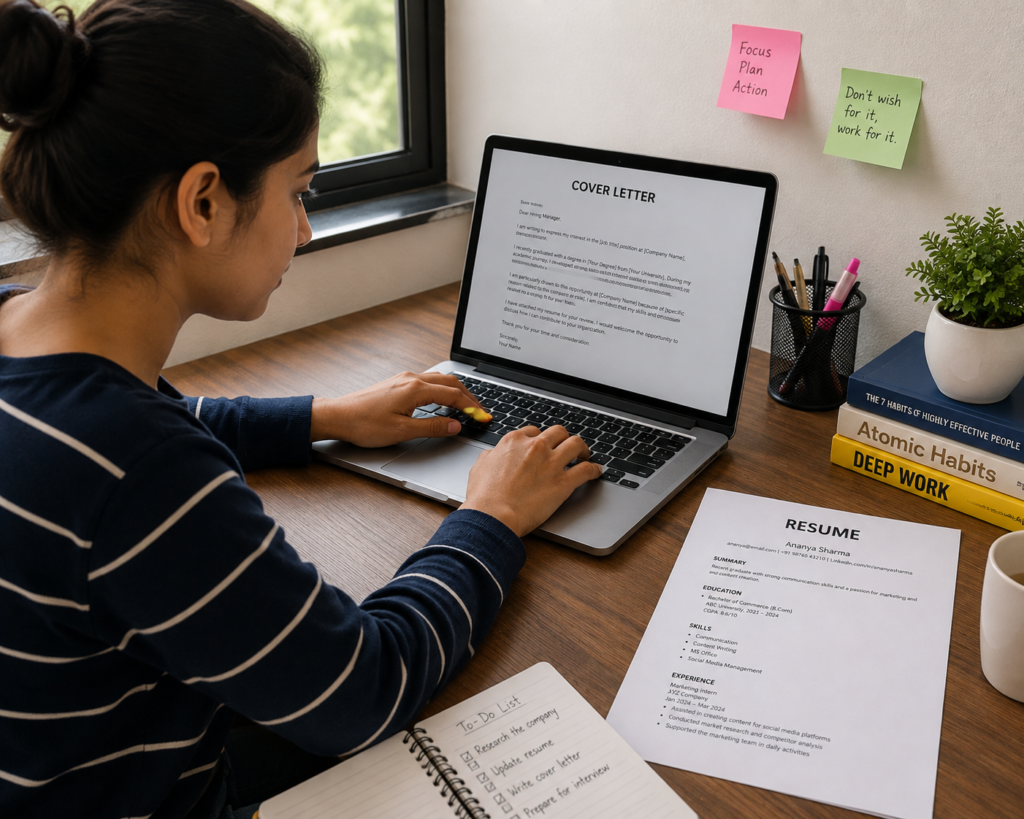
Your resume tells a recruiter what you’ve done. Your cover letter tells them why it matters for this job — and that distinction is exactly why a generic, recycled cover letter tends to do more harm than no cover letter at all. A recruiter who reads “I am writing to express my interest in this position” for the hundredth time isn’t impressed; they’re skimming past it to get to your resume.
This guide walks through exactly how to write a cover letter that doesn’t get skimmed past — the right structure, what to actually say in each section, a full example you can adapt, and the specific mistakes that make otherwise strong candidates sound interchangeable with everyone else.
Table of Contents
Do Freshers Even Need a Cover Letter
Short answer: when there’s an option to include one, use it — even if it’s marked optional.
Here’s the practical reasoning: as a fresher, your resume is naturally thin on work experience. A cover letter gives you room to do something your resume genuinely can’t — explain your motivation, connect a project or coursework directly to the role’s actual requirements, and demonstrate the kind of clear, professional writing that a bullet-point resume doesn’t showcase.
That said, always check the specific application. If a portal explicitly says “no cover letter needed” or offers no field for one, don’t force it in as an attachment nobody asked for. But whenever the option exists — even labeled “optional” — treat it as a genuine opportunity, not a box to skip.
Cover Letter vs Resume: What Each One Is For
Understanding this distinction changes how you write both documents.
| Document | Purpose |
|---|---|
| Resume | A structured, scannable record of your education, skills, projects, and experience |
| Cover Letter | A short, narrative explanation of why your background fits this specific role, in your own voice |
A common mistake is writing a cover letter that just repeats the resume in paragraph form. If your cover letter reads like your resume with sentences added, it’s not doing its job — it should add context, motivation, and specificity that a bulleted resume format can’t easily convey.
The Right Length and Format
- Length: 250–400 words. Long enough to say something real, short enough that it actually gets read.
- Structure: 3–4 short paragraphs — an opening, one or two body paragraphs, and a closing.
- Format: Plain, professional formatting — no elaborate fonts, no graphics, no columns. If you’re submitting a PDF, match your resume’s font and header style for a consistent, professional look.
- File naming: Use a clear, professional file name, such as
FirstName_LastName_CoverLetter.pdf— the same naming discipline that matters for your resume applies here too.
Cover Letter Structure, Section by Section
A strong cover letter for freshers generally follows this structure:
- Header — your name and contact details (can mirror your resume header)
- Greeting — addressed to a specific person where possible
- Opening paragraph — who you are and why you’re writing, with a specific hook
- Body paragraph(s) — your relevant background, connected directly to the role
- Closing paragraph — a confident, clear call to action
- Sign-off — a professional closing line and your name
Let’s go through the parts that trip people up most.
How to Open Without Sounding Generic
Avoid opening with “I am writing to apply for the position of X, as advertised on Y.” It’s not wrong, exactly — it’s just forgettable, because it’s what everyone writes.
A stronger approach: open with a specific, genuine hook — a line connecting your interest in the company or role to something concrete, not generic enthusiasm.
Weak opening: “I am excited to apply for the Software Engineer Intern position at your esteemed company.”
Stronger opening: “When I built a small tool last semester to automatically flag scheduling conflicts for my college’s event committee, I got hooked on exactly the kind of backend problem-solving your Software Engineer Intern role focuses on.”
The second version does the same job — announcing your interest in the role — but it does it through something specific and real, which immediately reads as more credible than a templated line.
Writing the Body: Connecting Your Background to the Role
This is the section where most cover letters either earn their place or confirm they should have been skipped.
The core technique: pick two or three specific requirements from the job description, and directly connect them to something concrete from your own background — a project, a course, an internship, or a personal initiative.
Example: “The internship description mentions working with REST APIs and collaborative Git workflows. During my final-year project, I built and documented three REST endpoints for a course management tool, and worked with a team of four using Git-based code review — the same collaborative process your posting describes.”
Notice this isn’t just listing skills — it’s showing evidence, tied directly to language pulled from the actual job description. That specificity is what separates a cover letter that reads as genuine from one that could have been sent to any company for any role.
Avoid vague, unsupported claims like “I am a hardworking, quick learner with excellent communication skills.” These phrases show up in nearly every weak cover letter and carry no real evidence behind them — the same buzzword problem that weakens resumes shows up here too.
How to Close Strong
Your closing paragraph should do three things clearly:
- Reaffirm your genuine interest in the specific role
- Reference your resume as attached for further detail
- End with a confident, professional call to action
Example: “I’ve attached my resume for more detail on my project work and technical background. I’d welcome the opportunity to discuss how I can contribute to your team, and I’m happy to provide any additional information you need.”
Avoid overly passive or apologetic closings like “I hope you will consider my application” — it undercuts the confident tone you want to leave the reader with.
A Full Sample Cover Letter for Freshers
Here’s a complete example you can adapt — notice how it follows the structure above while staying specific and grounded:
Dear Ms. Sharma,
When I built a small tool last semester to automatically flag scheduling conflicts for my college’s event committee, I got hooked on exactly the kind of backend problem-solving your Software Engineer Intern role focuses on. I’m a final-year Computer Science student at [College Name], and I’m writing to apply for this position.
Your job posting mentions experience with REST APIs and collaborative development workflows. During my final-year project, I designed and built three REST API endpoints for a course management tool used by over 200 students, and worked within a four-person team using Git-based code review to manage weekly releases. I also completed a summer internship at [Company Name], where I contributed to backend features for an internal analytics dashboard, gaining hands-on experience with Python and PostgreSQL along the way.
I’m particularly drawn to [Company Name]’s focus on [something specific about the company or team], and I’d welcome the opportunity to bring my technical background and genuine curiosity for backend systems to your team.
I’ve attached my resume with further detail on my projects and technical skills. I’d be glad to discuss how I can contribute, and I’m happy to provide any additional information you need.
Sincerely, [Your Name]
Notice this example is specific, evidence-based, and roughly 250 words — exactly the density and length that tends to actually get read in full.
Customizing Your Letter for Each Application
Just like your resume, your cover letter should be tailored — not rewritten from scratch every time, but genuinely adjusted for each specific role.
What to change for each application:
- The opening hook, tied to the specific role or company
- The two or three specific requirements you connect your background to in the body
- The company-specific detail in your closing paragraph
What can stay consistent:
- Your overall structure and tone
- Your core examples, lightly reframed depending on which requirement they best support
A reasonable system: keep a personal “bank” of three or four strong examples from your background (a project, an internship, a leadership moment, a technical achievement), and rotate/reframe them depending on which specific requirements each job description emphasizes.
Cover Letters for Internships vs Full-Time Roles
The core structure stays the same, but the emphasis shifts slightly:
| Element | Internship Cover Letter | Full-Time Cover Letter |
|---|---|---|
| Focus | Learning potential, coursework, and genuine curiosity | Readiness to contribute immediately, relevant project/internship depth |
| Tone | Enthusiastic, exploratory | Confident, outcome-focused |
| Evidence | Coursework, small projects, extracurriculars | Internships, larger projects, measurable outcomes |
For an internship application, it’s completely reasonable to lean on coursework and smaller personal projects. For a full-time role, prioritize your strongest internship or project experience, and frame it around what you can contribute from day one rather than just what you’re eager to learn.
When Your Cover Letter Is Just an Email
Not every cover letter is a separate attached document — often, especially when applying directly via email, your cover letter is the email body itself, with your resume attached separately. This version follows the same principles but needs a few adjustments:
- Keep it shorter — 150–250 words is often more appropriate for an email than a formal attached letter, since email readers expect brevity.
- Use a clear, specific subject line, such as “Application for Software Engineer Intern — [Your Name],” rather than a vague subject like “Job Application” or leaving it blank.
- Skip the formal letter header (your address, the date, the company address) that a traditional attached cover letter might include — email doesn’t need this formatting.
- Still include a proper greeting and sign-off, even in the shorter email format — this isn’t a text message, and the professional tone still matters.
The content principles remain identical: a specific hook, evidence-backed connection to the role, and a confident close — just compressed into a tighter, email-appropriate format.
- Reusing the exact same letter for every application. Even small, genuine customization signals real interest; a generic letter signals the opposite.
- Repeating your resume in paragraph form. Your cover letter should add context and motivation, not restate bullet points as sentences.
- Opening with a generic, templated line. “I am writing to apply for…” is technically fine but forgettable — lead with something specific instead.
- Using vague buzzwords without evidence. “Hardworking,” “passionate,” and “quick learner” mean little without a concrete example attached.
- Making it too long. Beyond 400 words, you risk losing the reader’s attention — tighter is almost always better.
- Addressing it generically when a name is available. “Dear Hiring Manager” is an acceptable fallback, but a specific name (when findable) shows real effort.
- Skipping proofreading. A cover letter with typos undercuts the professionalism it’s meant to demonstrate — read it twice yourself, and ideally have one other person review it too.
- Forgetting to update company-specific details from a previous draft. Submitting a cover letter that mentions the wrong company name is one of the most damaging, avoidable mistakes possible.
Expert Tips to Make Yours Stand Out
- Mirror language from the job description deliberately. If the posting uses specific terms — a tool, a methodology, a value — echoing that language (genuinely, not as keyword stuffing) signals a tailored letter.
- Lead with evidence, not adjectives. Every claim about your skills should be immediately backed by a specific example.
- Keep a reusable “example bank.” Three or four well-written examples of your work, each adaptable to different requirements, will save you significant time across multiple applications without sacrificing genuine customization.
- Read it out loud before submitting. Awkward phrasing and overly stiff, formal language become much more obvious when read aloud than when read silently.
- Match your tone to the company, within reason. A startup’s posting written in a casual, energetic tone can support a slightly less formal letter than a traditional enterprise company’s posting.
- Don’t restate your entire resume. Pick your two or three strongest, most relevant points and go deep on those, rather than trying to summarize everything.
Frequently Asked Questions (FAQ)
1. Do freshers really need to write a cover letter?
Whenever an application allows for one — even if labeled optional — it’s worth including, since it’s one of the few places you can explain your motivation and connect your background directly to the role in your own words.
2. How long should a cover letter be?
Aim for 250–400 words, structured across three to four short paragraphs.
3. What’s the biggest difference between a resume and a cover letter?
A resume is a structured record of what you’ve done; a cover letter is a narrative explanation of why that background fits this specific role.
4. Should I use the same cover letter for every job application?
No. While your overall structure and core examples can stay consistent, genuinely customize the opening hook, the specific requirements you address, and any company-specific details for each application.
5. What should I avoid saying in a cover letter?
Avoid vague, unsupported buzzwords like “hardworking” or “passionate” without a specific example, and avoid simply repeating your resume in paragraph form.
6. How should I address my cover letter if I don’t know the hiring manager’s name? “Dear Hiring Manager” is an acceptable fallback, though a specific name, when findable through the job posting or company website, shows extra effort.
7. Is it okay to write a cover letter for an internship with no prior work experience?
Yes. Lean on relevant coursework, small personal projects, and genuine enthusiasm for learning — this is completely appropriate and expected for internship applications.
8. Should my cover letter and resume use the same formatting?
It’s a good idea. Matching fonts and header styles across both documents creates a more polished, professional, consistent impression.
9. What’s a common opening mistake to avoid?
Starting with “I am writing to apply for the position of X” is technically fine but forgettable — a specific, genuine hook tends to perform much better.
10. Should I mention salary expectations in a cover letter?
Generally no, unless the job posting specifically requests it. A cover letter’s purpose is to demonstrate fit and motivation, not to open compensation discussions.
Conclusion
A well-written Cover Letter for Freshers 2026 isn’t about sounding impressively formal — it’s about being specific, genuine, and clearly connected to the actual role you’re applying for. Skip the generic buzzwords, lead with real evidence from your projects and experience, and take the extra few minutes to customize each letter rather than reusing the same template everywhere.
Done well, a cover letter is one of the few parts of your application where a recruiter hears your actual voice before they ever meet you — make it worth reading, and revisit your example bank every time you complete a new project so it keeps getting stronger.
For more practical, no-fluff career guidance, check out our Career Resources category page for regularly updated advice built for freshers and early-career professionals.
Suggested Internal Links
- Career Resources Category
- Software Engineer Resume Guide
- ATS-Friendly Resume Guide 2026
- HR Interview Questions and Answers 2026
- LinkedIn Profile Tips 2026