IBPS PO 2026 Notification has arrived, and for lakhs of graduates dreaming of a stable, respected career in public sector banking, this is arguably the single biggest opportunity of the year. Unlike the SBI PO exam, which recruits only for the State Bank of India, IBPS PO fills Probationary Officer positions across eleven different public sector banks in one common recruitment drive — which is exactly why this exam attracts such an enormous number of applicants every cycle.
If you’ve been searching for a single, reliable place to understand everything about this year’s notification — the exact dates, who’s eligible, what the salary actually looks like, how the exam pattern has changed, and how to avoid common application mistakes — this guide covers it all. We’ve cross-checked the details against the official IBPS registration portal and the latest verified updates, so you’re working with accurate, current information rather than outdated forum posts or recycled content from last year’s cycle.
Whether you’re a final-year student applying for your first government job or a working professional looking to make the jump into banking, read on for a complete, no-fluff breakdown of the IBPS PO 2026 recruitment process.
Table of Contents
What Is IBPS PO and Why It Matters
The Institute of Banking Personnel Selection (IBPS) is not a bank itself — it’s a common recruitment body that conducts a standardized examination on behalf of multiple public sector banks. This year’s cycle is officially called CRP PO/MT-XVI (Common Recruitment Process for Probationary Officers/Management Trainees, 16th edition).
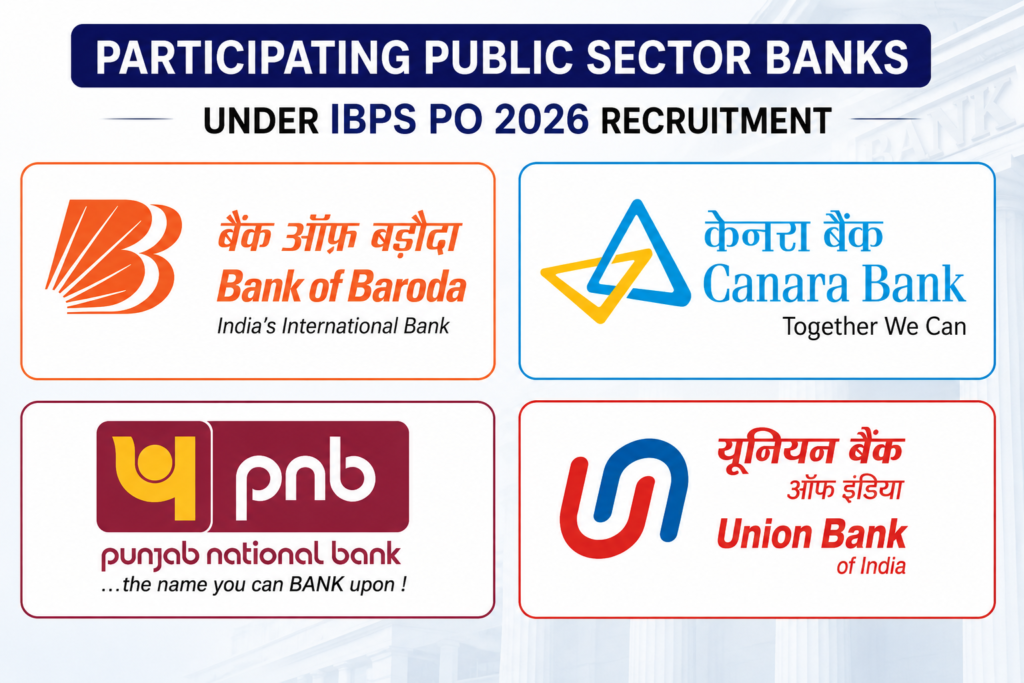
Once you clear this single exam and interview process, you become eligible for allotment to any of the participating public sector banks, such as Bank of Baroda, Canara Bank, Punjab National Bank, Union Bank of India, and several others — everyone except the State Bank of India, which runs its own separate SBI PO recruitment.
This structure is precisely why IBPS PO is considered the largest Probationary Officer-level recruitment drive in the country by both the number of participating banks and the number of vacancies on offer.
IBPS PO 2026 Important Dates
Here are the key dates for this year’s cycle, based on the official IBPS registration portal:
| Event | Date |
|---|---|
| Notification Release | 1 July 2026 |
| Online Application Start | 1 July 2026 |
| Online Application Closing Date | 26 July 2026 (extended from the original 21 July 2026 deadline) |
| Window for Editing/Correcting Application Details | Same as the closing date — 26 July 2026 |
| Online Fee Payment Window | 1 July – 26 July 2026 |
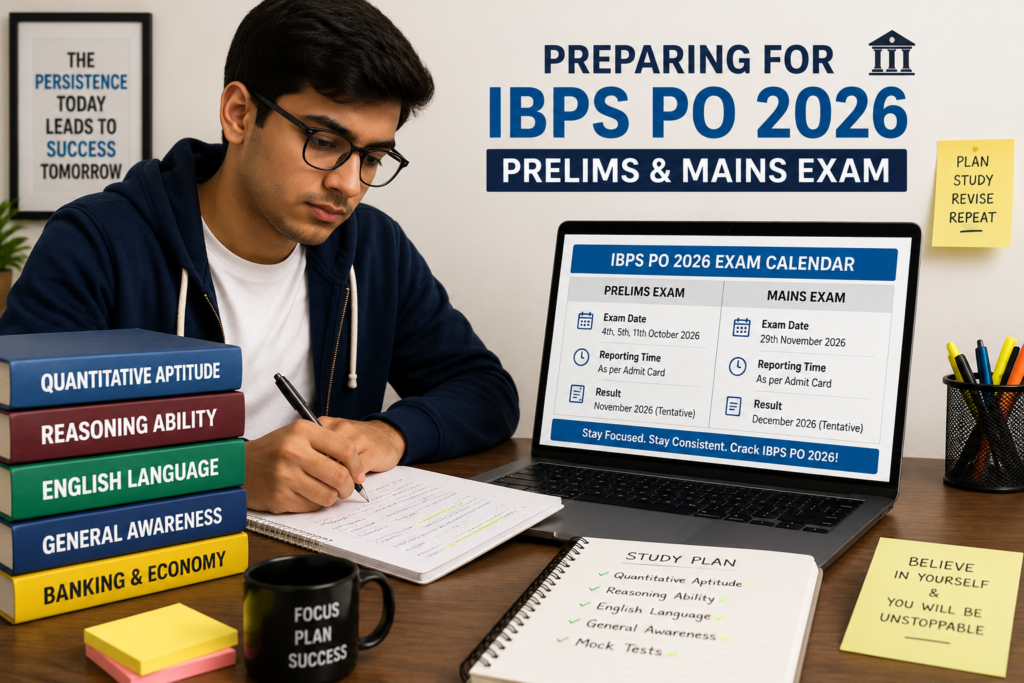
| Preliminary Examination | 22–23 August 2026 |
| Main Examination | 4 October 2026 |
| Interview / Personality Test | Expected November–December 2026 (tentative) |
| Provisional Allotment / Final Result | Expected early 2027 (tentative) |
Important note: IBPS initially set the application deadline at 21 July 2026, but subsequently extended it to 26 July 2026 to give candidates additional time. If you’ve been going by an older date, make sure you’re working from the most current version of the notification. Since the interview and final result dates are typically confirmed closer to the actual event, treat those two entries as indicative rather than fixed, and check the official IBPS website periodically for updates.
Our advice: don’t wait for the deadline. Server load tends to spike sharply in the final 48 hours of any large government exam registration window, and a last-minute technical glitch is not a risk worth taking for an opportunity this significant.
IBPS PO 2026 Vacancies
When the notification was first released, IBPS listed 6,715 vacancies across the reporting banks. However, since three of the eleven participating banks had not yet submitted their final vacancy figures at the time of release, the number was always expected to rise.
That’s exactly what happened — the vacancy count was subsequently revised upward to approximately 7,365 vacancies through an updated annexure, reflecting additional openings reported by the remaining banks.
A few points worth understanding about IBPS vacancy figures in general:
- Vacancy numbers published in the notification are described as “indicative” and can still be revised.
- Bank-wise vacancy distribution (how many seats each of the eleven banks gets) is usually detailed in a separate annexure released alongside or shortly after the main notification.
- Category-wise (General, OBC, SC, ST, EWS) and specially-abled (PwBD) vacancy splits are also published separately.
If precise bank-wise numbers matter for your planning, always refer to the latest official annexure on the IBPS website rather than an older cached version.
Eligibility Criteria
Getting your eligibility check right the first time saves you from painful rejection at the scrutiny stage. Here’s what’s required for IBPS PO 2026:
Age Limit
- Minimum age: 20 years
- Maximum age: 30 years
- Age is generally calculated as of a specific cut-off date mentioned in the official notification.
Category-wise age relaxation typically applies, such as for OBC, SC/ST, persons with benchmark disabilities, and ex-servicemen, in line with standard government recruitment norms. Always verify the exact relaxation years for your specific category in the official notification PDF, since relaxation slabs can be revised.
Educational Qualification
- A Bachelor’s degree in any discipline from a university recognized by the Government of India, or an equivalent qualification recognized as such by the Central Government.
- This includes candidates from technical/professional degree backgrounds (engineering, etc.) as well as those who completed their degree through an open university, provided the degree is recognized.
- No minimum percentage is required in your degree — simply passing is sufficient to meet the educational eligibility bar.
Nationality
Candidates must typically be a citizen of India, or fall under specific categories such as a subject of Nepal or Bhutan, or a Tibetan refugee who arrived in India before a specified cut-off date with the intention of permanently settling here (subject to the exact conditions listed in the official notification).
Computer Literacy
Working knowledge of computer systems is generally expected, since the entire examination — Prelims and Mains — is conducted online.
IBPS PO Salary and Pay Scale
This is usually the first question every aspirant wants answered, so let’s get straight to it.
The starting basic pay for an IBPS PO is ₹48,480 per month, following the pay scale structure:
₹48,480 – 2000/7 – 62,480 – 2340/2 – 67,160 – 2680/7 – 85,920
In simple terms, this means your basic pay increases through defined increments over your career progression, eventually reaching ₹85,920 at the top of this particular scale.
On top of the basic pay, you’re entitled to allowances such as:
- Dearness Allowance (DA)
- House Rent Allowance (HRA)
- City Compensatory Allowance (CCA)
- Special Allowance
- Medical benefits and other perquisites as per the rules of the specific bank you’re allotted to
Once these allowances are added, most estimates place the gross in-hand monthly salary somewhere in the range of ₹60,000 to ₹85,000, depending heavily on your posting location (metro cities generally carry higher HRA slabs than smaller towns).
A quick note on accuracy: exact in-hand figures vary by bank, city, and category, and are not something the official notification spells out as a single fixed number. Treat any specific in-hand salary figure — including the range above — as an informed estimate rather than a guarantee, and confirm final compensation details once you receive your actual offer.
Career Progression
IBPS PO is an officer-cadre position with a defined promotion hierarchy. A typical progression path looks like this:
Probationary Officer → Assistant Manager → Manager → Senior Manager → Chief Manager → Assistant General Manager → Deputy General Manager → General Manager
Newly selected candidates are usually placed on a probation period (commonly around two years), during which they undergo structured training across different banking functions before being confirmed as permanent officers.
Selection Process
The IBPS PO selection process runs across three main stages:
- Preliminary Examination — This is purely qualifying in nature. Marks scored here are not carried forward for final merit; you simply need to clear the sectional and overall cut-offs to proceed.
- Main Examination — This is the stage that actually decides your merit ranking. Performance here matters significantly.
- Interview / Personality Test — Conducted for candidates who clear the Main Examination cut-off, usually in a ratio decided by IBPS/participating banks.
Final Merit Calculation
The final merit list is prepared using a weighted formula:
- 80% weight given to your Main Examination score
- 20% weight given to your Interview/Personality Test score
This weighting makes it clear that while the interview matters, your performance in the Main Exam plays the dominant role in determining your final rank and subsequent bank allotment.
Prelims Exam Pattern 2026
The Preliminary Exam pattern for this cycle carries a structural change worth noting carefully if you’re a repeat aspirant.
| Section | Number of Questions | Maximum Marks | Duration |
|---|---|---|---|
| English Language | 30 | 30 | 20 minutes |
| Quantitative Aptitude | 35 | 30 | 20 minutes |
| Reasoning Ability | 35 | 40 | 20 minutes |
| Total | 100 | 100 | 60 minutes |
What’s changed: In earlier cycles, Quantitative Aptitude typically carried more marks relative to Reasoning Ability. This year’s pattern shifts some of that weight, giving Reasoning Ability the highest mark allocation (40 marks) despite having the same number of questions as Quant. If your prelims strategy previously leaned heavily on Quant scoring, it’s worth rebalancing your practice time toward Reasoning this cycle.
Sectional timing remains fixed at 20 minutes per section, so time management within each section is still critical — you cannot borrow extra time from one section to finish another.
Mains Exam Pattern 2026
The Main Examination is more comprehensive and covers a broader range of topics.
| Section | Number of Questions | Maximum Marks |
|---|---|---|
| Reasoning | 40 | 60 |
| General/Banking/Economy Awareness | 50 | 60 |
| English Language | 40 | 20 |
| Data Interpretation & Analysis | 40 | 60 |
| Objective Total | 170 | 200 |
| Descriptive Test (English) | 2 questions (Essay & Comprehension) | 25 |
The Descriptive English Test deserves special attention. It typically requires candidates to write on topics related to banking, the economy, ethics, and current affairs and technology, testing not just grammar but your ability to structure a coherent, well-argued piece of writing under time pressure. This section is frequently under-prepared by candidates who focus almost entirely on the objective sections — don’t make that mistake.
The overall duration of the Main Examination (including the descriptive component) generally runs to roughly three hours or more; always confirm the exact timing breakdown from your official admit card, since minor adjustments can occur between notification and exam.
Application Fee
| Category | Fee (Inclusive of GST) |
|---|---|
| General / OBC / EWS | ₹850 |
| SC / ST / PwBD | ₹175 |
Fees are payable only online, through options such as debit card, credit card, internet banking, IMPS, mobile wallets, or UPI. Once paid, the fee is non-refundable, so double-check your category and eligibility before completing payment. A separate correction fee (commonly around ₹200) may apply if you need to edit your submitted application within the correction window.
How to Apply for IBPS PO 2026
Follow these steps carefully to avoid application errors:
- Visit the official IBPS website (ibps.in) or the dedicated CRP PO/MT-XVI registration portal.
- Click on “Click Here for New Registration” and fill in your basic details to generate a provisional registration number and password. Save these credentials securely — you’ll need them for every subsequent step.
- Log back in using your registration number and password to complete the detailed application form.
- Upload the required scanned photograph, signature, and any other documents specified (such as a left thumb impression or handwritten declaration, if required).
- Carefully fill in your educational, personal, and category details, using the “Save and Next” option to review each section before final submission.
- Pay the application fee through the integrated online payment gateway.
- Download and save the system-generated application/registration slip for your records — you’ll likely need to present it later in the process.
- Recheck all details before the correction window closes, since post-deadline changes are typically not possible.
Reminder: Only apply through the official IBPS portal. Numerous unofficial websites mirror old notifications with outdated deadlines or vacancy numbers — always cross-verify against ibps.in directly.
Documents Required
Keep these ready before you start your application to avoid last-minute scrambling:
- Recent passport-size photograph (as per specified dimensions and file size)
- Scanned signature
- Proof of date of birth (10th certificate or equivalent)
- Bachelor’s degree certificate/provisional certificate and mark sheets
- Category certificate (if applicable — OBC/SC/ST/EWS/PwBD)
- A valid, active email ID and mobile number for OTP verification and communication
- Valid photo ID proof for use at the exam center
Common Mistakes to Avoid
- Waiting until the last date to apply. Server congestion in the final hours of a high-volume government exam registration window is common, and a failed submission at the deadline can cost you an entire year.
- Entering incorrect category or age details. These errors can lead to rejection at the scrutiny stage, even after you’ve cleared the exam.
- Ignoring the descriptive English section during preparation. Many candidates focus solely on objective sections and lose easy, avoidable marks here.
- Misjudging the new mark distribution in Prelims. Continuing to over-prioritize Quant while under-preparing Reasoning this cycle, given the revised weightage, can hurt your sectional cut-off performance.
- Uploading photographs or signatures that don’t meet the specified format. This is one of the most common reasons applications get flagged during document verification.
- Assuming vacancy or date figures from an older cached webpage are still accurate. Government notifications get revised — always check the live IBPS portal for the latest version.
- Skipping mock tests for the interview stage. Candidates often prepare intensively for Prelims and Mains but leave interview preparation until the last minute.
Expert Preparation Tips
- Rebalance your Prelims practice. Given that Reasoning Ability now carries more marks (40) than Quantitative Aptitude (30) despite equal question counts, allocate proportionally more practice time to Reasoning this cycle.
- Start descriptive writing practice early. Pick a few recurring themes — banking reforms, digital India, financial inclusion, ethics in public service — and practice writing structured 150–200 word essays and précis under timed conditions.
- Build a strong Banking & Economic Awareness base months in advance, since this section is difficult to cram at the last minute. Follow monthly current affairs digests specifically focused on the banking and finance sector.
- Use sectional timers religiously during mock tests. Since sectional timing is fixed in Prelims, practicing under identical time constraints (not just full-length mocks) will make the real exam feel far less stressful.
- Don’t neglect Data Interpretation in Mains. With 60 marks on the line, strong DI skills can be a significant differentiator in your merit score.
- Track your application status regularly after submission, and keep your registration slip, payment receipt, and admit card downloads organized in one folder.
- Prepare for the interview alongside Mains, not after. Basic awareness of current banking policies, your own resume/background, and simple HR-style questions should be part of your ongoing preparation, not a last-minute scramble after Mains results.
Frequently Asked Questions (FAQ)
1. What is the IBPS PO 2026 Notification? It is the official recruitment announcement for Probationary Officer/Management Trainee positions (CRP PO/MT-XVI) across eleven participating public sector banks in India, excluding the State Bank of India.
2. What is the last date to apply for IBPS PO 2026? The online application window, originally set to close on 21 July 2026, was extended to 26 July 2026.
3. How many vacancies are there in IBPS PO 2026? The notification initially listed 6,715 vacancies, which were subsequently revised upward to approximately 7,365 as the remaining participating banks reported their figures.
4. What is the age limit for IBPS PO 2026? Candidates must be between 20 and 30 years old, with relaxations available for reserved categories as per government norms.
5. What educational qualification is required? A Bachelor’s degree in any discipline from a recognized university, with no minimum percentage requirement.
6. What is the salary of an IBPS PO? The basic pay starts at ₹48,480 per month, with total in-hand compensation (including allowances) generally estimated between ₹60,000 and ₹85,000, depending on posting location.
7. What is the IBPS PO selection process? It consists of a Preliminary Examination (qualifying only), a Main Examination (merit-deciding), and an Interview/Personality Test, with final merit calculated as 80% Mains score plus 20% Interview score.
8. When is the IBPS PO Prelims exam? The Preliminary Examination is scheduled for 22–23 August 2026, based on the current IBPS exam calendar.
9. When is the IBPS PO Mains exam? The Main Examination is scheduled for 4 October 2026.
10. Has the exam pattern changed for 2026? Yes. In the Prelims, Reasoning Ability now carries 40 marks compared to 30 marks for Quantitative Aptitude, despite both sections having 35 questions — a shift from earlier patterns where Quant typically carried more weight.
Conclusion
The IBPS PO 2026 Notification represents one of the most significant banking recruitment opportunities of the year, offering a stable, well-structured career path across eleven public sector banks through a single unified exam. With vacancies revised upward to roughly 7,365, a clear salary structure starting at ₹48,480 basic pay, and a well-defined three-stage selection process, this is an opportunity worth preparing for seriously.
Given the extended application deadline and the exam pattern shifts in Prelims, now is the time to lock in your study plan — particularly around Reasoning Ability and the often-overlooked Descriptive English section in Mains. Don’t leave your application to the last moment, and always verify dates and vacancy figures directly from the official IBPS portal.
For more detailed exam pattern breakdowns, free mock test recommendations, and updates on other government and banking exams, visit our [Banking & Government Exams category page] for regularly updated, verified information.
Suggested Internal Links
Read more: IBPS PO 2026 Notification: Best Guide & Key Dates- IBPS PO 2026 Notification → https://carrerpoint.com/ibps-po-2026-notification/
- Analog Devices Cloud AI Engineer Recruitment → https://carrerpoint.com/analog-devices-cloud-ai-engineer-recruitment/
- PTC Hiring Associate Software Engineer → https://carrerpoint.com/ptc-hiring-associate-software-engineer/
- Concentrix Off Campus Hiring 2026 → https://carrerpoint.com/concentrix-off-campus-hiring-2026/
- Sutherland Off Campus Hiring 2026 → https://carrerpoint.com/sutherland-off-campus-hiring-2026/