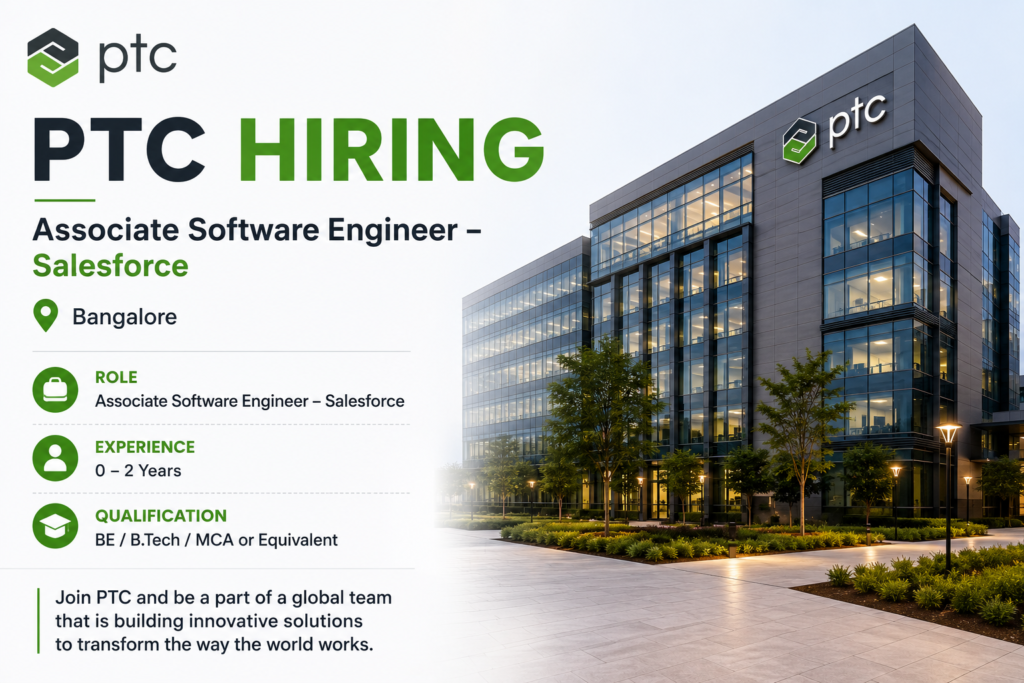
PTC Hiring Associate Software Engineer: PTC Associate Software Engineer Salesforce hiring is now open for its Bangalore office, and it’s a genuinely interesting opportunity for anyone who has spent the last couple of years building on the Salesforce platform and wants to work on enterprise-grade Field Service software. This isn’t a generic “any graduate can apply” listing — it’s a focused technical role for engineers who already have hands-on Salesforce development experience and want to grow into a position with real design and architecture responsibility. In this article, we’ll break down exactly who this role is for, what the day-to-day work looks like, the skills you genuinely need to bring to the table, and how to put together an application that gets noticed — all based on the official job posting so you’re working with accurate information rather than guesswork.
Table of Contents
About PTC
PTC is a global software company that builds technology used to design, manufacture, service, and operate physical products across industries like aerospace and defense, industrial manufacturing, automotive, medical technology, electronics, and high-tech. In simple terms, PTC sits at the intersection of the physical and digital worlds — its software helps companies design products digitally, track how those products perform once they’re out in the field, and manage the service and maintenance side of the business too.
This particular opening sits within PTC’s ServiceMax ecosystem,PTC Hiring Associate Software Engineer which is the part of the business focused on Field Service Management — essentially, software that helps companies manage technicians, service calls, equipment maintenance, and related workflows for physical assets out in the real world. If you’ve ever wondered what happens after a company sells a piece of industrial equipment (who tracks its maintenance schedule, who dispatches a technician when it breaks down, how spare parts get managed), ServiceMax is built to solve exactly that kind of problem, and Salesforce is the underlying platform it’s built on.
PTC positions itself around a small set of core values — putting customers first, encouraging bold thinking, and building an inclusive, collaborative culture (“PTC for All” and “Team PTC” are both explicitly named values in the company’s own job description). For someone evaluating where to build an early-to-mid career, that combination of enterprise software depth plus a genuinely global engineering culture is worth paying attention to.
Role Overview
Here are the core facts about the opening, taken directly from the official listing:
- Position: Associate Software Engineer – Salesforce (also listed as Software Engineer – Salesforce)
- Location: Bangalore, India
- Requisition ID: JR112454
- Experience required: 2+ years developing enterprise applications on the Salesforce PaaS (Platform-as-a-Service)
- Type of role: Individual contributor, working closely with engineering teams and product managers
- Core focus: Designing, developing, and enhancing Field Service application modules within the ServiceMax ecosystem
It’s worth flagging upfront that despite the “Associate” title, this is not a zero-experience fresher role. PTC’s own listing is explicit that they’re looking for someone with at least two years of hands-on enterprise Salesforce development experience. If you’re a complete beginner to Salesforce, this specific opening probably isn’t the right fit yet — but the skills section below will give you a clear roadmap of what to build toward if you want to be a strong candidate for a similar role down the line.
What You’ll Actually Be Working On
Based on the official role summary, this position blends three distinct areas of work, which is part of what makes it an interesting hire for someone who wants breadth early in their career rather than narrow, repetitive tasks:
- Core Salesforce engineering — building and maintaining Field Service application modules, which is the primary and largest part of the job.
- Repository and content management — maintaining Git-based repositories and content workflows, including version control hygiene and documentation.
- AI agent workflow operations — running, monitoring, and troubleshooting multi-step AI agent workflows that are used for tasks like content drafting, data gathering, classification, and automated tagging.
That third point is genuinely worth noting, because it signals where PTC (and honestly, a lot of enterprise software companies right now) is heading — engineers in this role aren’t just writing Apex code in isolation, they’re also expected to work alongside AI-driven automation tools as part of the regular workflow. If you’re building your skill set for a role like this, getting comfortable with how AI-assisted development and workflow tools operate is a genuinely useful investment of your time, not just a “nice to have.”
Technical Skills You Need
The listing is fairly specific about the technical bar for this role. Here’s what’s explicitly called out:
- 2+ years of experience developing enterprise applications on the Salesforce PaaS platform
- Strong understanding of Object-Oriented Programming (OOP) concepts and the ability to apply SOLID principles in real projects
- Hands-on experience with the Salesforce Lightning Framework, Lightning Web Components (LWC), and advanced JavaScript
- Strong expertise in Salesforce data modeling, Apex programming, and SOQL/SOSL query languages
- Experience with Salesforce integrations using REST and SOAP APIs to connect with external systems
- A solid grasp of core data structures and algorithms, and the ability to implement them using Apex and/or Java
- Comfort with application performance optimization, debugging, and troubleshooting
- Familiarity with build, release, deployment, and CI/CD processes specifically within the Salesforce ecosystem
- General awareness of current and emerging trends in the Salesforce ecosystem
If you’re currently building toward a role like this and don’t yet check every one of these boxes, prioritize Apex and Lightning Web Components first — those two skills form the backbone of almost every Salesforce engineering role at this level, and they’re also the easiest to demonstrate through personal projects, Trailhead badges, or open-source contributions if you don’t yet have paid work experience with them.
Domain and Additional Skills That Help
Beyond the core technical stack, PTC also calls out a few additional areas that strengthen a candidate’s profile:
- Field Service, CRM, or general Service Management domain knowledge is considered an advantage, since it directly maps to what ServiceMax does as a product
- Experience working with Git-based repositories and version control systems
- Exposure to AI-powered automation tools, AI agents, or workflow orchestration platforms
- Strong analytical and problem-solving skills, along with the ability to collaborate well across teams
- Comfort working independently and navigating ambiguity — a common expectation in fast-moving product engineering teams
None of these are described as mandatory, but if you have exposure to any of them, it’s worth calling them out explicitly in your resume rather than assuming a recruiter will infer it.
Roles and Responsibilities in Detail
The official listing breaks responsibilities into four clear buckets. Here’s what each one involves:
Salesforce Development & Engineering
- Designing, developing, and delivering complex Salesforce components and features end-to-end
- Making technology decisions based on scalability, maintainability, and business impact — not just “what works”
- Breaking large, ambiguous problems into smaller, well-scoped technical tasks and giving realistic effort estimates
- Writing high-quality, maintainable code that follows Salesforce best practices
- Evaluating and implementing new technologies or approaches within the Salesforce ecosystem where they add value
- Designing data models, Apex classes, triggers, Lightning Web Components, and system integrations
- Identifying performance bottlenecks and improving scalability and user experience
- Troubleshooting and resolving issues across both production and sandbox environments
- Working closely with product managers, architects, and QA engineers throughout the development lifecycle
- Supporting build, release, deployment, and CI/CD activities
Repository & Content Management
- Handling the day-to-day upload, organization, formatting, and maintenance of content assets in Git-based repositories
- Maintaining repository hygiene through proper version control, branching strategy, and documentation
- Working with cross-functional teams to keep technical and product-related content accurate and current
- Monitoring repository integrity and supporting the broader content lifecycle
AI Agent Workflow Operations
- Running, monitoring, and troubleshooting multi-step AI agent workflows used for tasks like content drafting, data gathering, classification, and automated tagging
- Partnering with engineering and product teams to improve these AI-assisted workflows over time
- Reviewing workflow outputs, spotting issues, and implementing fixes to improve reliability
- Supporting the broader adoption of AI-driven productivity tools within the development team
Collaboration & Innovation
- Driving effective collaboration across engineering, product, and business teams
- Researching emerging technologies and contributing ideas for improvement
- Demonstrating ownership and a continuous learning mindset
- Navigating ambiguity and proactively pushing solutions toward completion, rather than waiting for detailed instructions
Preferred Qualifications
These aren’t strict requirements, but candidates who have them will likely stand out during screening:
- Salesforce Platform Developer I or II certification
- Direct experience with Salesforce Field Service or the ServiceMax platform specifically
- Exposure to AI agents, workflow automation platforms, or generative AI applications
- Knowledge of DevOps tooling, Git, GitHub/GitLab, and automated deployment practices
- Experience working in Agile or Scrum development environments
If you’re actively preparing for this kind of role and haven’t yet taken a Salesforce certification, the Platform Developer I certification is a genuinely worthwhile investment — it’s specifically named in the preferred qualifications and is a credible, recognized signal of Apex and platform proficiency to any Salesforce-hiring team, not just PTC.
Eligibility Summary Table
| Criteria | Details |
|---|---|
| Role | Associate Software Engineer – Salesforce |
| Location | Bangalore, India |
| Experience | 2+ years on Salesforce PaaS development |
| Core Skills | Apex, LWC, SOQL/SOSL, REST/SOAP integrations, data modeling |
| Good to Have | Field Service/CRM domain, Git, AI workflow tools |
| Certification | Salesforce Platform Developer I/II (preferred, not mandatory) |
| Work Type | Individual contributor, cross-functional collaboration |
How to Apply
- Review the role carefully against your own experience. Since this role explicitly asks for 2+ years of Salesforce PaaS development experience, take an honest inventory of your Apex, LWC, and integration experience before applying.
- Apply through PTC’s official Workday careers listing for requisition JR112454, titled Associate Software Engineer – Salesforce, based in Bangalore. Avoid applying through unofficial third-party job boards claiming to have “special referral access” — always use PTC’s own careers site or a verified LinkedIn job link.
- Tailor your resume to highlight Apex, Lightning Web Components, data modeling, and any integration work (REST/SOAP) you’ve done, since these are the most heavily weighted technical skills in the listing.
- Mention any certifications explicitly, especially Salesforce Platform Developer I/II, since it’s specifically called out as a preferred qualification.
- If you have Field Service, CRM, or ServiceMax experience, make sure it’s clearly visible near the top of your resume rather than buried in a bullet point — it’s a direct domain match for this specific team.
- Prepare for a technical screening that will likely test your Apex fundamentals, data modeling knowledge, and understanding of Lightning Web Components, given how specific the listing is about these skills.
What the Selection Process Typically Looks Like
While PTC’s exact process can vary by team and location, a Salesforce engineering role at this level generally follows a pattern similar to this:
Resume/Profile Screening — Recruiters and hiring managers will look specifically for the core technical skills named in the listing: Apex, LWC, SOQL/SOSL, and integration experience. Vague resumes that don’t show these explicitly tend to get filtered out early.
Technical Screening Round — Often a coding or platform-specific assessment covering Apex fundamentals, data modeling concepts, and possibly basic data structure/algorithm questions, since the listing explicitly calls out DSA knowledge applied through Apex or Java.
Technical/System Design Interview — For a role with this much emphasis on “design and architecture guidance,” expect at least one round focused on how you’d approach designing a scalable Salesforce solution, not just whether you can write correct code.
Hiring Manager / Team Fit Round — A conversation focused on collaboration style, comfort with ambiguity, and how you’ve worked with product managers, architects, and QA teams in the past.
Offer Stage — If selected, you’ll receive details on compensation, start date, and any documentation required before joining.
Common Mistakes to Avoid
- Applying without genuine Salesforce experience. This role is explicit about wanting 2+ years of hands-on PaaS development experience — applying without at least foundational, demonstrable Apex and LWC experience is unlikely to get past the first screening.
- Listing “Salesforce” as a skill without specifics. Recruiters for technical roles like this want to see named skills — Apex, LWC, SOQL, REST/SOAP — not a generic one-line mention of “Salesforce knowledge.”
- Ignoring the AI workflow component of the role. Some candidates skip past this section since it seems secondary to “real” engineering work, but the listing dedicates a full responsibility area to it — showing any relevant exposure can meaningfully differentiate your application.
- Overlooking certifications. If you already hold a Salesforce Platform Developer I or II certification, not mentioning it clearly on your resume is a missed opportunity, since it’s explicitly named as a preferred qualification.
- Applying through unofficial channels. Only apply through PTC’s official Workday careers page or a verified, official LinkedIn posting to avoid fraudulent job scams that sometimes piggyback on real company names during active hiring periods.
Expert Tips to Strengthen Your Application
- Build a small portfolio project using LWC and Apex if you don’t have enough professional experience to point to directly. Even a simple custom app that demonstrates data modeling, a Lightning Web Component, and a REST integration can meaningfully strengthen a borderline resume.
- Get specific about integration work. If you’ve built any REST or SOAP integrations before, describe the systems involved and the problem it solved — vague mentions of “worked on integrations” don’t carry the same weight as a concrete example.
- Practice explaining architecture decisions out loud, not just writing code. Since this role explicitly involves “design and architecture guidance,” being able to clearly explain why you chose one data model or integration pattern over another is a skill worth actively practicing before interviews.
- Show comfort with ambiguity in your answers. The listing repeatedly emphasizes navigating ambiguity and taking ownership — when describing past projects, frame them around problems you identified and solved proactively, not just tasks you were assigned.
- If you have any exposure to AI-assisted development tools or workflow automation, even informally, mention it. It directly maps to a named part of the job and is still relatively uncommon among applicants, which can help you stand out.
Life as a Salesforce Engineer at PTC
Working within PTC’s ServiceMax-focused engineering team means spending most of your time on enterprise-grade Field Service software used by real companies to manage physical assets, technicians, and service operations — which tends to be more architecturally interesting than a typical CRM customization role, simply because Field Service workflows involve more complex data relationships and integrations by nature.
Given the fast-paced, agile environment described in the listing, you can expect regular sprint cycles, close collaboration with product managers and architects, and a genuine expectation that you’ll contribute ideas rather than just execute tickets. The explicit mention of AI-powered workflows and content management as part of the role also suggests this team is actively integrating modern tooling into its everyday engineering practices, rather than treating it as a separate, siloed initiative.
For someone building a long-term career in Salesforce engineering, a role like this offers a genuinely useful mix: deep platform-specific technical skill-building (Apex, LWC, data modeling) alongside broader software engineering fundamentals (system design, CI/CD, performance optimization) that remain valuable even if you eventually move beyond the Salesforce ecosystem.
- GSoC 2027: Why September Is the Right Time to Start
- Missed ITR Deadline 2026: Worse Than Just a Late Fee
- Tech Mahindra Hyderabad: 5 Walk-ins, Which Is Yours?
- DPDP Act 2026: What It Means When You Apply for Jobs
- Notice Period Buyout 2026: Can Employers Refuse It?
Frequently Asked Questions
Is this role suitable for a complete Salesforce beginner?
No. The listing explicitly requires 2+ years of hands-on experience developing enterprise applications on the Salesforce PaaS platform, so this specific opening is intended for candidates who already have practical Apex, LWC, and data modeling experience.
Is a Salesforce certification mandatory to apply?
No, certification is listed under “Preferred Qualifications,” not as a mandatory requirement. However, holding a Salesforce Platform Developer I or II certification can meaningfully strengthen your application.
Do I need ServiceMax-specific experience to apply?
No, ServiceMax experience is listed as a preferred qualification, not a requirement. Strong general Salesforce Field Service or CRM domain knowledge is described as “an advantage” rather than mandatory.
What programming languages are relevant for this role?
Apex is the primary language used for backend Salesforce development, alongside JavaScript for Lightning Web Components. The listing also mentions Java as relevant for demonstrating data structure and algorithm knowledge.
What does the “AI Agent Workflow Operations” part of the role actually involve?
It involves running, monitoring, and troubleshooting AI-driven workflows used for tasks like content drafting, data gathering, and automated tagging — essentially working alongside automation tools as part of the regular engineering workflow, not building AI models from scratch.
Where is this role based?
The role is based in Bangalore, India, and is listed as an on-site or hybrid engineering position within PTC’s local office, based on the official job posting.
How should I apply for this position?
Apply directly through PTC’s official Workday careers portal, searching for requisition JR112454 (Associate Software Engineer – Salesforce), rather than through unofficial third-party sites.
Does this role involve people management responsibilities?
No, based on the listing, this is an individual contributor role, though it does involve providing “technical leadership through design and architecture guidance” to the broader team.
What soft skills matter most for this role?
Strong analytical and problem-solving ability, comfort with ambiguity, and genuine collaboration skills across engineering, product, and business teams are all explicitly emphasized in the listing.
Is prior CI/CD experience necessary?
Familiarity with build, release, deployment, and CI/CD processes within the Salesforce ecosystem is explicitly listed as a desired technical skill, so at least basic working knowledge is expected.
Conclusion
The PTC Associate Software Engineer – Salesforce role in Bangalore is a strong opportunity for engineers who already have solid, hands-on experience with Apex, Lightning Web Components, and Salesforce data modeling, and who want to work on enterprise Field Service software with real architectural depth. It’s not an entry-level, zero-experience opening, but if you’re within striking distance of the 2+ years of experience and core technical skills listed, it’s well worth applying through PTC’s official careers page. For more job updates and detailed hiring breakdowns like this one, check out our latest openings on our [Careers & Off Campus Drives category page].
Related Jobs
- Microsoft Explore Internship 2026
- Analog Devices Cloud AI Engineer Recruitment
- Concentrix Off Campus Hiring 2026
- Sutherland Off Campus Hiring 2026
Official Sources
- PTC Careers – https://www.ptc.com/en/careers
- PTC Jobs Search – https://careers.ptc.com/