Every Article About the DPDP Act Talks to Companies. Here’s What It Means for You, the Applicant.Search “DPDP Act 2026” and you’ll land almost exclusively on content written for businesses — compliance checklists, penalty structures, consent manager registration requirements, and advice aimed at HR departments and legal teams. What’s almost entirely missing is the other side of this law: what it actually means for you, the person submitting your Aadhaar number, your photo, your resume, and your educational history to a company’s careers portal, a government recruitment site, or a job aggregator, every single time you apply for something.
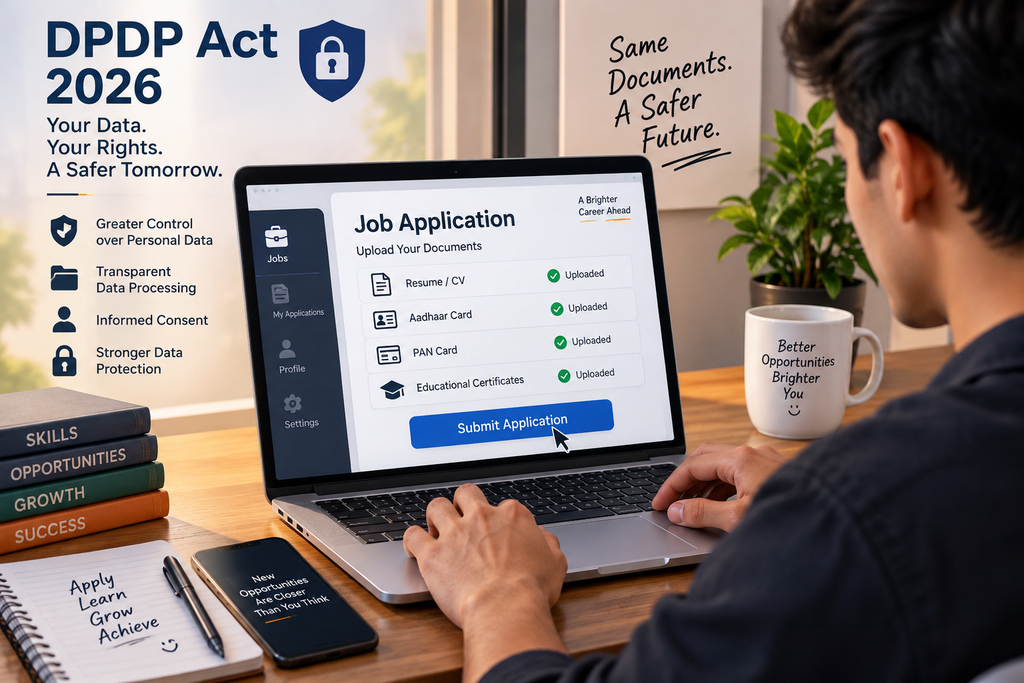
India’s Digital Personal Data Protection Act genuinely changes what rights you hold over that information, and if you’ve applied to even a handful of the notifications, walk-ins, or private job listings covered elsewhere on this site, you’ve already handed over exactly the kind of personal data this law is built to govern. This guide explains what’s actually happening with this law’s rollout, what rights you specifically have as a job applicant, where employers get a real exception that limits some of those rights, and what to actually watch for as this framework continues rolling out through 2026 and into 2027.
Table of Contents
What the DPDP Act Actually Is
The Digital Personal Data Protection Act, 2023, is India’s first comprehensive national law governing how organizations collect, process, store, and share personal digital data. It received presidential assent in August 2023, but — similar to the labour code reforms covered elsewhere on this site — its actual enforcement has followed a staggered, multi-year rollout rather than taking effect all at once. The detailed operational rules (the DPDP Rules, 2025) were formally notified on 13 November 2025, and full enforcement is scheduled to phase in over roughly 18 months from that date.
The Confusing Timeline, Laid Out Clearly
Given how much conflicting detail circulates about exactly when this law “takes effect,” here’s the clearest available breakdown of the actual phased schedule:
- 13 November 2025: The Data Protection Board of India was formally instituted, along with its core administrative provisions — this is the regulatory body that will oversee compliance, investigate breaches, and impose penalties.
- 13 November 2026 (roughly two months from this writing): The registration process for Consent Managers — intermediaries who help individuals manage, review, and revoke their consent for how their data is used — is scheduled to become operational.
- Mid-May 2027: Full compliance across most day-to-day employer obligations — notice and consent operations, breach notification, and individual rights handling — becomes fully enforceable, marking the end of the 18-month implementation window.
Employers are already expected to be actively preparing during this window rather than waiting for the final deadline, since penalties apply once specific provisions become enforceable, not just once the entire law is fully in force.
A Genuine Word of Caution About Coverage of This Topic
While researching this article, it became clear that a meaningful amount of content currently published about the DPDP Act reads as low-quality, templated, or algorithmically generated filler — vague, repetitive phrasing that technically mentions the right keywords (“Phase 1,” “implementation,” “framework”) without conveying any actual, checkable information. If you’re researching this topic further yourself, be skeptical of any source that describes the law’s “phases” and “framework” in increasingly abstract language without ever citing a specific date, rule number, or concrete right — that’s a strong signal of thin, non-substantive content rather than genuine legal reporting.
What Rights You Actually Have as a “Data Principal”
Under the Act, you — as the individual whose data is being collected — are legally termed a “Data Principal.” The rights this status grants you include:
- The right to be informed about what data is being collected, for what specific purpose, and whether it’s being shared with any third party
- The right to access, correct, or request deletion of your personal data held by an organization
- The right to object to processing of your data under certain conditions
- The right to data portability, allowing you to move your data between services in specific circumstances
- The right to nominate a representative, in certain cases, to act on your behalf regarding your data rights
Translated into a real job-search scenario: if you’ve submitted your resume, Aadhaar details, and photo to a company’s careers portal, you generally have the right to know what that data is being used for, to request a correction if something’s wrong, and — once these rights become fully enforceable — to request deletion of your data if you no longer want that company holding it, such as after a hiring process concludes and you weren’t selected.
The HR “Legitimate Use” Exception — Where Your Rights Are Actually Limited
This is the detail most job-seeker-focused coverage of this law misses entirely, and it’s genuinely important: employers generally do not need to obtain your explicit, separate consent for standard HR activities — recruitment, onboarding, payroll processing, and benefits administration are treated as falling under a “legitimate use” exception. This means a company collecting your resume, running a background check as part of a standard hiring process, or processing your salary details once you’re employed doesn’t need to ask for a separate, explicit consent click-through for each of these routine activities the way a marketing platform collecting your data for advertising purposes would.
Practically, this means the DPDP Act isn’t going to change the basic mechanics of how you apply for a job — you’ll still submit your resume, your documents, and your personal details largely as you do today. What it changes is your downstream rights over that data once it’s been collected: your ability to ask what’s being done with it, correct inaccuracies, and eventually request its deletion, particularly for data held by companies you didn’t end up joining.
What This Means Practically for Every Job Application You Submit
Given how many of the postings, walk-ins, and notifications covered on this site require submitting Aadhaar details, photographs, educational certificates, and personal contact information, it’s worth applying a few practical habits going forward:
- Only submit personal data to verified, official channels — the company’s own careers portal, a verified job aggregator, or an official government recruitment site — rather than an unofficial WhatsApp forward or an unverified third-party link claiming to represent a company’s hiring process. This matters more, not less, as data protection obligations tighten, since your recourse depends on the organization actually being a legitimate, accountable data fiduciary.
- Keep a personal record of where you’ve submitted your data, including Aadhaar-linked applications specifically, so that if you later want to exercise a deletion request under this law, you have a clear list of who to contact rather than trying to reconstruct months of scattered applications from memory.
- Watch for breach notifications. Under the Act, organizations are required to report serious data breaches, typically within 72 hours, and to notify affected individuals. If you receive a legitimate breach notification related to an application you submitted, take it seriously rather than dismissing it as spam — verify it through the organization’s official channels before ignoring or acting on it.
- Be specifically cautious with Aadhaar submissions. Since several government recruitment processes (as covered elsewhere on this site, including RRB and TSLPRB applications) require live Aadhaar-linked verification, understanding that this data carries genuine legal protection — and genuine risk if mishandled — is worth taking seriously rather than treating as routine paperwork.
What Happens If a Company Mishandles Your Data
Once the relevant provisions are fully enforceable, organizations that fail to implement reasonable security measures to prevent data breaches face penalties of up to ₹250 crore. Breaches involving mishandling of sensitive categories of data, or failure to properly notify the Board or affected individuals, can draw penalties up to ₹200 crore, with lesser violations facing penalties up to ₹50 crore — and these can accrue per instance of non-compliance. While these penalties are aimed at holding organizations accountable rather than directly compensating an individual whose data was mishandled, the scale of these figures signals that India is treating personal data mishandling as a genuinely serious regulatory matter, not a minor administrative lapse — which should, over time, push organizations toward more careful handling of the exact kind of personal data you submit during a job search.
Consent Managers: A Feature Worth Understanding Once It’s Live
Starting from the November 2026 registration window, Consent Managers — registered intermediaries acting as a single point of contact for individuals to give, manage, review, and withdraw consent — are meant to become part of the broader data ecosystem. Once operational and adopted by relevant platforms, this could eventually give you a more centralized way to see and manage what various organizations, including potential employers, are doing with your submitted data, rather than needing to track this manually across dozens of individual applications. This feature is not yet live as of this writing, so treat it as something to watch for rather than something to rely on today.
How This Connects to the Broader Regulatory Shifts Covered Here
If you’ve been following the new labour code changes affecting CTC structure and full-and-final settlement timelines, or the EPF withdrawal rule restructuring, the DPDP Act’s phased rollout follows a genuinely similar pattern: substantive provisions notified and technically “in force,” but with real enforcement and full operational compliance staggered over an extended implementation window. This is a recurring feature of how major Indian regulatory reforms have rolled out across 2025 and 2026 — worth recognizing as a pattern, since it means “the law is in effect” and “the law is being fully enforced in practice” are genuinely different statements, whether you’re talking about data protection, labour codes, or PF withdrawal rules.
What Job Seekers Should Actually Do Right Now
Given that full enforcement remains more than a year away, the realistic, practical response isn’t to change your job-search behavior dramatically today — it’s to build a few good habits now that will serve you well as this framework matures:
- Apply only through verified, official channels, consistent with general good practice regardless of this law specifically.
- Keep basic records of your applications, particularly ones involving Aadhaar or other sensitive identity documents.
- Read any data-related notice you receive from a company you’ve applied to, rather than reflexively dismissing it, since genuine breach notifications will start carrying real regulatory weight behind them.
- Stay generally aware of this law’s progress, since your practical rights — particularly around requesting deletion of your data after an unsuccessful application — will become more concretely actionable as 2026 and 2027 progress.
Why This Matters Even for International or Remote Applications
If you’ve been applying to remote roles with international companies — a pattern increasingly common given how many of the private-sector postings covered on this site involve global firms with India operations — it’s worth knowing that the DPDP Act’s protections aren’t limited to purely domestic Indian companies. The law’s extraterritorial application means it covers any organization processing personal data of individuals in India, including foreign companies based entirely outside the country, provided they’re offering goods or services (including employment opportunities) to people in India. This mirrors how the EU’s GDPR framework operates, applying to any organization handling EU residents’ data regardless of where that organization is physically based. Practically, this means a foreign company’s careers portal collecting your resume and personal details for a remote role is still subject to this same regulatory framework, even though the company itself may have no physical office in India — a detail worth knowing if you ever need to understand which law actually governs a specific international application you’ve submitted.
Common Mistakes to Avoid
- Assuming this law only matters to businesses and has no relevance to you as an individual applicant. You hold real, if still-maturing, rights over your own submitted data under this framework.
- Assuming employers need your explicit, separate consent for every standard HR activity. Recruitment, onboarding, and payroll processing generally fall under a legitimate-use exception, so this specific aspect of your job application experience isn’t changing.
- Treating “the law was notified” and “the law is fully enforced” as the same thing. The actual enforcement timeline is staggered through mid-2027, with different provisions becoming operative at different points.
- Submitting sensitive documents like Aadhaar through unverified third-party links, especially during a period when data protection accountability is still being built out — stick to verified official channels.
- Trusting low-quality, vague content about this law that never cites specific dates or provisions. As noted above, a meaningful share of current online coverage of this topic is genuinely thin or templated.
- Ignoring legitimate data breach notifications from companies you’ve applied to. These carry real regulatory significance now, unlike routine marketing emails.
Frequently Asked Questions
Does the DPDP Act affect me if I’m just applying for jobs, not running a business?
Yes — as a “Data Principal” under the Act, you hold specific rights over your personal data, including data submitted during job applications, even though most coverage of this law focuses on business compliance obligations.
Do companies need my consent to collect my resume and personal details for a job application?
Standard recruitment, onboarding, and payroll activities generally fall under a “legitimate use” exception, meaning companies don’t need separate, explicit consent for these routine HR processes the way they would for other types of data use.
When does the DPDP Act fully take effect?
Implementation is staggered: the Data Protection Board was instituted in November 2025, Consent Manager registration is scheduled for November 2026, and full operational compliance across most employer obligations is expected by mid-May 2027.
Can I ask a company to delete my data after I don’t get selected for a job?
This right exists under the Act’s data principal provisions, though practical, fully enforceable mechanisms for exercising it are still being built out as the law’s implementation continues through 2026 and 2027.
What happens if a company mishandles my personal data?
Penalties can reach up to ₹250 crore for failing to implement reasonable security safeguards, with additional penalties up to ₹200 crore for breach notification failures or mishandling sensitive data categories, and lesser penalties up to ₹50 crore for other violations.
What is a Consent Manager?
A registered intermediary meant to give individuals a centralized way to give, manage, review, and withdraw consent for how their data is used — registration for these was scheduled to become operational from November 2026.
Should I be worried about submitting Aadhaar details for government job applications?
Government recruitment processes requiring Aadhaar verification remain standard and generally legitimate, but this law reinforces the importance of only submitting such sensitive data through verified, official channels rather than unofficial links.
Does this law apply only to Indian companies?
No, it has extraterritorial application, covering any organization processing personal data of individuals in India, including foreign companies offering goods or services to Indian residents.
What should I do if I receive a data breach notification from a company I applied to? Take it seriously and verify it through the organization’s official channels — legitimate breach notifications carry real regulatory weight under this law, unlike routine spam.
Is all online content about the DPDP Act reliable?
No — a meaningful amount of current coverage is generic or templated, repeating vague phrases about “phases” and “frameworks” without citing specific dates or provisions. Prioritize sources that cite concrete details.
The Bottom Line
The DPDP Act 2026 story has been told almost entirely from the business compliance angle, but if you’ve submitted a resume, an Aadhaar number, or a photograph to any company or government portal covered on this site, you’re the other half of this story — the person whose data rights this law is actually meant to protect. The practical impact on how you apply for jobs today is limited, since standard HR processes fall under a legitimate-use exception, but your downstream rights to know what’s happening with your data, correct it, and eventually request its deletion are real and will become more concretely enforceable as the law’s phased rollout continues through 2026 and into 2027.
For more fact-checked coverage of policy changes affecting your career, check out our Trending category page for regularly updated analysis. And if you’re actively applying to roles that require submitting Aadhaar or other sensitive documents, our guide on Notice Period Buyout 2026 covers another set of employment rights worth understanding clearly before you need them.
Suggested Internal Links
- Trending Category
- Notice Period Buyout 2026: Can Employers Refuse It?
- CTC vs In-Hand Salary 2026: What Actually Changed
- Free ATS Resume Builder Tools 2026: 7 Tested
Suggested External References
- Ministry of Electronics and Information Technology (MeitY): https://www.meity.gov.in
- Data Protection Board of India: https://www.dpb.gov.in
- Digital Personal Data Protection Act, 2023 (Official Text): https://www.meity.gov.in/data-protection-framework