Salary Slip Components India Somewhere between 30% and 70% of your monthly earnings breakdown, your salary slip quietly stops telling you the full story. One recent analysis found that 70% of salaried employees can’t correctly identify which line items on their own payslip are negotiable, which are simply taxable, and which are mandatory deductions with no room to change at all. That’s not a knowledge gap that only affects freshers — it affects people who’ve been receiving the same document every month for years without ever really decoding it, often discovering the gaps in their own understanding only when a bank, an embassy, or a new employer asks a specific question their payslip alone can’t clearly answer.
This guide goes through every genuine component of an Indian salary slip, including the specific figures your employer contributes on your behalf that most payslips never actually display, a new legal provision that changed how your TDS is technically calculated starting this year, and a real, documented case showing exactly what can go wrong when a company gets the payslip format itself wrong, even while paying its employees correctly and on time every single month.
Table of Contents
The Three Sections Every Slip Actually Has
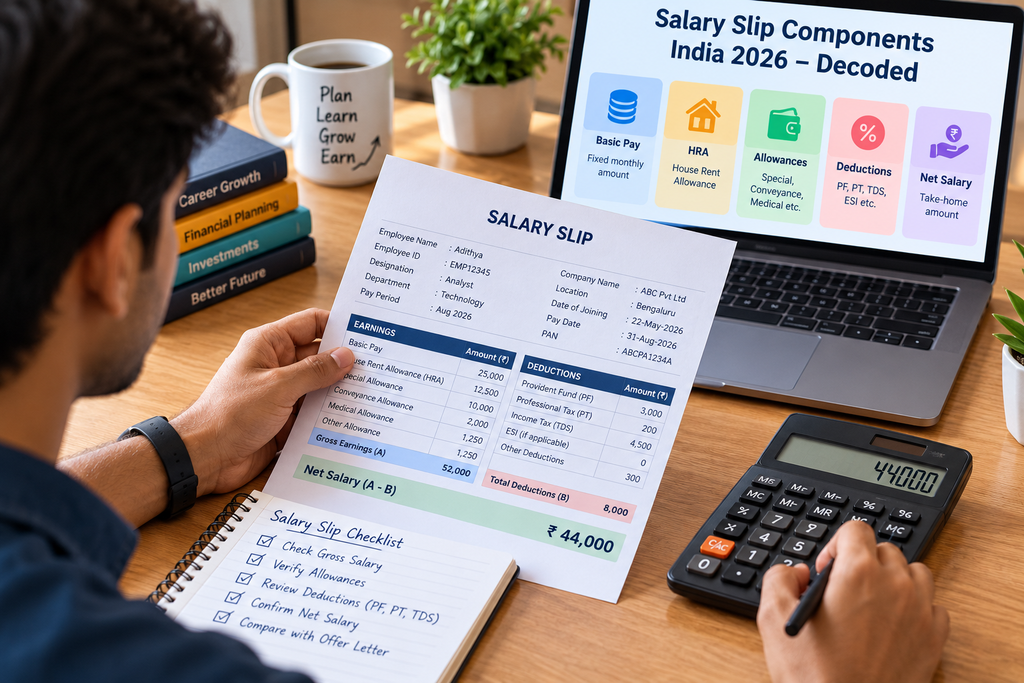
Structurally, every compliant Indian salary slip breaks into three parts: a header section (your name, employee ID, PAN, UAN, designation,Salary Slip Components India and the specific pay period covered), an earnings section on one side listing everything added to your gross pay, and a deductions section on the other listing everything subtracted before you reach your final net, take-home figure. Everything else covered in this guide is really just unpacking what belongs in each of these three sections, and why.
Basic Salary: The Foundation Everything Else Is Calculated From
Your basic salary is the fixed core component your other calculations build from — commonly 40 to 50% of your total CTC under the compensation structures increasingly common since the labour code changes covered elsewhere on this site, which specifically push basic pay toward at least 50% of CTC in many structures. This matters beyond just being a number on the page: statutory deductions like PF and gratuity are calculated as a percentage of basic salary specifically, not your total CTC or gross pay, which is exactly why a higher basic salary — while sometimes reducing your immediate take-home slightly — genuinely increases your retirement savings contributions over the full course of your career.
HRA: The Exemption Formula, Stated Precisely
House Rent Allowance is typically 40 to 50% of your basic salary (the higher figure applying to metro cities), and it’s one of the few genuinely tax-advantaged components on your slip if you’re paying rent. The tax-exempt portion of your HRA is calculated as the minimum of three specific figures: your actual HRA received, 40% (non-metro) or 50% (metro) of your basic salary, or your actual rent paid minus 10% of your basic salary. Whichever of these three figures is smallest is the amount that’s genuinely exempt from tax — the rest of your HRA, if any, gets taxed as regular income. This three-way minimum calculation is worth doing properly rather than assuming your entire HRA is automatically tax-free, since for many salary structures, it isn’t.
DA: Why Your Private-Sector Slip Probably Doesn’t Have One
Dearness Allowance specifically adjusts pay for inflation, and it’s a prominent, regularly revised line item on government salary slips, updated twice yearly based on the All India Consumer Price Index. If you work in the private sector, though, it’s genuinely normal for your payslip to have no DA line at all — most private companies in 2026 simply fold this amount directly into your basic salary rather than showing it as a separate component. If you’ve been searching your own payslip for a DA line and coming up empty, that’s not an employer error or an omission worth flagging — it’s standard private-sector practice.
Special Allowance: The Honest Explanation Nobody Gives You
This is worth stating plainly, since most explanations dance around it: special allowance is essentially the leftover. After your employer assigns your basic salary, HRA, DA (if shown separately), and any other named allowances, whatever remains of your total CTC lands here. It’s the plug number that makes the overall CTC math work out to the figure in your offer letter. It’s also fully taxable, with no exemptions attached — unlike HRA, there’s no calculation to reduce your tax liability on this component. Smaller named allowances (conveyance, medical, telephone reimbursement) vary company to company and are generally modest relative to your special allowance figure.
The Employer Contributions Your Payslip Probably Doesn’t Show
This is the genuinely underdiscussed part of your salary slip, and it’s worth understanding even though these specific figures often don’t appear on the document itself. Your employer contributes 12% of your Basic plus DA toward your Provident Fund — but this 12% doesn’t go entirely into your own EPF account. It splits: 8.33% goes toward the Employee Pension Scheme (EPS), a separate government pension mechanism, and only the remaining 3.67% actually goes into your own EPF account alongside your own 12% employee contribution. Many employees assume their employer’s “PF contribution” adds fully to the same retirement corpus their own deduction builds — it doesn’t, and understanding this split matters if you’re ever trying to reconcile your EPFO passbook figures against what you’d expect based purely on the headline 12%-plus-12% framing commonly used to describe PF contributions.
Separately, your employer also contributes 3.25% of your gross wages toward ESI (Employee State Insurance), where applicable, on top of your own smaller employee-side ESI deduction. Good payslip practice, and increasingly employee expectation, calls for these employer-side contribution figures to be shown as informational items below your net pay line, even though they don’t affect your take-home amount directly — specifically so you can verify your own EPFO and ESIC portal records against what your employer claims to be contributing on your behalf.
The New TDS Provision Almost Nobody’s Payslip Guidance Mentions Yet
Here’s a specific, dateable legal change worth knowing, and one that connects directly to the broader “two acts coexisting” transition covered in this site’s guide to the ITR filing deadline: from 1 April 2026, TDS on salary is governed by Section 392 of the Income Tax Act, 2025, which replaces the old, long-standing Section 192 of the earlier Income-tax Act, 1961. If your own understanding of how TDS gets calculated and deducted from your salary still references “Section 192,” that’s now technically outdated for income earned from April 2026 onward — the underlying mechanism (your employer estimating your annual tax liability and deducting a proportional share each month) remains conceptually the same, but the specific legal provision governing it has changed. This is exactly the kind of quiet legal transition that’s easy to miss unless you’re specifically tracking it, and it’s worth knowing the correct current reference if you’re ever discussing your own TDS deduction with your employer’s payroll team or researching your rights around it.
A Real Case Showing Why Payslip Format Actually Matters
This is worth including because it illustrates a genuinely underappreciated risk: a documented case involved a company that had been paying its employees correctly for two years, but whose salary slips never showed individual deduction components — no PF breakup, no ESI deduction, no TDS amount, no professional tax listed separately, and no employer-side contribution figures anywhere on the document at all. When one employee applied for a loan, the bank required proper documentation of these individual components, and the loan was delayed six weeks while the company scrambled to rebuild its entire payroll documentation from scratch to produce compliant slips retroactively. The company hadn’t done anything wrong in terms of actually paying correctly — it had simply never issued its salary slips in a legally compliant, properly itemized format. This is not, apparently, an isolated incident — thousands of businesses across India reportedly issue salary slips that look complete on the surface but fail basic statutory itemization requirements, with the consequences only surfacing at exactly the moment those slips are needed for something important, like a loan, a credit card application, or visa processing.
Loss of Pay: The Two Calculation Methods Worth Knowing
If you’ve taken unpaid leave and noticed your deduction seemed larger or smaller than you expected, it’s worth knowing that Loss of Pay (LOP) can be calculated using either a calendar-day method (dividing your monthly salary by the total number of calendar days in that month, including weekends) or a working-day method (dividing by only the actual working days in that month, excluding weekends and holidays). These two methods can produce genuinely different deduction amounts for the identical number of leave days taken, since a working-day-based calculation concentrates your full monthly salary across fewer divisor days, making each individual day of LOP proportionally more expensive under this method compared to the calendar-day approach. If your LOP deduction seems inconsistent with your own expectation, checking which specific method your employer’s payroll policy actually uses — rather than assuming a single universal formula applies everywhere across every Indian company — usually resolves the confusion quickly.
Why Government and Private Sector Slips Look Genuinely Different
If you’ve compared a government salary slip against a private-sector one and found the structure confusingly different, this reflects a genuine, structural difference rather than inconsistent formatting. Government salary slips are typically built around the applicable Pay Commission’s pay matrix, showing basic pay according to that matrix, Dearness Allowance prominently and separately (unlike most private slips), House Rent Allowance, transport allowance, and other government-specific approved allowances. Government employees also commonly see a National Pension System (NPS) deduction in place of the EPF deduction private-sector employees are more familiar with, reflecting the different retirement scheme structure that applies to many government roles. If you’re comparing a specific government job offer against a private-sector one, treating the two payslip formats as directly, line-by-line comparable is likely to cause confusion — it’s more useful to compare the actual net take-home and retirement contribution outcomes than to expect matching line items across the two structures.
Professional Tax: The Small, State-Specific Deduction
A smaller deduction worth understanding specifically because it confuses people who move between states: Professional Tax is levied by state governments, not the central government, which means both whether you pay it at all, and how much, depends entirely on which state you’re working in. Some states don’t levy professional tax at all, while others apply it on a slab basis tied to your salary level, typically capped at a few thousand rupees annually under the constitutional ceiling that applies to this specific tax. If you’ve moved from one state to another and noticed your professional tax deduction changed or disappeared entirely, this reflects genuine state-level variation rather than an error in your new employer’s payroll processing.
What This Means Specifically If You’re a Fresher Reading Your First Payslip
If this is genuinely your first salary slip, a few things are worth knowing beyond the component-by-component breakdown above and the general advice most first-job guides tend to offer. Your very first payslip may show a partial month’s pay if you joined partway through the pay cycle, calculated using whichever LOP method (calendar-day or working-day) your specific employer applies, which can make your first paycheck look smaller relative to your annual CTC divided by twelve than you might expect — this is normal and not a sign of a payroll error. It’s also worth specifically checking that your PF account has actually been created and your UAN generated within the first month or two of joining, since a delay here can create genuine downstream complications for your own retirement savings tracking down the line. And it’s worth keeping every single payslip you receive from your very first job onward in an organized folder, digital or physical, since the specific case described above shows exactly how consequential it can be to need this documentation later and discover it isn’t readily available.
What to Actually Check Every Month, Not Just When Something Feels Wrong
Given how much detail sits in a document most people glance at once and file away, a few specific habits are worth building:
- Verify your PAN and bank account details on every new slip, particularly after any HR system change or company transition, since an error here can cause real payment or tax-filing problems later.
- Cross-check your paid days and any LOP entries against your own attendance records, since payroll processing errors around leave and attendance are a genuinely common source of incorrect deductions.
- Periodically compare your employer’s stated PF contribution against your actual EPFO passbook, given the EPS/EPF split described above — this is the most reliable way to confirm your employer’s contributions are genuinely reaching your account as expected.
- Keep at least a few months of recent payslips readily accessible, given how frequently they’re required for loan applications, visa processing, and other formal documentation needs — the real case described above illustrates exactly how costly it is to need this documentation and discover it isn’t properly available.
How to Actually Use Your Payslip Beyond Just Checking the Net Figure
Given everything covered above, it’s worth thinking of your payslip as a genuinely useful financial document rather than something you glance at once a month purely to confirm the final number landed correctly. For tax planning specifically, tracking your HRA exemption calculation across the year helps you anticipate your actual tax liability rather than being surprised at filing time. For loan and credit applications, understanding which components your specific lender will want itemized — as illustrated by the real case above — means you can proactively request a properly formatted slip from your employer well before you’re in a time-sensitive application process. And for salary negotiation purposes covered in more depth elsewhere on this site, understanding exactly how your current basic-to-CTC ratio compares to a prospective new offer gives you a genuinely more precise basis for comparison than looking at headline CTC figures alone.
Quick Answers
What percentage of employees actually understand their own salary slip?
One analysis found 70% of salaried employees can’t correctly identify which components on their payslip are negotiable, taxable, or simply mandatory deductions.
Why doesn’t my private-sector payslip show a DA line?
Most private companies fold Dearness Allowance directly into basic salary rather than showing it separately — this is standard practice, not an error, and remains common across most private-sector employers in 2026.
What is special allowance, exactly?
It’s the remaining CTC amount after basic, HRA, DA, and other named allowances are assigned — essentially a fully taxable “plug” figure that makes your total CTC add up correctly.
Does my employer’s 12% PF contribution all go into my own EPF account?
No, it splits — 8.33% goes toward the Employee Pension Scheme (EPS), and only 3.67% actually adds to your own EPF account alongside your personal contribution.
What changed about TDS on salary starting in 2026?
From 1 April 2026, TDS on salary is governed by Section 392 of the Income Tax Act, 2025, which replaces the previous Section 192 of the Income-tax Act, 1961.
How is Loss of Pay actually calculated?
Either by a calendar-day method (dividing by all days in the month) or a working-day method (dividing by only working days), and these two methods can produce genuinely different deduction amounts for the same leave taken.
Can a company that pays correctly still have a compliance problem with its salary slips?
Yes, as illustrated by a documented case where a company paid correctly for two years but hadn’t issued properly itemized, compliant slips, causing a real loan delay when proper documentation was suddenly required by the bank processing the application.
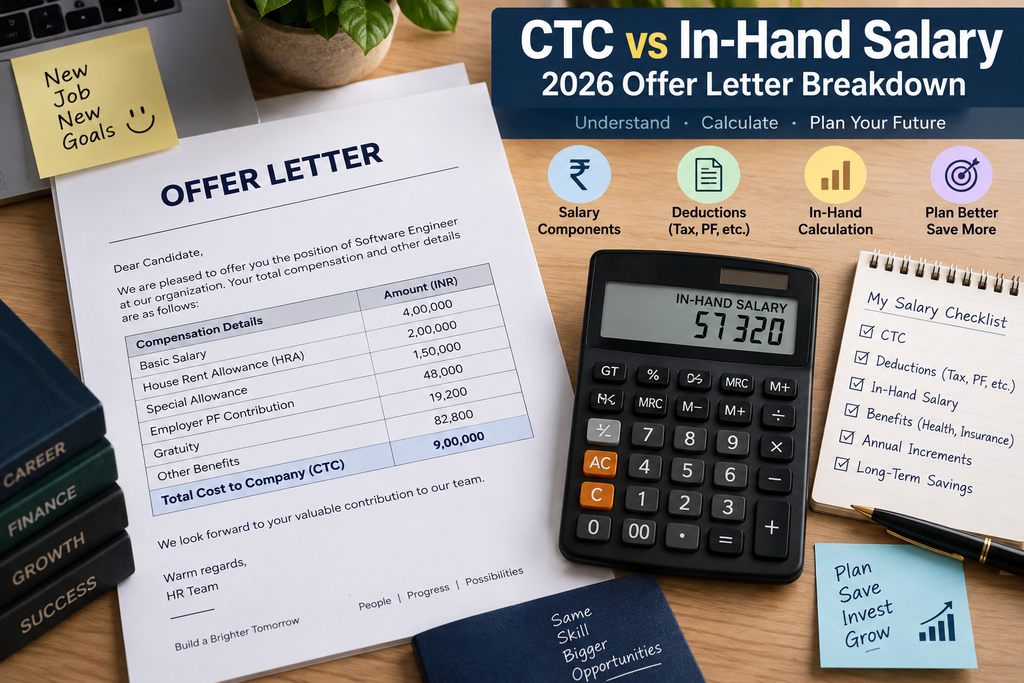
If you’re evaluating a full compensation package rather than just your monthly payslip, our guide on CTC vs In-Hand Salary 2026 and our piece on Night Shift Allowance India cover two other compensation components worth understanding in the same depth as the core payslip breakdown covered here, since a complete, accurate picture of your total compensation depends on understanding every one of these pieces together rather than any single document in isolation.
Suggested Internal Links
- Career Resources Category
- CTC vs In-Hand Salary 2026: What Actually Changed
- Night Shift Allowance: Legally Required, Legally Undefined
- ITR Deadline 2026: Worse Than Just a Late Fee
Suggested External References
- Employees’ Provident Fund Organisation (EPFO): https://www.epfindia.gov.in
- Income Tax Department e-Filing Portal: https://www.incometax.gov.in
- National Career Service Portal (India): https://www.ncs.gov.in