
If you’ve compared night shift allowance figures across a few job listings or company policies and found genuinely wildly different numbers — one company offering a flat ₹350 per night shift, another offering 25% of basic salary, a third offering something in between — you haven’t stumbled onto conflicting or unreliable information. You’ve run into a genuine, deliberate gap in Indian labour law. Section 54 of the Factories Act, 1948 establishes that workers required to work night hours must receive additional compensation for it. What it does not do is specify any fixed amount or percentage. That decision is explicitly left open, to be filled in by individual state governments, industry-specific wage boards, and ultimately each company’s own policy.
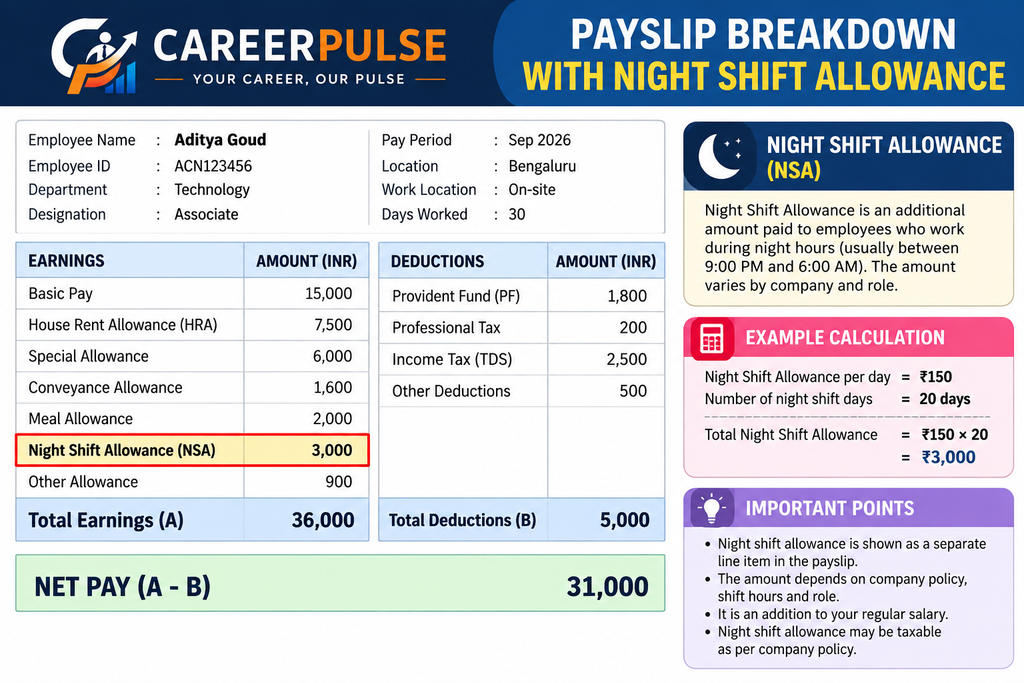
This matters practically because it means there’s no single “correct” night shift allowance figure to benchmark against — the legal variance is real, not a reporting error, and understanding the actual structure behind it helps you evaluate whether a specific offer’s night shift compensation is reasonable relative to genuine market patterns, rather than comparing it against a single number that doesn’t actually exist as a national standard.
Table of Contents
The Legal Mechanism, Explained Precisely
Section 54 of the Factories Act, 1948 recognizes shifts extending beyond midnight specifically as “night shift,” and establishes the underlying principle that workers required to work these hours are entitled to additional compensation. This principle exists because night and early-morning shifts genuinely disrupt normal routines, complicate commuting, and carry documented physiological costs — disrupting the circadian rhythm that regulates sleep, digestion, and alertness. The Act deliberately doesn’t fix the compensation amount itself, delegating that specific figure to state governments and sector-specific wage boards, which is precisely why the actual numbers you encounter vary so much depending on your state, your industry, and your specific employer’s own policy choices within that open legal space.
The Two Genuinely Different Compensation Models
Rather than one standard approach, Indian companies compensate night shift work through one of two structurally different models, and understanding which one applies to you changes how your allowance actually behaves over time:
The flat-rate model pays a fixed rupee amount per shift actually worked, commonly ranging from ₹100 to ₹500 per shift, with some senior or specialized roles reaching up to ₹1,000 per shift. This structure is reported as the preferred approach among most Indian IT and BPO companies specifically. Under this model, your allowance doesn’t scale with your base salary at all — a fresher and a senior colleague working the identical night shift receive the identical flat allowance, regardless of the difference in their base pay.
The percentage-based model instead ties the allowance to a defined salary component — commonly your basic salary — typically in the 10-15% range as a general cross-industry norm, though IT and BPO specifically often extend this to 15-25% given the demanding, customer-facing nature of overnight operations in these sectors. Under this model, your allowance scales directly with your base salary, meaning two employees on the same night shift can receive meaningfully different absolute rupee amounts depending on their individual base pay, even while both technically receive “the same percentage.”
Neither model is inherently more generous — a flat ₹500 per shift could exceed or fall short of 15% of a specific individual’s basic salary depending on what that base salary actually is. What matters is understanding which model your specific employer uses, since it changes how your allowance would grow (or not) as your base salary increases over time through raises and promotions.
A Concrete Example Worth Working Through
To make this genuinely concrete: a BPO agent working a 9 PM to 6 AM shift supporting US clients, earning a flat ₹350 per night shift attended, working 22 night shifts in a given month, earns a night shift allowance of ₹7,700 added to their monthly gross salary for that month specifically. This figure moves directly with attendance — miss shifts due to leave, illness, or any other reason, and your allowance for that month drops proportionally, since it’s calculated from actual attendance logs multiplying eligible shifts genuinely attended by the agreed rate, not a flat guaranteed monthly sum regardless of how many shifts you actually worked.
Why This Distinction From Overtime Pay Matters
This is worth clarifying directly, since the two are genuinely separate components that are easy to conflate. Shift allowance compensates you for working unsociable hours, regardless of how many hours you actually worked during that shift. Overtime pay compensates you for working beyond your standard contracted hours, regardless of what time of day those extra hours fall. These are structurally different concepts that can, and often do, stack — you can genuinely receive both a night shift allowance for working your regular 9-hour night shift, and separately, overtime pay if you’re then asked to work additional hours beyond that shift. Under the new labour code framework, overtime specifically requires double the regular wage rate (calculated on Basic plus Dearness Allowance), capped at 125 hours per quarter. If your payslip shows only one of these two components when you’ve genuinely both worked unsociable hours and worked beyond your standard shift length, it’s worth checking with your employer’s HR or payroll team whether the other component was correctly applied.
The On-Call Allowance: A Distinct, Less-Discussed Category
Beyond the standard night shift allowance, it’s worth knowing about a related but genuinely distinct compensation category: on-call allowance, paid specifically to employees required to remain available outside their normal working hours, even when they’re not actively working during that availability window. This is common in IT support teams and healthcare specifically, and compensates for the constraint placed on your personal time and availability — the inconvenience of not being able to fully switch off, plan freely, or travel outside your usual coverage area — regardless of whether you’re actually called in to work during that specific on-call period. If your role involves this kind of standby expectation without a clearly defined, separately compensated on-call allowance, it’s worth explicitly clarifying with your employer whether this constraint is meant to be covered under your existing shift allowance or should be treated as its own separate compensation line.
The Specific Safety Framework for Women on Night Shifts
It’s worth knowing this directly, since it occasionally comes up as a point of confusion or misinformation: women working night shifts in IT-enabled service companies in India is legal, under amendments to the relevant state-level Shops and Establishments Acts, provided specific safety conditions are met — commonly including door-to-door transport arrangements and proper documentation of these safety measures. If you’re a woman being offered or currently working a night shift role, it’s reasonable and appropriate to confirm directly with your employer that these specific safety provisions — transport arrangements in particular — are genuinely in place and documented, rather than assuming they’re automatically covered without direct confirmation.
Yes, Your Allowance Is Fully Taxable
A detail worth clarifying directly, since the word “allowance” sometimes creates an assumption of tax-exempt status similar to certain other specific allowances in Indian salary structures: night shift allowance is fully taxable as regular salary income, forming part of your standard monthly payroll and taxed accordingly. Don’t budget around an assumption of any special tax treatment for this specific compensation component — it’s treated, for tax purposes, exactly like any other component of your regular salary.
Real Compliance Stakes for Employers, Which Indirectly Protect You
It’s worth knowing that this isn’t merely a soft policy recommendation for employers — non-compliance carries genuine financial consequences under the newer labour code framework, with penalties for safety-related violations reaching up to five lakh rupees. While this penalty structure is aimed at employer compliance rather than directly compensating you as an individual employee, its existence reflects a broader shift toward this being treated as a genuine, enforceable regulatory obligation rather than an optional employer courtesy — which indirectly strengthens your position if you ever need to raise a concern about your own shift allowance or associated safety provisions not being properly honored.
What to Actually Confirm Before Accepting a Night Shift Role
Given how much legitimate variance exists in this specific compensation component, a few concrete questions are worth asking directly during your offer discussion, rather than assuming a standard figure applies:
- Which model does this specific employer use — a flat per-shift rate, or a percentage of a defined salary component — and what is the specific figure or percentage?
- Is the allowance calculated from actual attendance, meaning it varies month to month based on shifts genuinely worked, or is it structured as a fixed monthly addition regardless of attendance?
- Does this role also involve on-call expectations beyond the scheduled shift itself, and if so, is that separately compensated or assumed to be covered within the standard shift allowance?
- For women specifically, what safety and transport provisions are documented for night shift staff, and can these be confirmed in writing as part of your offer?
- How does the night shift allowance interact with overtime pay if you’re occasionally required to work beyond your standard shift length — are both components genuinely stacked, or does one substitute for the other?
Why This Component Deserves the Same Scrutiny as Your Base Salary
Given how this guide’s broader coverage of CTC and salary negotiation has emphasized understanding your compensation structure in full rather than fixating on a single headline number, night shift allowance deserves the same treatment specifically. For a role built around a substantial number of night shifts monthly, this component can meaningfully affect your actual take-home pay — the example calculation above showed a single BPO role adding ₹7,700 in a single month from this component alone. Treating it as a minor footnote rather than a genuine, negotiable part of your overall compensation package means potentially leaving real money on the table, or accepting an offer without a clear picture of how much your actual monthly income might fluctuate based on attendance and shift allocation.
The Health Dimension Behind the Legal Requirement
It’s worth understanding briefly why this legal protection exists in the first place, since it connects the compensation question to a genuine physiological reality rather than treating night shift work as simply a scheduling inconvenience. Working against your body’s natural circadian rhythm has documented effects on sleep quality, digestion, and sustained alertness, and these effects don’t fully resolve simply by adjusting to a night schedule over time — they represent an ongoing, structural cost to your physical wellbeing for as long as you continue working these hours. Occupational health guidance on managing this, including from bodies like the CDC’s NIOSH, generally recommends consistent sleep scheduling, a dark and cool sleep environment during your daytime rest period, and deliberate meal timing to help manage the disruption. None of this changes the compensation structure covered throughout this guide, but it’s worth keeping this underlying health dimension in view when evaluating whether a specific allowance figure genuinely feels adequate for your own circumstances, rather than treating the decision purely as a financial calculation.
Industry Patterns Worth Knowing Beyond IT and BPO
While this guide has focused heavily on IT and BPO given how central night shift work is to supporting international clients in these sectors, it’s worth knowing that manufacturing, healthcare, and logistics also maintain substantial night shift workforces with their own sector-specific allowance conventions. Manufacturing units running multiple shifts to maintain continuous production typically follow more standardized, often percentage-based allowance structures tied to established wage board recommendations for that specific industry, given how much longer these multi-shift manufacturing patterns have existed compared to the more recently developed BPO night shift model built around supporting overseas clients. Healthcare night shifts, particularly for nursing and support staff, often combine a night allowance with additional hazard or hardship-related compensation given the specific physical and emotional demands of overnight patient care, a combination less commonly seen in the pure customer-service context of BPO night shift work. If you’re evaluating a night shift role outside IT and BPO specifically, it’s worth researching your specific sector’s own conventions rather than assuming the BPO-centric figures discussed throughout this guide apply uniformly across every industry.
How Shift Allowance Affects Your Long-Term Financial Planning
It’s worth thinking about this component over a longer time horizon than just a single month’s payslip, particularly if you’re relying on a flat-rate allowance as a meaningful part of your household budget. Since a flat-rate allowance doesn’t increase alongside your base salary through annual raises or promotions, its relative contribution to your total income gradually shrinks over time even if the nominal rupee figure stays exactly the same — a ₹350 per-shift allowance that felt substantial early in your career becomes proportionally less significant as your base salary grows, unless your specific employer periodically revises the flat rate itself, which isn’t guaranteed to happen automatically. If you’re on a flat-rate structure and night shift work forms a substantial, ongoing part of your role over multiple years, it’s reasonable to periodically ask whether the per-shift rate has been reviewed against current market rates, rather than assuming it will be adjusted without you raising the question directly.
A Final Note on Comparing Offers With Different Allowance Structures
Given everything covered in this guide, it’s worth ending with a practical synthesis for anyone actively comparing two or more job offers with genuinely different night shift allowance structures. Rather than simply comparing the headline figures side by side, work through what each structure would actually produce for you personally over a representative month — factoring in your likely attendance pattern, whether the role also involves on-call expectations, and whether the allowance is flat or tied to a basic salary figure that itself might differ meaningfully between the two offers. A percentage-based allowance attached to a lower basic salary can genuinely produce a smaller absolute rupee figure than a flat-rate allowance attached to a role with a lower headline CTC overall, which is exactly the kind of counterintuitive outcome that only becomes visible once you actually calculate the real numbers rather than comparing percentages or flat rates in isolation.
Quick Answers
Is there a legally fixed night shift allowance rate in India?
No, the Factories Act, 1948 mandates that night shift workers receive additional compensation but deliberately doesn’t specify a fixed amount, leaving this to states, wage boards, and individual company policy.
What are the two common ways companies pay night shift allowance?
A flat rupee amount per shift (commonly ₹100-500, up to ₹1,000 for senior roles), or a percentage of a defined salary component like basic salary (commonly 10-15% generally, 15-25% in IT and BPO specifically).
Is night shift allowance the same as overtime pay?
No, these are separate, stackable components — shift allowance compensates for working unsociable hours regardless of duration, while overtime compensates for hours worked beyond your standard shift length, calculated at double the regular wage rate under current labour code rules.
Does my night shift allowance change if I take leave or miss shifts?
Under the common attendance-based calculation method, yes — the allowance is typically calculated from actual shifts attended multiplied by the agreed rate, so missed shifts directly reduce that month’s allowance.
Is it legal for women to work night shifts in Indian BPOs and IT companies?
Yes, under state-level Shops and Establishments Act amendments, provided specific safety conditions are met, commonly including documented door-to-door transport arrangements.
Is night shift allowance taxed differently from regular salary?
No, it’s fully taxable as ordinary salary income and forms part of your standard monthly payroll, with no special tax-exempt treatment.
What is on-call allowance, and is it the same as night shift allowance?
No, on-call allowance compensates you for being required to remain available outside normal hours, even without actively working, and is a distinct compensation category from a standard scheduled night shift allowance.
If you’re evaluating a night-shift-heavy role as part of a broader compensation package, our guide on CTC vs In-Hand Salary 2026 and our piece on Salary Negotiation India 2026 are worth reading alongside this one, since understanding every component of your offer — not just the headline CTC figure — gives you a genuinely complete picture before you accept or negotiate, and a night shift allowance calculated the way this guide describes is exactly the kind of variable, attendance-dependent component that deserves the same careful scrutiny you’d apply to any other part of your total compensation package.
Suggested Internal Links
- Career Resources Category
- CTC vs In-Hand Salary 2026: What Actually Changed
- Salary Negotiation India 2026: Why CTC Changes Everything
- India’s 4-Day Work Week: Not What You Think It Means
Suggested External References
- Ministry of Labour and Employment, Government of India: https://labour.gov.in
- Factories Act, 1948 (Official Text): https://labour.gov.in
- National Career Service Portal (India): https://www.ncs.gov.in