
India 4 Day Work Week 2026 Headlines announcing India’s new 4-day work week option have been circulating widely through 2026, and if you’ve seen international coverage of 4-day workweek pilots in the UK or elsewhere — the model where employees work 80% of their usual hours for 100% of their pay — it’s natural to assume India has adopted something similar. It hasn’t. India’s version, introduced under the newly notified Occupational Safety, Health and Working Conditions (OSH) Code, doesn’t reduce your total working hours at all. It redistributes the same legally mandated 48-hour work week across four days instead of five or six, which in practice means employees choosing this option could work close to 12 hours a day in exchange for three days off each week.
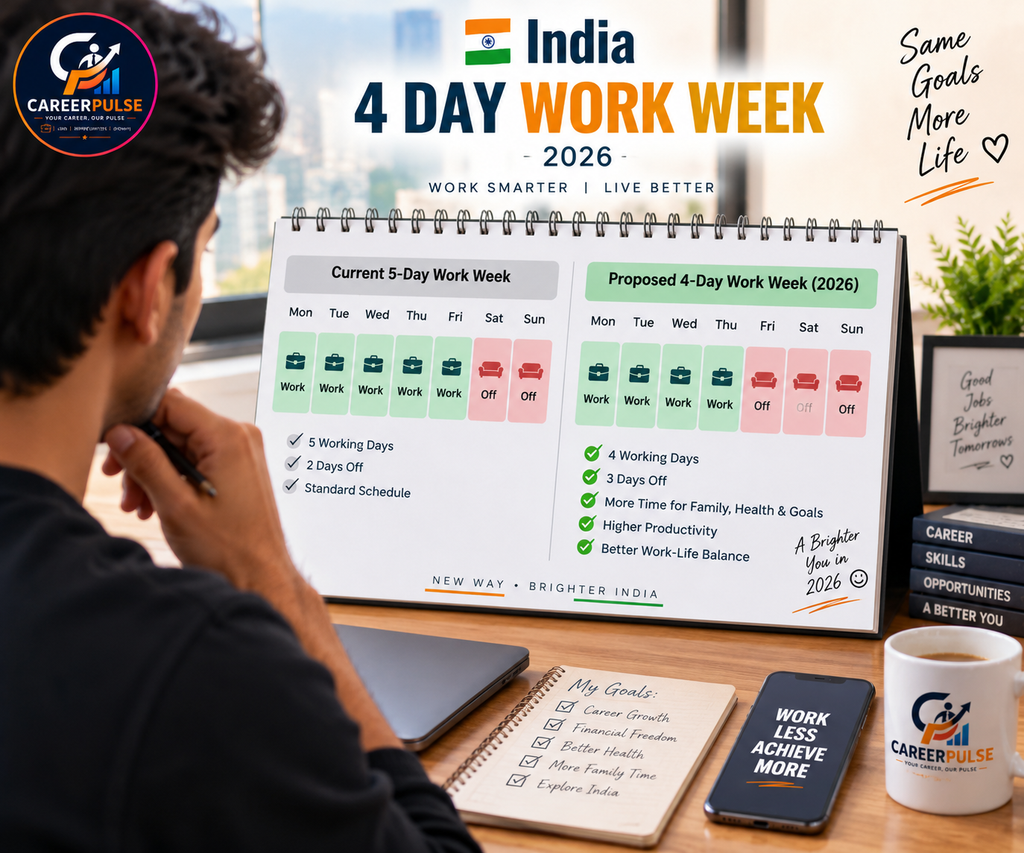
This is a fundamentally different proposition from the reduced-hours pilots that dominate global “4-day work week” coverage, and confusing the two can lead to a genuinely mismatched expectation if your employer ever raises this option. This guide explains exactly what India’s version actually permits, how it compares to the global model most people picture when they hear “4-day work week,” and what specific questions are worth asking before agreeing to any compressed schedule your employer proposes.
Table of Contents
What the Rule Actually Says
Under the OSH Code, employers may now offer employees a four-day work week with three days of rest, India 4 Day Work Week 2026 provided the total weekly working hours remain capped at 48 — the same overall limit that applied under the previous five- or six-day structure. Instead of working fewer total hours, employees choosing this arrangement work the same 48 hours compressed into four days, which works out to roughly 12 hours per working day rather than the more familiar 8 to 9.6 hours across five or six days.
Two conditions apply directly: the arrangement is not mandatory for any employer to offer, and it requires mutual agreement between employer and employee — meaning a company cannot simply impose a compressed schedule without your consent, and you’re not entitled to demand one either. It’s a permissive option, not a new legal right or obligation for either party.
How This Differs From the Global “4-Day Work Week” Model
This is the core distinction worth understanding clearly, since it’s exactly where the confusion originates. The UK’s widely publicized 4-day work week pilot — involving more than 70 companies and roughly 2,900 employees — tested a model where participants received 100% of their normal pay while working just 80% of their usual hours, effectively a genuine reduction in total work time with no corresponding pay cut. That pilot reported strong results: the large majority of participating companies maintained or improved productivity, and a substantial share of employees reported meaningful wellbeing improvements.
India’s OSH Code provision shares only the surface-level framing — “four days instead of five” — with this model. The substance is different: your total weekly hours and, by extension, your total weekly output expectation stay exactly the same. What changes is purely the distribution of those hours across fewer, longer days, with three days off instead of one or two. If you’ve read enthusiastic coverage of the UK-style model and are hoping India’s version offers something comparable, it’s worth recalibrating that expectation now rather than being disappointed if your employer eventually raises this option.
What a 12-Hour Compressed Day Actually Means Practically
Before deciding whether a compressed schedule like this would genuinely suit you, it’s worth thinking through the practical texture of a 12-hour working day, not just the appeal of three days off. A single 12-hour day leaves considerably less time and energy for anything else on a working day — commuting, family responsibilities, personal errands, or simply rest, compressed into a smaller window around a longer shift. The trade-off is a genuinely longer uninterrupted rest period across your three days off, which some people find meaningfully more valuable than the same total hours spread more thinly across five shorter days, while others find the daily fatigue of a 12-hour shift outweighs the benefit of the extra day off. This is a genuinely personal calculation, and there’s no universally correct answer — it depends heavily on your specific job’s physical and mental demands, your commute, and your personal life circumstances.
Overtime Protections Remain in Place
A detail worth knowing clearly: the new rules explicitly preserve overtime protections even under a compressed schedule. Any work performed beyond 8 hours in a day or 48 hours in a week must be paid at double the normal wage rate. This matters specifically because it prevents a scenario where an employer could push actual working hours beyond the compressed schedule’s already-longer days without additional compensation — the daily and weekly overtime thresholds still apply, and exceeding them still triggers the same premium pay obligation regardless of whether you’re on a standard or compressed schedule.
Which Industries Are Actually Expected to Adopt This
Legal and industry analysts covering this provision have been fairly consistent in their assessment of where a compressed schedule is genuinely practical versus where it faces real operational hurdles. IT, ITES, and other knowledge-based service sectors are generally seen as better positioned to adopt this model, since the nature of the work doesn’t inherently require continuous, staggered staffing coverage the way other sectors do. By contrast, sectors like healthcare, logistics, hospitality, and manufacturing are expected to face genuine operational challenges implementing a compressed four-day model, since these industries typically depend on consistent, round-the-clock or continuously staffed operations that a concentrated four-day schedule can complicate significantly.
If you work in one of these more operationally constrained sectors, it’s reasonable to expect this option may simply never become practically available to you, regardless of what the law technically permits, purely because of how your specific industry’s staffing and operational needs work.
Why State-Level Rollout Adds Another Layer of Uncertainty
Consistent with the broader pattern covered elsewhere on this site regarding India’s new labour codes, this provision faces the same structural rollout challenge: labour is a concurrent subject under India’s constitution, meaning individual states must separately notify their own implementing rules before the central code’s provisions become fully operative within that state. Legal experts have specifically noted that many states have not yet notified changes permitting longer daily shifts, which means the four-day work week option remains, in a genuinely practical sense, less immediately available in some parts of the country than the national headline coverage might suggest. Before assuming this option is available to you, it’s worth checking whether your specific state has actually notified the relevant implementing rules, rather than assuming the central code’s permissive language is immediately and universally operative everywhere.
What to Actually Ask If Your Employer Raises This Option
If your employer does propose a compressed four-day schedule, a few specific questions are worth asking before agreeing, since the general framework leaves considerable room for how any specific arrangement is actually structured:
- Confirm the exact daily hour structure. A genuine 48-hour week compressed into four days averages 12 hours daily, but ask whether your employer’s specific proposal follows this evenly, or structures it differently.
- Clarify how overtime is calculated and paid under your specific compressed schedule, given that the daily 8-hour and weekly 48-hour thresholds still apply and still trigger double-pay overtime obligations.
- Ask whether this is a trial or permanent change, and what the process would be to revert to a standard schedule if the compressed model doesn’t work well for you personally after trying it.
- Consider your own commute, health, and personal circumstances honestly before agreeing — a 12-hour working day is a genuinely different daily experience than an 8-hour one, regardless of the appeal of three days off.
- Confirm this is genuinely voluntary, not something you’re being pressured into agreeing to as an unofficial expectation despite the law’s stated requirement for mutual agreement.
Health and Wellbeing Considerations Worth Taking Seriously
Beyond the scheduling logistics, it’s worth acknowledging that sustained 12-hour working days carry genuine physical and mental fatigue considerations that a standard 8 to 9-hour day doesn’t involve to the same degree. Occupational health research on extended shift patterns generally points to increased fatigue-related risk over consecutive long shifts, particularly for roles involving sustained concentration, physical activity, or safety-critical decision-making. This doesn’t mean a compressed schedule is inherently unsafe or unsuitable for everyone, but it does mean the calculation shouldn’t rest purely on the appeal of three days off without genuinely weighing the sustained demand of four consecutive 12-hour days beforehand. If your role involves physically demanding work, extended screen time, or high-concentration tasks, it’s worth considering whether four consecutive long days creates a meaningfully different, and potentially more taxing, experience than the same total hours distributed more evenly across a standard week.
Negotiating a Trial Period Rather Than a Permanent Switch
If you’re genuinely interested in trying a compressed schedule but uncertain whether it will suit you long-term, it’s worth explicitly proposing a trial period rather than agreeing to an open-ended, permanent change from the outset. A defined trial — say, four to eight weeks — with an agreed check-in point to honestly evaluate how the schedule is working for both you and your employer, gives you a genuine opportunity to assess the real, lived experience of the compressed model before committing indefinitely. Given that the law explicitly frames this as requiring mutual agreement, proposing a structured trial rather than accepting or rejecting the idea outright is a reasonable, low-risk way to explore whether this option genuinely fits your circumstances, without either side needing to commit to a permanent change based purely on theoretical appeal.
How This Connects to the Broader 2026 Labour Code Changes
If you’ve been following the other labour code changes covered on this site — the 50% basic pay rule affecting how CTC translates into take-home salary, the faster 48-hour full and final settlement timeline, and the extended EPF withdrawal waiting periods — this four-day work week provision sits within the exact same broader restructuring, notified under the same overall labour code consolidation. None of these changes exist in isolation, and understanding them together gives a more complete picture of how significantly India’s employment framework has shifted in a relatively short window than looking at any single provision alone would suggest.
What This Means When Comparing Job Offers Going Forward
As this provision gains adoption, particularly in the IT and knowledge-services sectors more likely to offer it, it’s worth factoring schedule structure into how you evaluate and compare job offers, not just salary and CTC composition already covered elsewhere on this site. Two roles with identical compensation packages could genuinely differ in appeal based on whether one offers a standard five-day structure and the other offers a compressed four-day option — and this preference is entirely personal, with no universally correct answer. If schedule flexibility matters to you specifically, it’s reasonable to ask directly during an interview process whether a company offers or is considering this option, treating it as a genuine, relevant factor in your decision-making alongside salary, benefits, and role responsibilities, rather than assuming schedule structure is a fixed, non-negotiable given across every employer.
A Final Thought on Reading Labour Reform Headlines Generally
This case is worth remembering as a broader pattern beyond just the four-day work week specifically: a headline announcing a new workplace right or option often compresses genuinely important nuance into a phrase that sounds more dramatic or more generous than the underlying legal text actually delivers. The same discipline worth applying here — checking whether a provision is mandatory or permissive, whether it requires mutual agreement or can be unilaterally imposed, and whether its practical implementation has actually caught up with its legal notification — is worth applying to any future labour reform headline you encounter, not just this specific one. Reading past the headline into the actual conditions and caveats is consistently the difference between an accurate understanding of your genuine rights and options, and a mismatched expectation that only becomes clear once you’re actually navigating the specific situation yourself.
Should You Actually Want This Option?
Given everything covered here, it’s worth being honest that this isn’t a straightforwardly positive or negative development — it’s a genuinely neutral flexibility option whose value depends entirely on your personal circumstances and preferences. If you have a long commute, a compressed schedule that trades daily length for an extra full day off might genuinely improve your quality of life by reducing your total weekly commuting trips. If you have caregiving responsibilities that require your presence at consistent times each day, a longer workday might create real, practical difficulty regardless of the appeal of extra days off. There’s no universally correct answer here — the honest recommendation is to think through your own specific situation carefully rather than assuming either that this is an obviously appealing perk or an obviously unwelcome burden, since the reality depends heavily on factors specific to your own life and work.
Why This Provision Emerged Alongside the Other 2026 Reforms
It’s worth understanding briefly why a compressed-week option appeared as part of this same broader labour code overhaul rather than as a standalone policy. The government’s stated rationale across the 2026 labour code reforms generally centers on modernizing employment regulations and simplifying compliance while offering greater flexibility to both employers and workers — a philosophy that shows up consistently across the wage restructuring, the settlement timeline changes, and this scheduling provision alike. The four-day week option specifically reflects a broader global conversation about alternative work structures that has gained momentum since the rise of remote and hybrid work arrangements during and after the pandemic, with India’s version representing a distinctly Indian adaptation of that conversation — prioritizing employer and employee flexibility in how hours are distributed, rather than adopting the hours-reduction model that some other countries have experimented with more directly.
Quick Answers
Does India’s 4-day work week mean I’ll work fewer total hours?
No, this is the core misunderstanding worth correcting — your total weekly hours remain capped at 48, the same as before; only the distribution across days changes, typically to around 12 hours across four days instead of standard hours across five or six.
Is my employer required to offer a 4-day work week?
No, this is explicitly a permissive option, not a mandatory requirement — employers can choose whether to offer it, and it requires mutual agreement with employees, not a unilateral employer decision.
How is this different from the UK’s 4-day work week pilot?
The UK model tested reduced total hours (80% of normal hours) for full pay — a genuine reduction in work. India’s model redistributes the same total hours into fewer, longer days, without reducing total work time.
Do overtime protections still apply under a compressed schedule?
Yes, work beyond 8 hours in a day or 48 hours in a week still requires double-rate overtime pay, regardless of whether you’re on a standard or compressed schedule.
Which industries are most likely to actually offer this?
IT, ITES, and other knowledge-based service sectors are generally seen as better positioned to adopt this model; healthcare, logistics, hospitality, and manufacturing face more significant operational challenges implementing it.
Is this option available in every Indian state right now?
Not necessarily — since labour is a concurrent subject, individual states must notify their own implementing rules, and several states have not yet done so for the specific provisions permitting longer daily shifts.
Can I refuse a compressed schedule if my employer proposes one?
Yes, the provision explicitly requires mutual agreement between employer and employee — it cannot be unilaterally imposed without your consent.
If you’re navigating these broader labour code changes alongside a recent or upcoming job transition, our guide on Notice Period Buyout 2026 and our piece on CTC vs In-Hand Salary 2026 cover two other major pieces of this same 2026 employment restructuring worth understanding together rather than in isolation, since a genuinely complete picture of your employment rights and options in 2026 requires looking at all three of these interconnected changes rather than any single one on its own.
Suggested Internal Links
- Career Resources Category
- CTC vs In-Hand Salary 2026: What Actually Changed
- Notice Period Buyout 2026: Can Employers Refuse It?
- EPF Withdrawal Rules 2026: Easier AND Harder Now
Suggested External References
- Ministry of Labour and Employment, Government of India: https://labour.gov.in
- Occupational Safety, Health and Working Conditions Code, 2020 (Official Text): https://labour.gov.in/sites/default/files/OSH_Gazette.pdf
- National Career Service Portal (India): https://www.ncs.gov.in