Probation Period Rights India 2026 Since 21 November 2025, the Industrial Relations Code, 2020 has been in force, replacing the old Industrial Employment (Standing Orders) Act, 1946. Under its standing-orders provisions, the government notified the Model Standing Orders, 2026 on 8 May 2026, and they set probation at six months, extendable by up to three more months. If you read that and assumed it’s now the national rule for your own job, it’s worth slowing down, because for most private-sector white-collar employees, it isn’t.
Statute versus contract: the distinction that actually matters
The Model Standing Orders apply to establishments the Code covers,Probation Period Rights India 2026 in practice generally larger industrial establishments with a workforce above a set threshold. Where certified standing orders apply, they define probation and confirmation for the categories of workers covered.
For most private-sector office jobs in India, none of that applies directly. Courts have consistently held that where no statute governs the point, the terms in your own employment contract or appointment letter are what bind both sides, provided those terms don’t violate any statutory provision. So the honest starting point for figuring out your own probation rights is your own appointment letter, not a headline about a new central rule.
Market norms, separate from any legal requirement, tend to run three to six months, with six months standard for engineering roles and senior individual contributors, and three months common for junior or operations roles. Twelve months is unusual and, in a competitive hiring market, is the kind of term candidates increasingly push back on before signing.
What actually stays with you during probation, regardless of contract
A few protections don’t depend on your probation status or your specific contract wording:
- PF and ESI coverage applies from your date of joining, not from confirmation, where your employer and role are otherwise covered by those schemes.
- Gratuity’s service clock also starts from your joining date. Gratuity requires five years of continuous service, and probation doesn’t pause that count.
- The POSH Act (Protection of Women from Sexual Harassment at Workplace) applies to every woman employee from day one, including probationers, contractual workers, and interns.
What genuinely does vary by contract is things like earned leave encashment and annual performance bonuses. Many appointment letters structure these so that leave accrues during probation but can only be used, or paid out, after confirmation. That’s generally enforceable if your contract says so plainly, so check the actual wording rather than assuming either way.
“Deemed confirmation”: a real protection worth knowing about
Here’s something that doesn’t show up in every explainer, and it’s worth knowing precisely: in some Indian court judgments, continued employment beyond the stated probation period, with no formal extension issued, has been interpreted as deemed confirmation. In other words, if your probation was meant to end and your employer simply let it run past that date without doing anything on paper, you may already be a confirmed employee in the eyes of a court, whatever your employer says informally.
This is described consistently across the sources I checked as a real legal principle, not a guarantee, and how it plays out depends on the specific facts and the actual wording of your contract. If your probation end date has passed with no confirmation letter and no extension letter, the practical step is to follow up in writing and keep a copy, rather than simply waiting.
Extensions have to be done properly, and there’s a real timing rule
If your employer wants more time to assess you, that’s normal and expected. What makes an extension legally sound is specific:
- It should be communicated in writing.
- It should be issued before the original probation period ends, not after.
- It should state a new, defined end date and, ideally, the specific goals you’re being given more time to meet.
One source I checked calls this the mechanical detail that most often catches employers out: issuing the extension after the original period has already lapsed. If that happens to you, it’s worth knowing that a late or verbal-only extension sits on genuinely weaker ground than one done properly, which connects directly to the deemed-confirmation point above.
There’s also a cap worth knowing under the Model Standing Orders specifically, for establishments they cover: the extra period is capped at three months. Probation, even where extensions are allowed, isn’t meant to run indefinitely.
Termination during probation: more flexible, not unlimited
Employers generally have more room to end a probationary employee’s job than a confirmed one’s, often with a shorter notice period than a confirmed employee would get, as set out in the contract. Detailed justification isn’t typically required. But that flexibility has real limits: termination can’t be arbitrary in a way that violates natural justice, and it can’t be discriminatory. Ending someone’s probation because of gender, caste, religion, pregnancy, or union activity is illegal and actionable under labour law and the Constitution, regardless of how much informal flexibility probation otherwise gives an employer.
Practically, a probationary termination should still come with written notice as per your contract, a prompt full and final settlement (salary, any leave encashment you’re owed, statutory dues), and a relieving letter and Form 16 where applicable. If notice wasn’t properly given, that can translate into a right to payment in lieu of notice.
The three outcomes, and what each one actually means for you
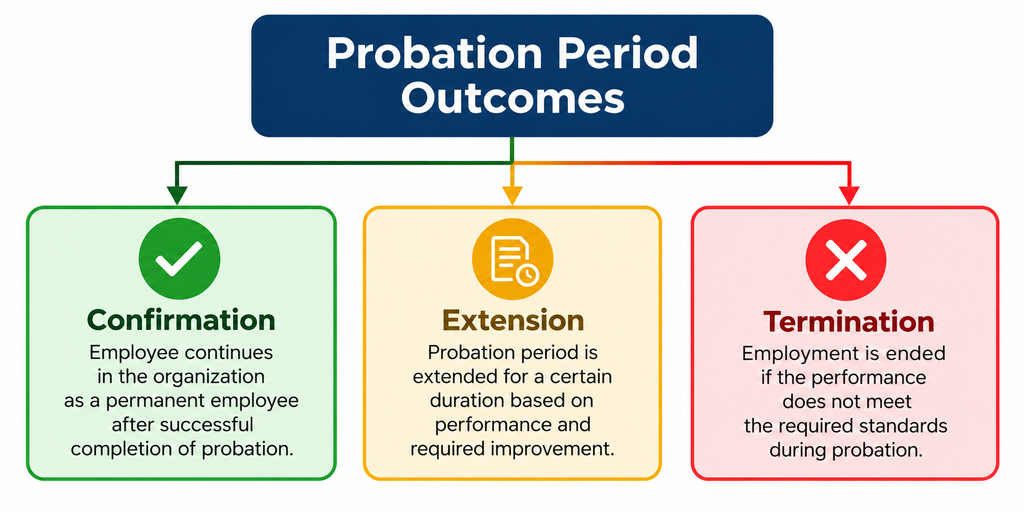
At the end of probation, there are really only three paths:
Confirmation. You get a formal confirmation letter stating you’ve been assessed as satisfactory. From that point you’re typically eligible for the full range of benefits, including anything that was deferred during probation, like leave encashment or bonuses.
Extension. Done properly, as above: in writing, before the original end date, with a defined new end date and, ideally, clear goals.
Termination. The employment relationship ends, generally through a formal letter, following whatever notice terms your contract sets.
If your probation period ends and none of these three things happens, that silence is itself worth acting on. Follow up in writing, and keep a record that you did.
What this means practically
Read your own appointment letter for the actual probation length, the confirmation process, and the notice period during probation, since this is what genuinely governs your situation in the large majority of private-sector jobs, whatever a general headline about new central rules might suggest. Separately, know that PF, ESI, gratuity’s service clock, and POSH protection don’t wait for confirmation. And if you’re ever in the position of an extension arriving late, verbally, or not at all past your stated end date, that’s worth raising in writing rather than assuming it will sort itself out.
Suggested Internal Links
- Immediate Joiners Only: The Hypocrisy Nobody Names
- Night Shift Allowance: Legally Required, Legally Undefined
- Salary Slip Components India 2026 Decoded
Suggested External References
- Ministry of Labour and Employment: https://labour.gov.in
- Industrial Relations Code, 2020: https://labour.gov.in