Background Verification India 2026 You’ve accepted the offer, negotiated your CTC, and set a joining date — and then HR sends the email asking you to complete your background verification. For most candidates, that email triggers a specific kind of low-grade anxiety, even among people who haven’t lied about anything: a nagging worry about a one-month employment gap, whether an old manager will pick up the reference call, or whether a freelance gig you didn’t mention on your resume is somehow going to surface. Most of this anxiety is disproportionate to the actual risk for someone who’s been broadly honest — but understanding exactly what’s being checked, how long it takes, and what a genuine discrepancy versus an honest inconsistency looks like from the employer’s side removes most of the uncertainty driving that anxiety in the first place, which is the actual goal of this guide.
This is also, genuinely, not a small-scale or occasional process. Industry data from AuthBridge’s Workforce Fraud Files for the first half of FY26 found material discrepancy rates of 12.4% to 13% in high-growth sectors like IT and BFSI specifically — meaning roughly one in every eight candidates in these sectors is misrepresenting something material about their credentials, a figure substantial enough that most large employers now treat thorough verification as a baseline operational necessity rather than an optional formality. Other analyses covering the broader Indian job market put resume mismatch rates anywhere between one in six and one in three, depending heavily on sector and how strictly “mismatch” is defined. These numbers vary because different studies measure different things — some count any inconsistency, others only material fraud — but the consistent underlying signal across all of them is the same: background verification exists because interviews alone genuinely can’t confirm what candidates claim, and employers have real, current data showing a meaningful share of resumes don’t fully hold up.
Table of Contents
What a Standard Background Check Actually Covers
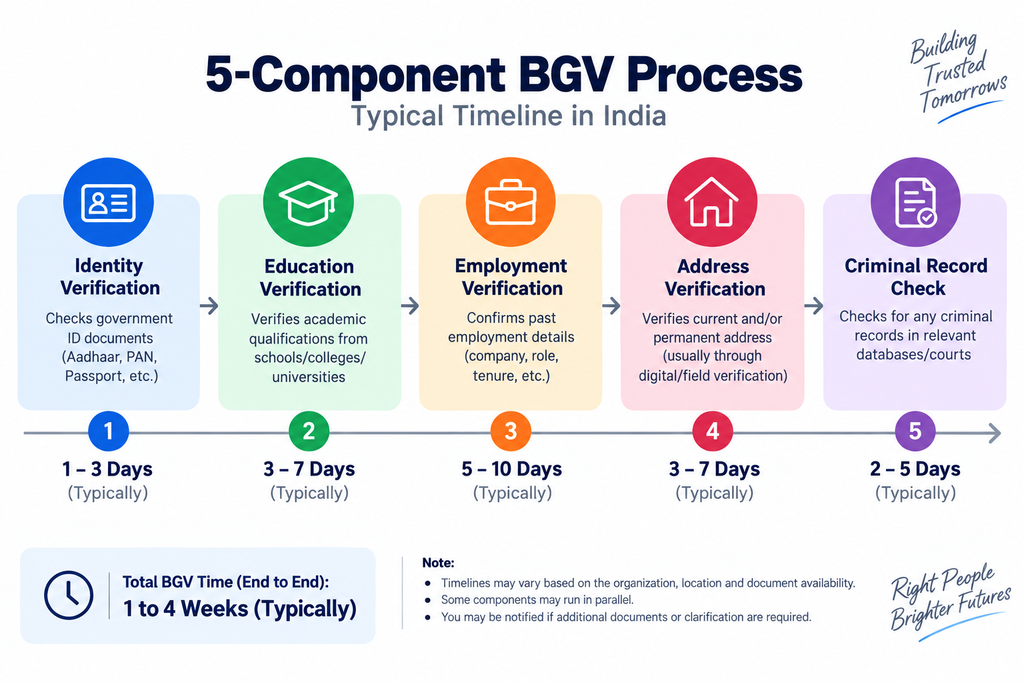
A standard Indian BGV typically covers five core components:Background Verification India 2026 identity verification, education verification, employment history verification, criminal record checks, and address verification. Each component draws on a different kind of record — identity checks against government databases and Aadhaar-linked systems, education checks against university and board records (sometimes through the National Academic Depository or UGC databases), employment checks through direct contact with your previous employers’ HR teams, criminal checks against court and police records in your stated addresses, and address verification against your provided residential history.
How Long This Actually Takes, and Why
A full five-component BGV typically takes 7 to 15 business days end to end, though the components move at very different speeds. Digital identity verification, using Aadhaar e-KYC and DigiLocker integration, is the fastest — often completed within 1 to 3 days, since it draws directly on government digital infrastructure rather than requiring manual outreach. Education verification is consistently the slowest component, frequently taking the full 7 to 15 day window, particularly for older or smaller institutions that still process verification requests manually rather than through a digital records system. If your background check is taking longer than expected, education verification delays — not fraud suspicion — are the most statistically likely explanation.
The Detail Most Candidate Guides Don’t Mention: Moonlighting Detection
This is genuinely new territory worth understanding, and it traces directly back to the moonlighting controversies that erupted at Wipro and Infosys in 2022-2023, when it became public that some employees were secretly holding a second full-time job simultaneously, a revelation that prompted a meaningful, lasting shift in how thoroughly Indian employers now scrutinize concurrent employment patterns during hiring. In direct response, BGV agencies have built specific checks for exactly this pattern: cross-referencing multiple UAN (Universal Account Number) entries active during the same time period, which can reveal that you were formally employed — with PF contributions being made — at two different companies simultaneously. Separately, if you did consulting or freelance work on the side while employed full-time elsewhere, and that client deducted TDS under Section 194J, this shows up in your Form 26AS, a record your new employer’s verification process can access.
The practical distinction worth understanding clearly: as of 2026, many product companies have become genuinely comfortable with disclosed past freelancing — work you openly mentioned during your interview or application process. What consistently triggers serious concern, particularly at TCS, Infosys, Wipro, and Accenture specifically, is undisclosed parallel full-time employment — holding two formal jobs simultaneously without either employer’s knowledge. If you’ve done any side work historically, the honest, low-risk approach is disclosing it proactively during your hiring process rather than hoping it doesn’t surface during verification, since the underlying records — UAN history and Form 26AS — are genuinely visible to a thorough verification process regardless of whether you mention it yourself.
What Counts as a Serious Discrepancy Versus an Honest Inconsistency
Not every mismatch between what you stated and what verification confirms results in a revoked offer, and it’s worth understanding the actual decision logic employers typically apply:
- A minor date discrepancy — you recall leaving a role in March, your former employer’s records say April — is generally treated as a normal clarification point, not a red flag, and is resolved through a simple conversation rather than an automatic rejection.
- A significant, unexplained employment duration mismatch — you claimed three years at a company, verification confirms eighteen months — is presented to you directly for explanation; if it remains unexplained or the explanation doesn’t hold up, this can trigger an offer withdrawal under the conditions-precedent clause most Indian offer letters include.
- A degree from an institution that shows no record isn’t automatically treated as fraud either — older institutions, closed colleges, and pre-digital record-keeping genuinely produce missing records for entirely legitimate degree holders. This is typically raised as a discussion point, not an immediate disqualification, particularly if you can provide alternate evidence.
- A termination-for-cause discovered where you stated voluntary resignation is treated far more seriously, particularly where the stated cause involves fraud, theft, or harassment — this is the kind of discrepancy most likely to result in an offer being withdrawn outright, since it reflects a material misrepresentation about your own conduct, not just an administrative record mismatch.
The Genuinely Sobering Warning Worth Internalizing
This is worth stating plainly, since it has real, practical consequences for how you should sequence a job change: candidates have had confirmed offers revoked as late as 45 days after officially joining a new company — in some documented cases, after they’d already formally resigned from their previous role, once a delayed background check finally surfaced a serious discrepancy. This is a genuinely uncomfortable risk worth planning around specifically if you know your own employment history contains something that might raise questions — don’t assume that receiving an offer letter, or even physically starting your new role, means your background verification has been fully completed and cleared. If your own history includes something genuinely complicated to explain, proactively addressing it early and honestly, rather than hoping verification doesn’t catch it, is the lower-risk path by a meaningful margin.
How to Actually Speed Up Your Own Verification
Since much of the delay in a standard BGV comes from waiting on documentation and manual employer responses, there are genuine, legitimate steps you can take to move your own process along faster:
- Submit complete documentation immediately upon request, rather than trickling documents in over several days. This typically includes offer letters, relieving letters, your last three months of payslips, Form 16 for the last two years, all academic marksheets, and your Aadhaar, PAN, and passport.
- If a previous employer’s HR team is notoriously slow to respond (a genuinely common bottleneck, since a former employer confirming a simple date can take a former employer’s HR team two weeks on its own), provide alternate supporting proof proactively — bank statements showing salary credits, your PF passbook, or your own ITR filings can substantiate your employment claims even while you’re waiting on your former employer’s formal confirmation.
- Respond promptly to any verification agency outreach, since candidate non-responsiveness (failing to supply documents or reference contacts on time) is itself one of the most common causes of extended delays, entirely within your own control to avoid.
Your Data Rights During This Process
Given how much sensitive personal data a BGV process handles — salary slips, Aadhaar numbers, employment history — it’s worth knowing this now sits under real regulatory oversight. Under the Digital Personal Data Protection (DPDP) Act, companies handling this kind of sensitive candidate data face penalties of up to ₹250 crore for failing to implement reasonable security safeguards, a detail covered in more depth in this site’s dedicated guide to the DPDP Act from a job seeker’s perspective. Additionally, verification records are increasingly expected to follow defined retention limits — generally deleted once the stated verification purpose no longer applies, rather than being retained indefinitely on a shared company drive. If you’re ever uncertain how a specific verification agency or employer is handling your submitted documents, you’re entitled to ask directly what their retention and data-handling practices actually are.
Why This Matters More the Higher the Trust Requirement of Your Role
It’s worth knowing that BGV rigor scales meaningfully with the nature of the role you’re being hired for. Roles involving financial trust, regulatory compliance, or handling sensitive client data — common across BFSI, healthcare, and IT services companies serving clients with SOC 2, ISO 27001, or GDPR obligations — typically undergo more thorough, more strictly enforced verification than a general entry-level role with less inherent trust exposure. This isn’t arbitrary; it reflects genuine downstream risk to the employer and, often, to that employer’s own clients if a verification gap later proves consequential. If you’re targeting a role in one of these higher-trust categories specifically, treat your own documentation and disclosure practices with correspondingly greater care.
The “Not Eligible for Rehire” Flag Worth Understanding
A specific and less commonly discussed detail worth knowing: when you leave a job, particularly under difficult circumstances, your former employer sometimes marks your internal record as “not eligible for rehire” — a flag that can surface during verification at a completely different company, since some BGV checks include a general standing inquiry with a former employer beyond just confirming your dates and title. This flag doesn’t automatically block a new offer, but it can prompt additional questions from your prospective employer about the circumstances of your departure. If you left a previous role under genuinely contentious circumstances, it’s worth being prepared to discuss this honestly and directly if it comes up, rather than being caught off guard by a question referencing something you assumed was a closed chapter.
Why Skipping Verification Entirely Is a Real Risk You Bear Too
It’s worth noting this isn’t purely a company-side concern — the broader cost of workplace fraud in India has been estimated at over ₹21,000 crore across recent years, and background verification functions as the primary defense against a meaningful share of that. Companies that skip or under-invest in BGV, often smaller startups or SMEs managing per-candidate costs carefully, expose themselves to real fraud risk — but this cuts both ways for you as a candidate too. Working at a company with genuinely lax verification standards means your own colleagues may not have been vetted with the same rigor you went through, which is worth factoring into your broader assessment of a specific employer’s organizational maturity and risk management practices, particularly for roles involving significant trust or access to sensitive systems.
Who Actually Conducts Your Verification
It’s worth knowing that in most cases, the company hiring you doesn’t perform this verification itself — it’s outsourced to specialized BGV agencies. In the Indian IT and corporate sector specifically, the most commonly used providers include First Advantage, AuthBridge, HireRight, and Verifacts, among others. This matters practically because your point of contact during the verification process is often this third-party agency rather than your actual future employer’s HR team directly, and questions about document requirements, verification status, or timeline delays are frequently better directed to the agency handling your specific file rather than your new employer’s HR contact, who may have limited direct visibility into the granular status of an outsourced verification process.
How Reference Checks Actually Work in Practice
Beyond the document-based components covered above, many verification processes also include a direct reference check — a phone call to a former manager or HR contact you’ve listed, confirming your role, tenure, and general conduct. It’s worth preparing for this component specifically by giving your listed references genuine advance notice that they may be contacted, both as a courtesy and as a practical step to improve the odds they actually respond promptly when the verification agency reaches out, rather than letting an unexpected call go unanswered or unreturned. If a specific former manager or HR contact has historically been slow to respond to this kind of request, or if your relationship with a former employer ended on genuinely difficult terms, it’s worth having a backup reference in mind and, where the process allows it, proactively suggesting that alternate contact rather than leaving your only reference option someone unlikely to respond in a timely way.
What Happens If You’re Currently Between Jobs With a Genuine Gap
If you’re actively job hunting with a real employment gap in your recent history — something covered in more detail in this site’s separate guide to explaining resume gaps — it’s worth knowing that a gap itself is not treated as a red flag during background verification, since BGV confirms the accuracy of what you’ve stated, not whether a gap existed at all. The risk specifically arises when the stated reason for a gap, or the stated dates surrounding it, don’t match what verification actually confirms. An honestly and consistently described gap, even a lengthy one, generally verifies cleanly; a gap you’ve tried to disguise by adjusting dates or inventing an explanation is precisely the kind of thing this process is specifically designed to catch.
Quick Answers
How common is resume misrepresentation in India actually?
Industry data varies by methodology and sector — AuthBridge’s H1 FY26 data found 12.4-13% material discrepancy rates in IT and BFSI specifically, while broader estimates across sectors range from roughly one in six to one in three, depending on how “mismatch” is defined.
How long does a background check typically take?
A standard five-component check takes 7 to 15 business days, with digital identity verification completing fastest (1-3 days) and education verification typically the slowest (up to the full 7-15 day window).
Does a minor date discrepancy automatically get my offer revoked?
No, minor discrepancies are typically treated as clarification points and discussed directly with you, not as automatic grounds for rejection.
What specifically changed in BGV after the 2022-2023 moonlighting controversies?
Verification agencies now specifically check for multiple active UAN entries in the same period and Form 26AS records, which can reveal undisclosed parallel full-time employment.
Is disclosed freelance work a problem during background verification?
Generally no — many companies, especially product companies, are comfortable with disclosed past freelancing; the concern is specifically undisclosed, simultaneous full-time employment at two companies.
Can my offer really be revoked after I’ve already joined and resigned from my old job?
Yes, this has genuinely happened in documented cases, sometimes as late as 45 days into the new role — treat any complicated employment history as something to disclose and address proactively rather than hope it goes unnoticed.
What documents should I have ready to speed up my own verification?
Offer letters, relieving letters, your last three months of payslips, Form 16 for the last two years, academic marksheets, and your Aadhaar, PAN, and passport.
If you’re navigating a job transition where background verification is part of the process, our guide on DPDP Act 2026 covers your broader data rights as a candidate submitting sensitive documents like these, and our piece on Notice Period Buyout 2026 is worth reading before you resign from a current role, given the genuine risk of a delayed verification outcome covered above — the safest sequencing, wherever your specific situation allows it, is confirming your verification has genuinely cleared before formally severing ties with your previous employer, rather than assuming a joining date alone means the process is behind you.
Suggested Internal Links
- Career Resources Category
- DPDP Act 2026: What It Means When You Apply for Jobs
- Notice Period Buyout 2026: Can Employers Refuse It?
- CTC vs In-Hand Salary 2026: What Actually Changed
Suggested External References
- Ministry of Electronics and Information Technology (DPDP framework): https://www.meity.gov.in
- Employees’ Provident Fund Organisation (UAN services): https://www.epfindia.gov.in
- National Career Service Portal (India): https://www.ncs.gov.in