Job Offer Scam Verification 2026 most guides to spotting a fake job offer give you a checklist of warning signs — don’t pay fees, verify the email domain, check the office address. That’s useful, but it puts you in a purely reactive position, scanning every offer for something wrong. A more reliable approach is knowing what a genuine, legitimate hiring process actually looks like at a real company, step by step, so you can immediately recognize when something deviates from that pattern — rather than trying to remember a growing list of red flags under the pressure of an exciting-sounding offer.
This matters urgently right now for a specific reason: AICTE (the All India Council for Technical Education) issued updated internship scam guidance with a stated last-update date of 15 September 2026 — essentially current as of this writing — specifically because fraudulent internship listings have become sophisticated enough to warrant a fresh, direct warning from the regulatory body overseeing India’s technical education internship pipeline. Off-campus hiring now accounts for roughly 40% of entry-level hiring in India, which means the volume of genuine opportunities you’re navigating — and the volume of fraudulent listings hiding among them — has both grown substantially. This guide covers what a legitimate offer process actually looks like, the specific verification techniques that work, and exactly what to do if you’ve already been targeted.
Table of Contents
What a Genuine Major-Company Hiring Process Actually Looks Like
Rather than starting with red flags,Job Offer Scam Verification 2026 it’s more useful to understand the legitimate sequence first, since deviations from this pattern are what you’re actually watching for. A genuine hiring process at an established company — the kind covered throughout this site’s walk-in and recruitment coverage — typically follows this structure:
- Interview rounds, usually one to three depending on the role, conducted virtually through a mainstream platform like Microsoft Teams, sent from a corporate email address with a real, verifiable meeting link — or in person, sometimes at a campus for final rounds.
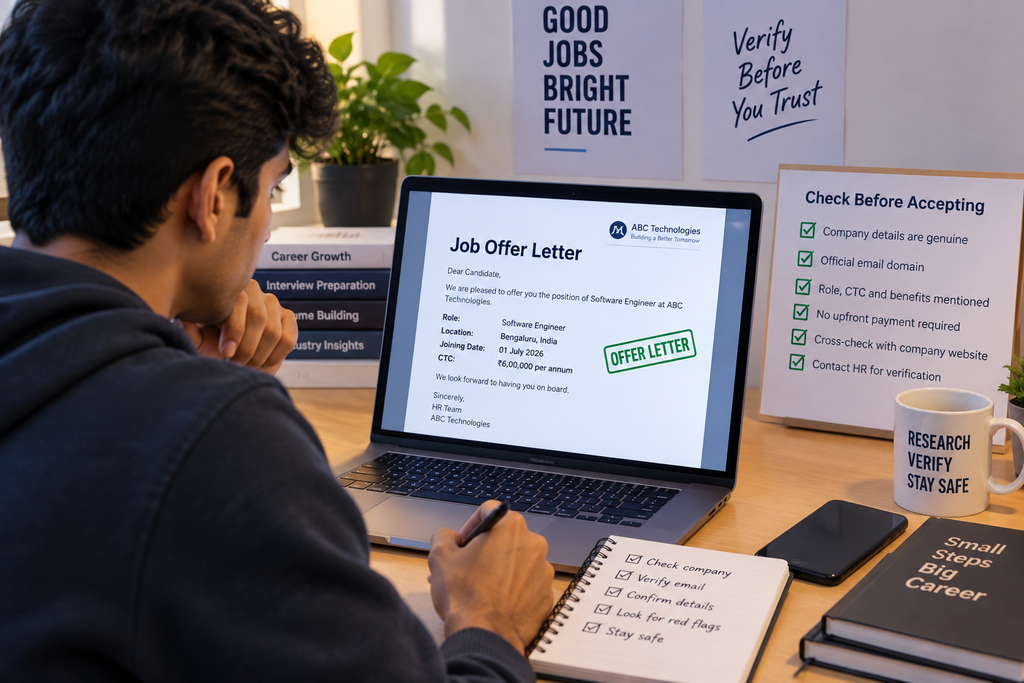
- An offer letter issued from an HR email address on the company’s actual corporate domain, on official letterhead, typically digitally signed, and including a full, itemized CTC breakdown rather than just a single headline number.
- Background verification, handled by an empanelled third-party BGV partner — commonly First Advantage, AuthBridge, or IDfy — who contacts you directly from their own corporate domain. Critically: you never pay this BGV partner anything. The cost is borne entirely by the hiring employer.
- A joining kit and systems setup, once verification clears, with no financial transaction required from you at any point in this entire sequence.
The single clearest signal worth internalizing from this whole structure: at no point in a genuine hiring process does money move from you to anyone else. If a request for payment appears anywhere in this sequence — for training material, a security deposit, equipment, processing fees, or anything else — the entire interaction is fraudulent, regardless of how legitimate everything before that point appeared.
The Breaking AICTE Update Worth Knowing Directly
Since this guidance was updated within the last few days of this writing, it’s worth covering its specific, actionable content directly. AICTE’s National Internship Portal (aicte-india.org) is stated as the only official channel for internship applications under its purview — any Google Form, WhatsApp message, or external payment link claiming to be part of this process is explicitly flagged as fraudulent. The guidance is direct on a critical point: registration and even selection never guarantee a stipend or job offer — a clarification specifically included to undercut a common fraud tactic where scammers claim a guaranteed outcome to pressure a fee payment. Organizations posting genuine opportunities through this portal are explicitly forbidden from collecting any money from students at any stage — application, selection, or placement.
The guidance also specifies a concrete action sequence if you’ve already paid money to a fraudulent internship scheme: act within 24 hours, call the National Cyber Helpline at 1930 to request a hold on the transaction, then file a formal complaint on the National Cybercrime Reporting Portal (cybercrime.gov.in) with screenshots, emails, and payment proof attached. AICTE can also be alerted directly through its portal helpline for internship-specific fraud.
Specific Verification Techniques That Actually Work
Beyond understanding the legitimate process template, a few concrete verification steps let you check any specific offer directly, rather than relying on gut feeling:
- Check the sender’s email domain, not just the display name. A genuine offer from TCS comes from an address ending in the company’s actual domain (something like @tcs.com) — not a generic email provider address like tcs.hr.india@gmail.com, regardless of how official the display name looks.
- Search the recruiter’s name on LinkedIn independently, rather than trusting a link provided in the email itself, and confirm their profile genuinely shows them as a current employee at the company in question.
- Look for an internal job requisition or reference code in the offer or interview communication, which most genuine corporate offers from major companies include — you can typically cross-check this against the original job posting on the company’s own careers portal.
- Never call a phone number that appears only inside the offer letter or a message from the recruiter. If a number is genuinely from the company, it should also be findable independently on the company’s own official website — call that independently-sourced number instead, since a scammer fully controls any number they’ve provided you directly.
- Search the registered office address on Google Maps. Fraudulent offers frequently list an address that either doesn’t exist or doesn’t correspond to an actual corporate office for that company.
- Be skeptical of a CTC dramatically above typical fresher packages for that specific role and company. Scammers frequently over-offer deliberately, since an unusually generous number is a proven way to make a candidate override their own caution.
The Specific Pattern Behind Overseas Job Scams
A distinct, serious variant worth knowing about separately from domestic fake-job schemes: advertisements for high-paying positions in destinations like Dubai, Malaysia, Thailand, or Singapore, circulated through social media or messaging platforms, offering extraordinary pay for minimal stated requirements. The fraud pattern here specifically involves requesting upfront payment for visa processing, flight tickets, documentation, or “agent fees” before any job or travel materializes — after payment, the agent and the company frequently turn out not to exist at all. This pattern specifically targets the appeal of overseas opportunity and unfamiliarity with international hiring processes to justify upfront costs that would be immediately suspicious in a domestic context. The same core rule applies here as everywhere else: a genuine employer does not require you to personally fund your own recruitment costs before you’ve even started working.
The WhatsApp and Social Media Pattern Specifically
It’s worth naming this channel directly, since it’s consistently where fraudulent listings concentrate: fake job and internship drives circulate heavily through WhatsApp forwards and social media posts, precisely because these channels lack the editorial or platform-level verification that even a basic job portal applies before publishing a listing. A drive or opportunity that reaches you exclusively through a forwarded WhatsApp message, with no corresponding listing on the company’s own careers page or a reputable job portal, warrants independent verification before you engage with it at all — regardless of how official the forwarded message looks or how many times it’s apparently been shared.
What a Genuine Offer Letter Actually Looks Like on the Page
Beyond the digital verification steps above, the physical or document-level details of a genuine offer letter carry real, checkable signals of their own. Legitimate offer letters use consistent fonts throughout the document, a correctly proportioned and high-resolution company logo rather than one that looks stretched or pixelated, the company’s accurate full legal name rather than an informal or slightly altered version, and a real, registered office address you can independently verify. A document that looks assembled from mismatched fonts, a low-quality logo image, or an address that doesn’t correspond to anything findable online is worth treating as a serious warning sign in itself, independent of anything else about the offer.
Why Scammers Specifically Target Freshers and Students
It’s worth understanding directly why this particular population — freshers, students, and recent graduates — is disproportionately targeted by job scams, since understanding the underlying psychology makes the manipulation easier to recognize in the moment. Freshers are navigating their first real job search, often without the benchmark experience of previous, genuine hiring processes to compare a suspicious offer against. Financial pressure, genuine eagerness for a first opportunity, and family or social expectation around securing employment quickly all combine to create real psychological pressure that a well-crafted scam is specifically designed to exploit — an unusually generous salary offer or minimal stated requirements aren’t accidental features of these schemes, they’re deliberately calibrated to override the caution a more experienced job seeker might apply more readily. Recognizing that this pressure is a known, deliberately exploited pattern — not a personal failing if you’ve felt it — is itself a useful piece of protection, since it reframes hesitation and verification as sensible caution rather than something to feel embarrassed about doing, and normalizing that instinct is precisely what helps a genuinely eager first-time job seeker pause long enough to check before acting.
Why Genuine Off-Campus Drives Also Move Fast — And How to Tell the Difference
This is worth addressing directly, since it can genuinely blur the line between a legitimate opportunity and manufactured urgency: real off-campus hiring drives frequently do run on tight timelines, sometimes opening and closing within 48 to 72 hours, which is a normal, legitimate feature of how high-volume fresher hiring operates in 2026, not inherently a scam indicator on its own. The distinction that actually matters isn’t the speed — it’s whether the urgency is being used to pressure you into skipping verification or making a payment. A legitimate fast-moving drive asks you to apply and complete an assessment quickly; a fraudulent one asks you to pay quickly, often specifically invoking the tight timeline as a reason you don’t have time to verify anything first. Speed alone isn’t the red flag — speed paired with a payment request is.
What Never Belongs in a Legitimate Early-Stage Hiring Process
A few specific requests should be treated as an immediate stop signal regardless of what stage of the process you’re in: any request for an OTP code or banking password, any request for full identity documents before any real verification of the opportunity itself has occurred, any request for remote access to your device, and any payment request framed as job confirmation, training material, registration, or a security deposit. Legitimate employers do not need your banking OTP for any reason connected to hiring — this specific request pattern exists purely to enable direct account access or fraudulent transactions, dressed up as a hiring formality.
Before You Resign From Your Current Role
If you’re currently employed and receiving what looks like a genuine offer elsewhere, it’s worth connecting this guidance directly to the broader employment-transition risks covered elsewhere on this site: do not resign from your current position until an offer has been fully and independently verified through the techniques above, and ideally not until background verification has genuinely cleared, given the documented cases of offers being revoked well after a candidate has already started — or even resigned from — their previous role. This same caution applies with even more force if there’s any uncertainty about whether the offer itself is genuine in the first place; resigning based on an unverified offer compounds the financial risk of a scam with the additional cost of voluntarily leaving stable employment.
What to Do If You Realize You’ve Already Been Targeted
If you recognize any of these patterns in something you’ve already engaged with, a few immediate steps genuinely help contain the damage:
- Stop all further communication with the suspected scammer immediately, including any further document or payment requests.
- If any payment has already been made, act within 24 hours — call the National Cyber Helpline at 1930 and request a hold on the transaction before the funds move further.
- File a formal complaint on the National Cybercrime Reporting Portal (cybercrime.gov.in), attaching screenshots, emails, and any payment proof you have.
- If you shared sensitive documents or banking details, inform your bank or the relevant financial institution directly, in addition to the cybercrime report.
- Report the fraudulent listing to whichever platform you found it on — a job portal, social media platform, or messaging app — so it can be flagged and removed for other job seekers.
Why Verification Habits Matter Even When an Offer Turns Out Genuine
It’s worth framing this final point clearly: applying these verification steps to every offer you receive, including ones that turn out to be entirely legitimate, isn’t wasted effort or excessive suspicion — it’s a genuinely reasonable, low-cost habit given how much financial and personal risk a single successful scam can create. A legitimate employer never penalizes a candidate for asking reasonable verification questions or taking a short amount of time to independently confirm details before proceeding — if anything, a company’s response to a candidate’s genuine, polite verification questions is itself a useful signal about that company’s own legitimacy and professionalism.
How This Connects to the Broader Trust Ecosystem Around Hiring
It’s worth situating this guidance within the broader shift toward more formalized, regulated hiring practices covered elsewhere on this site. The same DPDP Act provisions requiring companies to handle candidate data responsibly, the background verification standards that genuine employers follow, and now AICTE’s direct internship-specific scam guidance all reflect a common underlying trend: as India’s hiring volume grows and more of it moves through digital, off-campus, and app-based channels, both the regulatory framework and the genuine hiring process itself are becoming more structured and verifiable — which, in turn, means genuine opportunities increasingly leave a clearer, checkable trail. A fraudulent offer, by contrast, almost always fails at least one of these verification points precisely because building a fake version of this entire regulated infrastructure is far harder than simply asking a candidate to pay a fee and disappearing.
Quick Answers
What’s the single clearest sign a job offer is fraudulent?
Any request for payment at any stage of the hiring process — for training, registration, equipment, or a security deposit — since a genuine employer never requires you to fund your own recruitment.
Is AICTE’s National Internship Portal really the only official channel?
Yes, according to AICTE’s own current guidance, aicte-india.org is the sole official application channel for internships under its purview, with any Google Form or external payment link explicitly flagged as fraudulent.
How can I check if a recruiter’s email is genuine?
Verify the domain matches the company’s actual website (not a generic email provider), and independently search the recruiter’s name on LinkedIn to confirm they’re a genuine current employee.
Should I trust a phone number given to me directly in an offer letter?
No, never call a number that appears only inside the offer letter itself — find and call an independently-sourced number from the company’s own official website instead.
What should I do if I’ve already paid money to a fraudulent job scheme?
Act within 24 hours by calling the National Cyber Helpline at 1930 to request a transaction hold, then file a complaint at cybercrime.gov.in with supporting evidence.
Is a fast-moving, urgent-sounding job drive automatically a scam?
No, legitimate off-campus drives often do move quickly and close within 48-72 hours — the actual red flag is urgency specifically paired with a payment request, not speed on its own.
Do genuine companies ever ask for an OTP or banking password during hiring?
No, this is never a legitimate part of any hiring process at any stage, regardless of how it’s framed.
If you’re actively navigating off-campus applications, our guide on Background Verification India 2026 covers what happens after you accept a genuine offer, and our piece on Notice Period Buyout 2026 is worth reading before resigning from any current role based on an offer you haven’t yet fully verified — treating these three guides together gives you a genuinely complete picture of how to navigate a job transition safely, from spotting a fraudulent offer before you engage with it, through to confirming a genuine one has fully cleared before you leave your current role.
Suggested Internal Links
- Internships Category
- Background Verification India 2026: What Actually Gets Checked
- Notice Period Buyout 2026: Can Employers Refuse It?
- DPDP Act 2026: What It Means When You Apply for Jobs
Suggested External References
- AICTE National Internship Portal: https://internship.aicte-india.org
- National Cybercrime Reporting Portal: https://cybercrime.gov.in
- National Career Service Portal (India): https://www.ncs.gov.in