HR Interview Questions and Answers 2026 is exactly what you need to bookmark before your next job interview, because the HR round is rarely the formality candidates assume it to be. It’s the stage where a recruiter decides whether your communication, self-awareness, and cultural fit match what the company is actually looking for — often before a single technical or role-specific question ever comes up.

Most candidates walk into this round either over-rehearsed with generic answers that sound robotic, or completely unprepared and relying on improvisation. Neither approach works particularly well. What actually works is understanding why each question is being asked, and having a flexible framework you can adapt to your own real experience — not a memorized script.
In this guide, we’ll walk through the most common HR interview questions asked in 2026, organized separately for freshers and experienced professionals, along with example answer frameworks, a breakdown of frequently asked behavioral questions, and the specific mistakes that quietly cost candidates the offer. We’ll close with expert-level tips that go beyond just the verbal answer — because how you present yourself matters just as much as what you say.
Table of Contents
What Is an HR Interview, Really
An HR interview isn’t a rubber-stamp step after your technical or functional rounds — it’s where a recruiter evaluates dimensions that are much harder to test through a coding round or a case study. Specifically, HR interviewers are typically assessing:
- Communication skills — can you explain your experience clearly and concisely?
- Emotional intelligence — how do you handle feedback, conflict, and pressure?
- Cultural fit — will you work well within this specific team and company?
- Motivation and intent — are you applying because you actually want this role, or because you’re applying everywhere?
Once you internalize that the HR round is testing these specific qualities, the “right” answer to nearly every question becomes less about clever wording and more about giving a genuine, structured example that demonstrates one of these traits.
HR Interview Questions for Freshers
If you’re a recent graduate or about to finish your degree, these are among the questions you’re most likely to face, along with a framework for building your own answer.
1. Tell me about yourself
This is usually the opening question, and it functions as your elevator pitch. The strongest answers follow a simple structure: education → a relevant experience or project → what you’re looking for next, tied loosely to the role you’re applying for.
Example framework: “I recently completed my degree in [field] from [college]. During my final year, I worked on [a specific project or internship] where I [specific measurable contribution]. I’m now looking to apply that experience in a role where I can [specific interest tied to the job].”
2. Why do you want to work here
This question tests whether you’ve actually researched the company or are simply applying broadly. Reference something specific — a product, a recent initiative, a value the company is known for — and connect it to your own interests or skills.
3. What are your strengths
Rather than listing adjectives, pick one or two strengths and immediately back them with a specific situation. “I’m good at problem-solving” means little on its own; “I noticed our team was spending hours manually formatting reports, so I built a simple script that cut that time by half” demonstrates the same strength through evidence.
4. What are your weaknesses
This question rewards honesty paired with self-awareness. Pick a real, moderate weakness — not a disguised strength like “I work too hard” — and describe a concrete step you’ve taken to manage it.
Example framework: “I’ve noticed I sometimes spend too long perfecting small details before moving on. I’ve started setting time limits for each task, which has helped me stay focused on the bigger picture without losing my attention to quality.”
5. Where do you see yourself in five years
Recruiters aren’t expecting a rigid five-year plan — they’re checking whether your general direction is compatible with the role and the company’s growth path. Keep your answer focused on skill growth and increasing responsibility rather than a specific job title.
6. Why should we hire you
This is your chance to directly connect your background to the job description. Pick two or three specific requirements from the posting and explain, briefly, how your background maps onto each one.
7. Tell me about a time you worked in a team
Use a specific example — a college project, a hackathon, a part-time role — and be clear about your individual contribution, not just what “the team” accomplished.
8. How do you handle criticism
Describe a real instance where you received feedback, what you did with it, and the resulting improvement. This shows maturity far more convincingly than simply saying “I take feedback well.”
9. How do you handle tight deadlines
Interviewers are listening for a system, not just an outcome. Mention how you break tasks down, prioritize, and communicate proactively when a deadline is genuinely at risk.
10. Tell me about a challenge you faced and how you overcame it
Choose a challenge that had a real obstacle and a real resolution — academic, personal, or extracurricular are all fair game for freshers. Structure your answer as: the situation, the specific action you took, and the outcome.
HR Interview Questions for Experienced Professionals
If you’re switching jobs or moving into a more senior role, expect the emphasis to shift toward past impact, leadership, and decision-making under real workplace constraints.
1. What has been your biggest achievement so far
Pick an achievement with a measurable outcome, and be specific about your individual role within it, especially if it was a team effort.
2. Why did you leave your last job
Keep this forward-looking and free of criticism toward your previous employer. Frame the move around growth, new challenges, or alignment with the new role — not frustration with the old one.
3. How do you handle conflict with a coworker
Interviewers want to see a de-escalation approach: understanding the other person’s perspective, finding common ground, and reaching a resolution that didn’t require escalation to a manager.
4. What are your salary expectations
We’ve dedicated a full section to this one below, since it’s consistently rated as the most stressful question in the entire interview.
5. What’s your leadership style
Even if you haven’t held a formal leadership title, you can speak to how you’ve guided a project, mentored a junior colleague, or influenced a decision without direct authority.
6. How do you stay updated with industry trends
Be specific — name an actual resource, course, certification, or community you’re part of, rather than a vague “I read a lot online.”
7. Describe a project you led and its outcome
Structure this around scope (what you were responsible for), obstacle (what made it hard), and result (a measurable outcome, even if modest).
8. Describe a time you failed at something and how you handled it
Own the mistake directly, without over-explaining external factors, and focus most of your answer on what changed afterward as a result.
9. How do you motivate your team during difficult periods
If you’ve managed people, talk about a specific low-morale period and the concrete actions you took. If you haven’t formally managed a team, you can adapt this to peer motivation instead.
10. How would you handle an underperforming team member
Employers want to see empathy paired with accountability — understanding the root cause of underperformance, then setting a clear, supported path to improvement.
Common Behavioral & Situational Questions
Beyond the questions above, HR interviews frequently draw from a broader pool of behavioral prompts. Here’s a quick-reference table of additional questions you should be ready for, along with what each one is really testing.
| Question | What It’s Really Testing |
|---|---|
| How do you prioritize your work? | Time management and organizational systems |
| What motivates you? | Long-term engagement and genuine interest in the work |
| How do you handle stress or pressure? | Coping mechanisms and composure |
| Do you prefer working alone or in a team? | Flexibility across different work styles |
| How do you handle feedback you disagree with? | Maturity and open-mindedness |
| What’s the biggest risk you’ve taken professionally? | Decision-making and comfort with uncertainty |
| How do you stay organized with multiple tasks? | Structured workflow and attention to detail |
| Describe a difficult decision you had to make | Judgment and weighing trade-offs |
| How do you adapt to changes in the workplace? | Resilience and openness to change |
| How have you contributed to a positive team culture? | Initiative beyond your core job responsibilities |
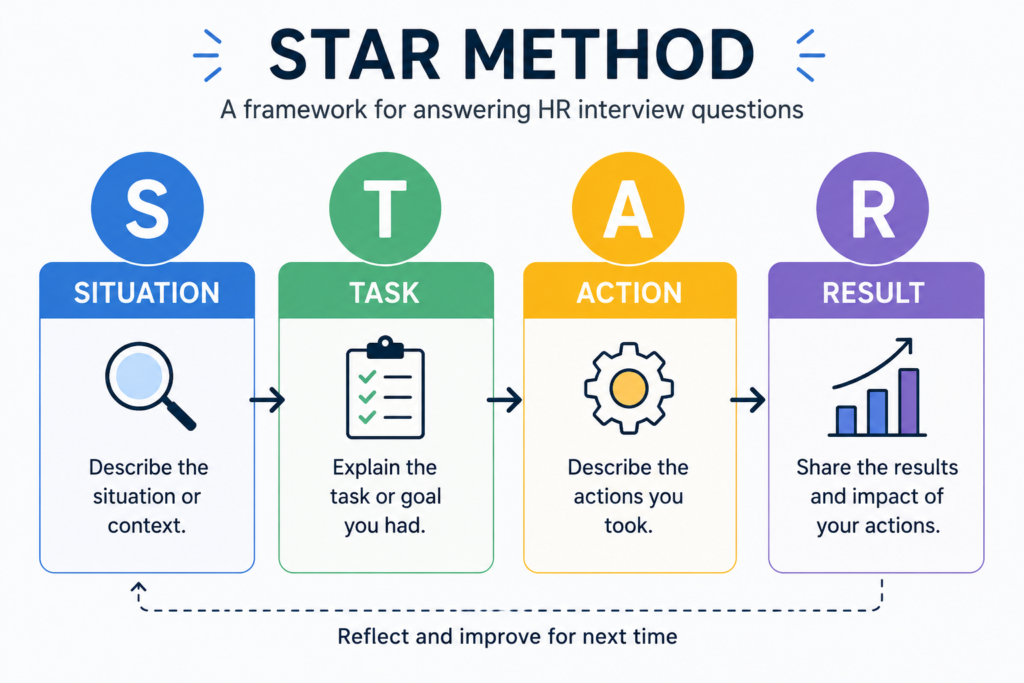
A useful habit: for each row in this table, jot down one real example from your own experience before your interview. You don’t need a polished script — just a clear memory of the situation, your action, and the outcome, often called the STAR method (Situation, Task, Action, Result).
How to Answer the Salary Expectations Question
Few questions cause as much anxiety as “What are your salary expectations?” — but it becomes far more manageable with a bit of preparation.
Before the interview:
- Research the market rate for the specific role, industry, and location using salary aggregator sites and professional networks.
- Decide on a realistic range rather than a single number, giving yourself room to negotiate.
During the interview:
- State a range rather than a fixed figure, anchored in your research.
- Signal flexibility — your priority is the right role and growth opportunity, not just the number.
Example framework: “Based on my research into similar roles in this industry and location, I’d expect a range of [X to Y]. That said, I’m open to discussing this further, since my main priority is finding a role where I can contribute meaningfully and grow.”
This approach shows preparation, keeps the door open for negotiation, and avoids either underselling yourself or naming a number that immediately disqualifies you.
Virtual vs In-Person HR Interviews: What Changes
A growing share of HR interviews in 2026 happen over video calls rather than in person, and while the core questions stay largely the same, a few practical details deserve extra attention when you’re preparing HR Interview Questions and Answers 2026-style responses for a virtual format.
For virtual interviews:
- Test your setup in advance. Check your camera framing, lighting, microphone, and internet connection at least 15–20 minutes before the call, not five minutes before.
- Choose a plain, distraction-free background. A cluttered or overly personal background can pull attention away from what you’re saying.
- Look at the camera, not the screen. It feels unnatural at first, but looking directly at your camera lens approximates eye contact far better than looking at the interviewer’s video tile.
- Keep a notepad just out of camera view. It’s completely reasonable to glance at a few bullet points, as long as you’re not visibly reading a script.
For in-person interviews:
- Plan your travel time with a buffer. Arriving flustered from a last-minute rush undercuts even strong preparation.
- Bring physical copies of your resume, even if you’ve already submitted it digitally — some interviewers appreciate having a printed copy in front of them.
- Be mindful of the entire experience, including how you interact with the receptionist or any staff you meet before the actual interview — this is sometimes informally factored into hiring decisions.
Regardless of format, the substance of your answers matters most, but small format-specific details can either reinforce or quietly undercut the impression your words are creating.
Building Your Own Answer Bank Before the Interview
One of the most effective things you can do before applying any HR Interview Questions and Answers 2026 framework in a live interview is to build a personal “answer bank” — a short list of 5–6 real experiences that can flex across multiple questions.
A simple way to build this:
- List 5–6 significant experiences — a challenge you overcame, a project you led, a conflict you resolved, a mistake you learned from, and a moment you’re proud of.
- Write one or two sentences per experience covering the situation, your specific action, and the measurable or observable result.
- Map each experience to 2–3 likely questions it could answer. A single strong story about resolving a team conflict, for instance, can answer questions about teamwork, conflict resolution, and even leadership with small adjustments in framing.
- Practice saying each story out loud, not just reading it silently — the delivery matters as much as the content itself.
This approach is far more resilient than memorizing individual answers, because it prepares you to handle question variations and unexpected follow-ups without freezing.
- Memorizing answers word-for-word. Rehearsed, robotic answers are easy for experienced interviewers to spot, and any unexpected follow-up question can throw you off completely.
- Speaking negatively about a previous employer or team. Even if your experience was genuinely difficult, framing it negatively raises concerns about how you might describe this company later.
- Giving vague answers without specific examples. “I’m a team player” means very little without a concrete situation attached to it.
- Avoiding the weakness question entirely. Claiming to have no real weaknesses reads as a lack of self-awareness rather than confidence.
- Naming an unresearched salary figure. Both underselling and overshooting the market rate can work against you — preparation matters here more than instinct.
- Failing to ask any questions when invited to. Not asking anything can come across as disinterest, even if that’s not your intention.
- Ignoring body language. Poor posture, avoiding eye contact, or fidgeting can undercut even a strong verbal answer.
- Not researching the company at all. Generic answers to “why do you want to work here” are one of the most common reasons candidates lose momentum in an otherwise strong interview.
Expert Tips Beyond Your Verbal Answers
- Prepare stories, not scripts. Have four or five real experiences ready that you can adapt to multiple questions — a challenge you overcame, a conflict you resolved, an achievement you’re proud of, and a time you failed and recovered.
- Practice the STAR method out loud. Structuring your answers around Situation, Task, Action, and Result keeps your responses focused and prevents rambling.
- Mind your body language. Sit upright, maintain natural eye contact, and avoid crossing your arms or fidgeting — these small signals contribute meaningfully to the impression you leave.
- Arrive early, not just on time. Punctuality signals reliability before you’ve said a single word.
- Dress slightly more formal than you expect the role to require. It’s easier to recover from being slightly overdressed than underdressed.
- Prepare two or three thoughtful questions for the interviewer. Questions about team structure, growth opportunities, or current challenges show genuine engagement.
- Listen fully before responding. Interviewers can tell when a candidate is waiting for their turn to speak rather than genuinely listening to the question being asked.
- Keep learning after the interview, win or lose. Every HR interview — successful or not — is useful practice for refining your delivery and self-awareness over time.
Frequently Asked Questions (FAQ)
1. What is the purpose of an HR interview?
An HR interview assesses your communication skills, emotional intelligence, and cultural fit — qualities that are difficult to evaluate through a technical or functional round alone.
2. What is the most common HR interview question?
“Tell me about yourself” is typically the opening question in nearly every HR interview, functioning as a brief personal and professional introduction.
3. How should freshers answer “Tell me about yourself”?
Structure your answer around your education, one relevant project or internship experience, and what you’re looking for next, keeping it concise and relevant to the role.
4. How do I answer the weakness question without hurting my chances?
Choose a genuine, moderate weakness and pair it with a specific, concrete action you’ve taken to improve — this shows self-awareness rather than a flaw.
5. How should I answer the salary expectations question?
Provide a researched range rather than a single number, and express flexibility, emphasizing that your main priority is finding the right role and growth opportunity.
6. Should I speak negatively about my previous employer?
No. Even in a difficult situation, frame your reasons for leaving around growth and new opportunities rather than criticism of your former workplace.
7. What is the STAR method?
STAR stands for Situation, Task, Action, and Result — a structured way to answer behavioral questions using a real example from your experience.
8. Do experienced candidates face different HR questions than freshers?
Yes. Experienced candidates are typically asked more about leadership, past achievements, team conflict, and decision-making, while freshers are asked more about education, potential, and foundational teamwork experiences.
9. Should I ask questions during my HR interview?
Yes. Having two or three thoughtful questions ready shows genuine interest and engagement, and declining to ask anything can come across as disinterest.
10. How important is body language in an HR interview?
Very important. Posture, eye contact, and reducing fidgeting all contribute to the overall impression you leave, sometimes as much as your verbal answers themselves.
Conclusion
Preparing with HR Interview Questions and Answers 2026 in mind isn’t about memorizing forty perfect responses — it’s about understanding the intent behind each question and having a handful of genuine, well-structured stories you can adapt on the spot. Focus on specific examples over vague claims, stay honest in questions like the weakness question, and prepare your salary range with real research rather than guesswork.
Combine strong verbal answers with solid body language, punctuality, and genuine company research, and you’ll walk into your next HR round significantly more prepared than most of the candidates sitting in the waiting room with you.
For more interview preparation guides, resume tips, and career resources, visit our [Career Resources category page] for regularly updated, practical advice.
Suggested Internal Links
Suggested External References (for fact-checking and updates)
| S.No | Resource | Action |
|---|---|---|
| 1 | LinkedIn Career Support | Visit |
| 2 | LinkedIn Learning | View |
| 3 | MIT Career Development | Visit |
| 4 | Harvard Business School | Visit |
| 5 | Glassdoor Salaries & Interviews | Check |
| 6 | AmbitionBox Salary Insights | Check |