
Read enough coverage of the new EPF Withdrawal Rules 2026 and you’ll hit a genuine contradiction: some headlines describe a “simpler, faster” system with quicker claim settlements and digital-first processing. Others describe a “stricter” system, with the wait time for full PF withdrawal after leaving a job extended from 2 months to 12 months. One source directly acknowledges that “inaccurate claims circulated online” about these changes, prompting the Ministry of Labour & Employment to clarify that the new rules expand benefits rather than restrict access. So which is it?
The honest answer is that both descriptions are accurate, because they’re describing different parts of the same restructured system. The process genuinely got faster and simpler — fewer forms, quicker settlement, digital verification. The waiting periods for certain withdrawals, particularly full withdrawal after unemployment, genuinely got longer. This guide untangles both halves clearly, explains the specific new categories and limits, and reconciles the exact figures that look contradictory across different news reports but actually describe the same underlying rule.
What Actually Happened: A New Scheme, Not Just an Update
The Employees’ Provident Fund Organisation (EPFO) introduced the Employees’ Provident Fund Scheme, 2026, replacing the previous 1952 scheme entirely — this isn’t a minor amendment, but a full structural replacement of the rules governing how India’s PF system works. The stated goals are to simplify a previously fragmented system with numerous separate withdrawal categories and forms, while also protecting members’ long-term retirement savings from being eroded by excessive early withdrawals.
The Genuinely Confusing Headline Numbers, Reconciled
Here’s where most of the public confusion comes from, and it’s worth resolving directly: you’ll see reports stating “75% withdrawal after 1 month of unemployment” alongside separate reports stating “full withdrawal only after 12 months of unemployment.” These are not contradictory — they describe two tiers of the same rule:
- After 1 month of unemployment, you can withdraw up to 75% of your eligible PF balance.
- The remaining 25% (which completes a full withdrawal) becomes accessible only after 12 months of unemployment.
Previously, the rule was simpler but more restrictive in a different way: full withdrawal was permitted after just 2 months of unemployment, with no partial/full split. So the honest comparison is: you now get faster partial access (75% at just 1 month, versus needing to wait 2 months for anything at all before), but full access to the last quarter of your balance takes considerably longer than before (12 months versus 2 months). Neither headline alone tells the complete story — you need both figures together to understand what actually changed.
The Three New Withdrawal Categories
EPFO has consolidated what used to be numerous separate withdrawal categories, each with its own conditions and forms, into three broad heads:
- Essential Needs — covering circumstances like medical treatment, education, and marriage
- Housing — covering home purchase, construction, or related housing needs
- Special Circumstances — covering other approved situations including unemployment-related withdrawals
This consolidation is a genuine simplification worth appreciating — rather than needing to identify which of many narrow categories your specific situation falls under, most needs now map to one of these three broader groups, reducing paperwork and processing complexity.
The Minimum Balance Rule: 25% Always Stays
Across most partial withdrawal categories, EPFO now requires you to retain a minimum of 25% of your total PF balance in your account at all times — you can generally access up to 75% for eligible partial withdrawals, but the remaining quarter stays protected and continues earning interest. This is a deliberate design choice: the Labour Ministry has stated that frequent, uncapped withdrawals were leaving many members with very small balances by the time they reached retirement, and this minimum-balance floor is meant to prevent that pattern going forward, even as access to the accessible portion becomes faster and simpler.
The New Uniform Service Requirement
Previously, different withdrawal purposes carried different waiting periods before you became eligible — some purposes allowed near-immediate access, others required longer service. Under the 2026 scheme, this has been standardized: members generally need 12 months of service across most eligible categories before making a partial withdrawal. This includes medical withdrawals, which under some previous interpretations could be accessed with less service given the emergency nature of medical needs — worth knowing directly, since this represents a genuine tightening for members with less than a year of service facing an urgent medical situation, even though the medical withdrawal category itself otherwise remains relatively generous (see frequency limits below).
How Often You Can Actually Withdraw for Each Purpose
The new rules specify clear frequency limits by purpose, another genuine simplification compared to the previous, more ambiguous framework:
| Purpose | Frequency Limit |
|---|---|
| Medical treatment | Unlimited withdrawals (no specified cap) |
| Education | Up to 10 times during EPF membership |
| Marriage | Up to 5 times during EPF membership |
The unlimited allowance for medical treatment specifically reflects an intent to keep this category genuinely accessible for recurring or ongoing health needs, even as the general service-period requirement (12 months) applies before any of these become available in the first place.
Claims Now Move Faster — With Real Accountability
This is the genuinely positive, simplification-focused half of the story: EPFO has reduced the standard claim settlement timeline to 20 days, and critically, introduced real accountability for delays — if EPFO fails to process a valid claim within this window without a legitimate reason, it’s now required to pay 12% penal interest on the delayed amount. This is a meaningful shift from a system where claim delays were common and members had limited recourse, to one where the organization itself faces a financial consequence for its own processing delays.
Digital-First Processing: What’s Actually New
Several genuinely useful digital improvements accompany this restructuring:
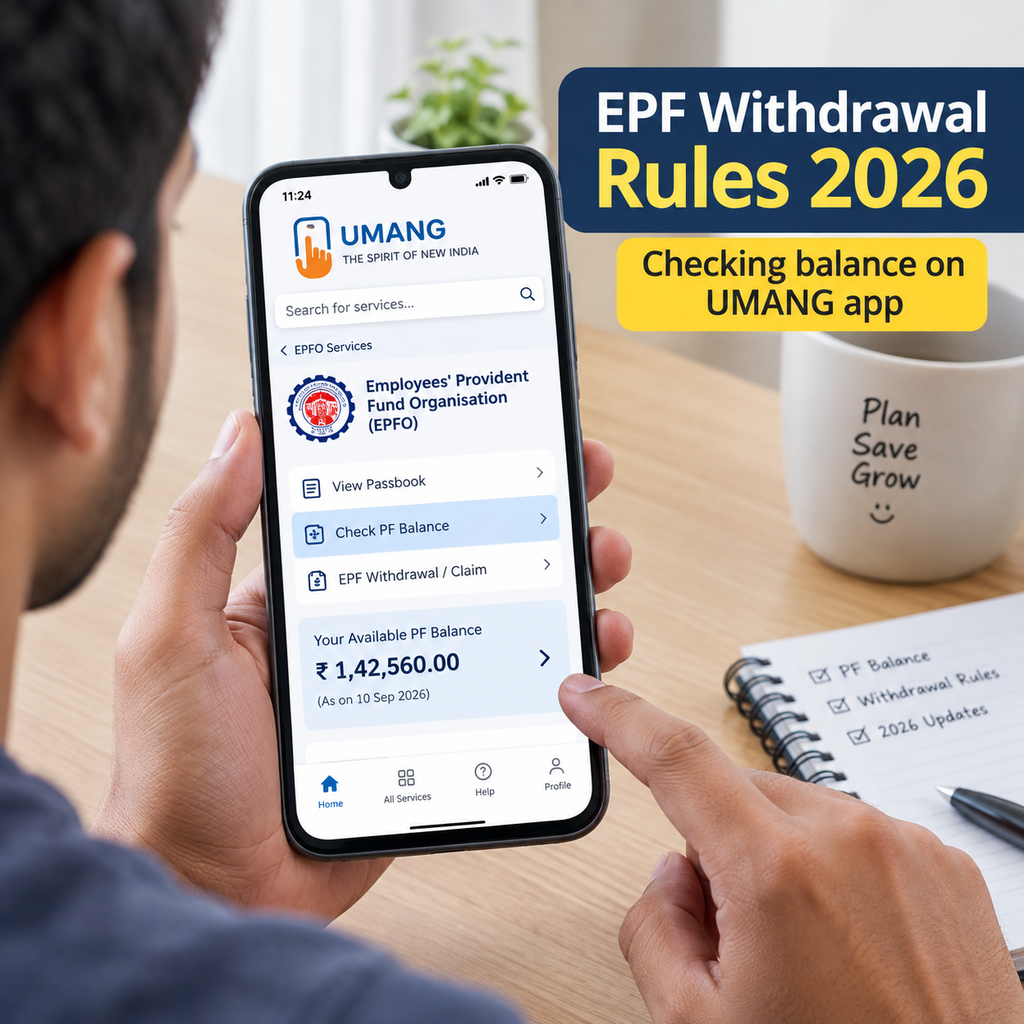
- UAN generation, activation, and authentication via face recognition through the UMANG app, reducing dependence on physical documentation
- Passbook Lite, a simplified way to check your PF balance, contributions, and transaction history
- UPI-based PF withdrawal options, further reducing the friction of the claims process
- Broader Aadhaar and UAN integration across the claims process, cutting down on repetitive paperwork
Collectively, these changes explain the “faster and simpler” framing you’ll see in some coverage — and they’re genuinely real improvements, independent of the extended waiting periods discussed above.
The Pension (EPS) Change Most Coverage Buries
Separate from your core PF balance, if you’re also covered under the Employees’ Pension Scheme (EPS), the waiting period for withdrawing your EPS pension accumulation has been extended to 36 months — a considerably longer wait than applies to your general PF withdrawal, and a detail that gets far less attention in casual coverage than the headline PF unemployment figures. If your specific situation involves EPS withdrawal rather than general PF withdrawal, don’t assume the same 12-month figure applies — plan around the longer 36-month window specifically for this component.
Tax Implications Haven’t Fundamentally Changed
TDS (Tax Deducted at Source) rules remain largely consistent with prior practice: if your withdrawal exceeds ₹50,000 and occurs before completing 5 years of continuous service, TDS applies — at 10% if you’ve submitted your PAN, or a higher rate if you haven’t. This is worth keeping in mind specifically if you’re withdrawing early in your career, since the 5-year continuous service threshold for tax-free withdrawal hasn’t shifted under this restructuring.
The Wage Ceiling Change Few People Notice
A more technical but practically significant change: the ₹15,000 wage ceiling, which determines certain EPF contribution calculations, was previously written explicitly into the EPF Scheme’s text, meaning any change required a formal amendment to the scheme itself. The 2026 Scheme instead references a wage ceiling notified separately by the Central Government, decoupling this figure from the scheme’s core text. Practically, this means future adjustments to the wage ceiling can happen through a simpler government notification, without requiring the more cumbersome process of amending the entire scheme — a structural change that makes future policy updates faster to implement, even though it doesn’t change today’s ceiling amount directly.
How to Actually Check Your Balance and File a Claim
- Visit the EPFO Member Passbook Portal or use the UMANG app.
- Log in using your UAN (Universal Account Number), password, and captcha, or authenticate via face recognition through UMANG if you’re generating or activating your UAN for the first time.
- Verify your KYC details are current — an outdated bank account, Aadhaar, or nomination detail can delay your claim even under the faster new processing timeline.
- Navigate to Online Services to check your balance via Passbook Lite, or to submit a new claim under the appropriate category (Essential Needs, Housing, or Special Circumstances).
- Authenticate your claim submission via Aadhaar OTP.
- Track your claim status online — remember, EPFO is now expected to settle valid claims within 20 days, with penal interest owed to you if it doesn’t, absent a valid reason for delay.
What This Means Practically, By Situation
- If you’ve recently left a job: You can access 75% of your eligible balance after 1 month of unemployment, but plan around a full 12-month wait for the remaining 25% — don’t assume you can access your entire balance quickly, even though partial access has genuinely gotten faster.
- If you’re facing a medical emergency with less than 12 months of service: Be aware the uniform service requirement now applies to medical withdrawals too, which is a genuine tightening worth knowing about in advance rather than discovering during an actual emergency.
- If you’re planning for retirement and also hold EPS pension benefits: Factor in the extended 36-month waiting period for EPS withdrawal specifically, separate from your general PF timeline.
- If you’re withdrawing before 5 years of continuous service: Remember the ₹50,000 TDS threshold still applies, and make sure your PAN is on file to access the lower 10% rate rather than a higher default rate.
Old System vs New System, Side by Side
Seeing the two frameworks directly compared makes the overall shift easier to internalize than reading the changes as a list:
| Aspect | Pre-2026 (1952 Scheme) | 2026 Scheme |
|---|---|---|
| Full withdrawal after unemployment | 2 months | 12 months (with 75% accessible at 1 month) |
| Withdrawal categories | Numerous separate categories, each with distinct forms | Consolidated into 3 broad heads |
| Service requirement for withdrawal | Varied by purpose, sometimes minimal | Uniform 12 months across most categories |
| Claim settlement timeline | No standard enforced timeline; delays common | 20 days, with 12% penal interest for unjustified delay |
| Minimum retained balance | Not uniformly enforced | 25% of total balance must remain |
| UAN/KYC verification | Largely manual, document-heavy | Face authentication via UMANG, digital-first |
| Wage ceiling | Fixed in scheme text (₹15,000), required formal amendment to change | Referenced externally, adjustable via government notification |
| EPS pension withdrawal wait | Shorter | Extended to 36 months |
Laid out this way, the pattern becomes clear: nearly every process-and-technology dimension moved toward speed and simplicity, while nearly every waiting-period dimension moved toward longer, more protective timelines. This is a coherent policy design, not an inconsistency — the government is trying to make the system easier to interact with while making it harder to drain prematurely.
What to Do Before You Actually Need to Withdraw
Since several of these changes only become relevant at the moment you actually need to access your funds, a bit of proactive preparation now can save real friction later. Log into the EPFO portal or UMANG app today, before any urgent need arises, and confirm your KYC details — Aadhaar linkage, bank account, and nomination — are all current and accurate. Check that your e-Nomination is filed, since this is now treated as a standard requirement under the 2026 scheme, and an unfiled nomination can complicate a claim for your family in circumstances where you’re not the one filing it yourself. If you’re between jobs or anticipating a transition soon, calculate roughly what 75% of your current balance would be, so you have a realistic sense of what’s actually accessible at the 1-month mark versus what you’d need to wait the full 12 months for.
Common Mistakes to Avoid
- Assuming the “75% after 1 month” and “full withdrawal after 12 months” figures are contradictory. They describe two tiers of the same rule — partial access is faster, full access is slower than before.
- Assuming medical withdrawals remain immediately accessible regardless of service length. The new uniform 12-month service requirement now applies to medical withdrawals as well, a genuine change from more flexible prior treatment.
- Confusing general PF withdrawal timelines with EPS pension withdrawal timelines. The EPS pension component now has a considerably longer 36-month wait, distinct from the 12-month PF figure.
- Letting your KYC details go stale. An outdated UAN, Aadhaar link, bank account, or nomination detail can delay your claim even under the faster new settlement framework.
- Assuming the wage ceiling figure is fixed permanently at ₹15,000. The 2026 scheme specifically restructured this to allow easier future government revision.
- Not knowing about the 12% penal interest entitlement. If your valid claim is delayed beyond 20 days without a legitimate reason, you’re entitled to this penal interest — don’t assume you have no recourse for a slow claim.
Frequently Asked Questions
Do the new EPF rules make withdrawal easier or harder?
Both, depending on which part of the process you mean — claim processing and partial access have gotten faster and simpler, while full withdrawal after unemployment now takes longer (12 months versus the previous 2 months).
How much of my PF can I withdraw after losing my job?
Up to 75% after 1 month of unemployment; the remaining 25% becomes accessible only after 12 months of unemployment.
Has the minimum service period for withdrawal changed?
Yes, most categories now require a uniform 12 months of service, including medical withdrawals, which some previous interpretations allowed with less service given their emergency nature.
How long does EPFO now take to settle a valid claim?
20 days, with a mandatory 12% penal interest payment to the member if EPFO delays processing without a valid reason.
Is there a limit on how many times I can withdraw for medical treatment?
No specified cap — medical treatment withdrawals remain unlimited in frequency, though the 12-month minimum service requirement still applies before you become eligible.
What about education and marriage withdrawal limits?
Education withdrawals are capped at 10 times, and marriage withdrawals at 5 times, across your entire EPF membership.
Does this affect my EPS pension withdrawal timeline too?
Yes, and this is easy to miss — EPS pension accumulation withdrawal now requires a 36-month wait, separate from and longer than the general PF withdrawal timeline.
Is there a minimum balance I must maintain in my PF account?
Yes, 25% of your total balance generally must remain in your account, with 75% accessible for eligible partial withdrawals.
Do TDS rules on early withdrawal still apply?
Yes, withdrawals exceeding ₹50,000 before 5 years of continuous service still attract TDS — 10% if your PAN is on file, higher otherwise.
Where do I check my PF balance and file a claim under the new rules?
Through the EPFO Member Passbook Portal or the UMANG app, using your UAN, with Aadhaar-based authentication for claim submission.
The Bottom Line
The EPF Withdrawal Rules 2026 genuinely deserve the seemingly contradictory “easier and harder” description many are struggling to reconcile — because both are real, describing different parts of a single restructured system. Claims process faster, digital access has improved meaningfully, and the category structure is simpler. But full withdrawal after leaving a job, and medical withdrawals for members with less than a year of service, both now involve longer waits than before. Understanding both halves together, rather than reacting to whichever single headline you happened to see first, is what actually lets you plan around these changes correctly.
For more career and financial planning resources relevant to your work life, check out our Career Resources category page for regularly updated coverage. And if you’re navigating a recent job change alongside these PF changes, our guide on CTC vs In-Hand Salary 2026 covers another major structural shift affecting your take-home pay this year.
Suggested Internal Links
- Career Resources Category
- CTC vs In-Hand Salary 2026: What Actually Changed
- HCLTech Freshers Hiring 2026: What Each Round Tests
- Resume Tips for Experienced Candidates 2026: Best Guide
Suggested External References
- EPFO Official Member Portal: https://www.epfindia.gov.in
- UMANG App Official Page: https://web.umang.gov.in
- Ministry of Labour and Employment: https://labour.gov.in