
ITR Deadline 2026 the Real Cost of Missing July 31 Isn’t the Late Fee — It’s What You Lose Access To Somewhere in the last few months, a decent number of people reading this site got their first proper salary slip. If that’s you, there’s a decent chance you’re about to file an income tax return for the first time in your life, and there’s a genuinely important detail buried in this year’s filing rules that almost nobody explains clearly until it’s too late to do anything about it. Miss the 31 July 2026 deadline, and it’s not just a late fee waiting for you. Under Section 139(1), you can only choose the old tax regime — the one with all the familiar deductions like 80C investments, 80D health insurance, HRA exemption, and home loan interest — if you file on or before that due date. Miss it, file a belated return, and you’re locked into the new regime for that entire year, whether or not it actually works out cheaper for you.
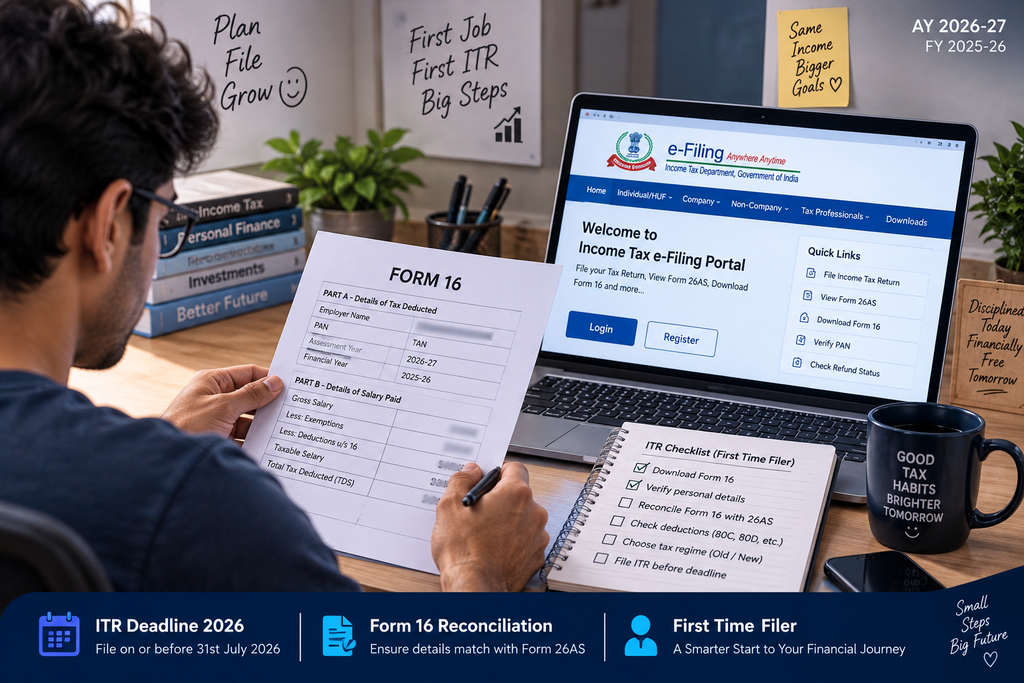
That’s a genuinely different kind of consequence than most people picture when they think “late fee.” A late fee is annoying. Losing your ability to claim deductions you’ve already invested toward — money you put into an ELSS fund or a PPF account specifically to reduce your tax bill — is a real financial loss, and it’s one that quietly happens to a lot of first-time filers who assume a few extra weeks past the deadline just means a small penalty and nothing more.
Which Year This Actually Covers, and Why the Numbering Is Confusing
The return you’re filing in 2026 covers income you earned between 1 April 2025 and 31 March 2026 — what’s called Financial Year 2025-26, or Assessment Year 2026-27 in the tax department’s own terminology. ITR Deadline 2026 If you started your first job sometime in the middle of that window, your first Form 16 will only reflect salary from whenever you actually joined, not a full twelve months, and that’s completely normal.
Here’s a genuinely odd wrinkle worth knowing about: a brand new Income-tax Act, 2025 technically came into effect on 1 April 2026. But because the income you’re reporting this year was earned before that date, your return is still governed by the older Income-tax Act, 1961. So for one filing season, you’re using ITR forms built for AY 2026-27 under a law that’s technically already been replaced for anything earned going forward. The new Act only starts applying to income earned from 1 April 2026 onward, which means it becomes relevant for the return you’ll file in 2027, not this one. If you’re confused by that, you’re not missing something — it’s a genuinely awkward transition year, and it’s the kind of detail that trips up even people who’ve filed returns before, let alone someone doing this for the first time.
For Most Salaried Freshers, ITR-1 Is What You’ll Actually Use
If your income is reasonably simple — salary, maybe some interest from a savings account or fixed deposit, nothing more complicated than that — you’ll almost certainly file using ITR-1, sometimes called Sahaj. One change worth knowing about this year: ITR-1 now covers income from up to two house properties, where previously owning a second property (even a rented-out one) forced you into the more complex ITR-2 form. If your situation is genuinely just a salary and maybe some bank interest, ITR-1 remains the straightforward form built for exactly your situation.
What Form 16 Actually Tells You
Your employer is legally required to issue you a Form 16 if any tax was deducted from your salary during the year, and by regulation this is supposed to happen by 15 June. It has two parts: Part A summarizes the tax that was actually deducted and deposited on your behalf, and Part B breaks down your salary structure and, importantly, tells you which regime — old or new — your employer used to calculate the TDS they deducted from your paychecks throughout the year.
Here’s something worth sitting with for a second: the regime shown on your Form 16 is not necessarily your final regime. It only reflects whatever you told your employer to use for calculating TDS during the year. When you actually file your return, pure salaried filers can switch between regimes freely, every single year, without any additional form or declaration — you’re not locked into whatever your employer used for deducting tax throughout the year. If your employer deducted tax assuming the new regime, but it turns out the old regime would genuinely save you more money once you account for your actual investments and expenses, you can still choose the old regime at filing time, provided you’re filing before the deadline discussed above.
If You Switched Jobs This Year, Read This Part Twice
This is directly relevant if any part of your year involved leaving one employer and joining another — something covered in more detail in a separate guide on this site about notice periods and buyouts. When you’ve had two employers in the same financial year, you need to include salary from both of them in your return, and you’ll need a Form 16 from each. The trap here is specific and genuinely common: your new employer typically doesn’t automatically know what you earned at your previous job unless you explicitly provide that information to them, which means the TDS they deducted was likely calculated only against the salary they paid you, not your combined annual income. Combined income can push you into a higher tax slab than either employer individually accounted for, which means you can end up owing additional tax at filing time even though tax was already being deducted from every paycheck all year. This isn’t a sign anything went wrong — it’s just how the math works when nobody had the full picture along the way — but it does mean budgeting for a possible tax payable amount rather than assuming a refund by default if you changed jobs mid-year.
Reconciling Your Numbers Before You File
Before you actually submit anything, cross-check your Form 16 against two other documents available on the income tax portal: Form 26AS, which shows the tax actually deposited against your PAN, and the Annual Information Statement (AIS), which pulls together a broader picture of your financial transactions reported to the tax department from various sources. Mismatches between what your Form 16 claims and what these two documents show are consistently cited as one of the most common reasons ordinary, honest filers end up receiving a tax notice later — not because anyone did anything wrong deliberately, but because a discrepancy nobody caught before submission raised a flag afterward. A few minutes spent comparing these three documents before you file is genuinely one of the highest-value things you can do in this entire process.
The Deadline, and What Happens on Either Side of It
For most salaried employees whose accounts don’t require an audit, the due date for filing is 31 July 2026. If you miss it, you can still file what’s called a belated return under Section 139(4), up until 31 December 2026, but three real costs attach to that delay. First, a late fee under Section 234F — up to ₹5,000, reduced to ₹1,000 if your total income is ₹5 lakh or below. Second, and this is the one worth internalizing properly: you lose the ability to opt for the old tax regime for that year, locking you into the new regime’s rules regardless of whether that’s genuinely better for your specific situation. Third, if you had any capital losses or business losses to carry forward, a belated filing generally forfeits your ability to do that as well.
There’s also a genuinely useful safety net worth knowing about on the other side of things: if you do file on time but later spot a mistake, the window to file a revised return correcting it has been extended to 31 March 2027, up from the earlier December cutoff — a meaningfully longer runway to fix a genuine error than filers had in previous years.
Submitting Isn’t the Final Step — Verification Is
A detail that catches a genuine number of first-time filers off guard: submitting your return online is not the end of the process. You then need to e-verify it, typically within 30 days of submission, through one of several methods — Aadhaar OTP is the fastest and most common, though net banking, an Electronic Verification Code, or a physically signed ITR-V form mailed to the CPC in Bengaluru all work as alternatives. An unverified return is treated, for all practical purposes, as though it was never filed at all. If you’ve submitted your return and then walked away assuming you’re done, double back and confirm the verification step actually went through — this is a genuinely easy thing to forget, and a genuinely costly thing to have forgotten if it turns out your submission never counted.
If You Received Salary Arrears This Year
If you got a delayed increment, a pending Dearness Allowance adjustment, or any other salary arrears paid out in a lump sum this year, it’s worth knowing that this lump sum gets taxed in the year you actually received it — which can push you into a higher tax bracket than you’d otherwise be in, purely because of the timing of the payment rather than any real increase in your ongoing income. Section 89(1) exists specifically to provide relief for exactly this situation, effectively spreading the arrears back across the years they actually belonged to for tax calculation purposes. To claim this relief, you need to file Form 10E on the income tax portal, and you need to do this before you file your actual return — not after, and not instead of it.
A Structural Detail Worth Knowing, Even Though It Doesn’t Affect You This Year
Some sources covering this filing season mention that Form 16 is being renumbered to Form 130, and Form 26AS to Form 168. This is real, but it’s easy to get confused about timing: this renumbering only comes into effect starting with the Tax Year 2026-27 filing (the one you’d do in 2027), not the return you’re filing right now. Your employer will still issue you the familiar Form 16 for this year’s filing — worth mentioning mainly so you’re not confused if you come across the new form numbers while researching and wonder whether you’re looking at outdated information.
What the Regime Choice Actually Comes Down To
The new tax regime is the default now — if you don’t actively tell your employer otherwise, TDS gets calculated assuming you’re in the new regime. The new regime offers a standard deduction of ₹75,000, compared to ₹50,000 under the old regime, but strips away most of the itemized deductions people are used to — the old regime’s 80C investments, 80D health insurance premiums, HRA exemption, and home loan interest deduction under Section 24(b) simply don’t apply if you’re filing under the new regime. Whether the new regime or the old one actually saves you more money depends entirely on how much you’re genuinely investing and spending in the categories the old regime rewards. If you’ve barely made any 80C investments and don’t pay significant rent or a home loan EMI, the new regime’s simplicity and higher standard deduction often works out better. If you’ve been diligently investing toward tax-saving instruments or paying substantial rent with HRA as part of your salary structure, running the numbers both ways before deciding is worth the twenty minutes it takes, rather than defaulting to whatever your employer assumed when calculating your monthly TDS.
There’s also a specific relief worth knowing about if your income sits right around the ₹12 lakh threshold under the new regime: marginal relief under the proviso to Section 87A ensures that if your total income is, say, ₹12,00,500, you only pay tax on the ₹500 that exceeds ₹12 lakh, plus applicable cess — not the full slab rate applied to your entire income. This prevents the strange situation where earning slightly over a threshold would otherwise leave you worse off than earning slightly under it.
Why the Portal Gets Slow Every Single Year, and What That Means for You
It’s worth understanding why “file early” isn’t just generic advice but a genuinely evidence-based recommendation. Tens of millions of salaried individuals across India share the exact same deadline, and a large share of them, understandably, wait until the final week to actually sit down and file, either out of procrastination or because they’re waiting on a last document from an employer or bank. The income tax department’s servers face a genuine, predictable surge in traffic in the days immediately before 31 July, and in past years this has resulted in slow page loads, failed submissions, and payment gateway timeouts right when people can least afford the delay. If your return is straightforward — a single employer, no arrears, simple deductions — there’s rarely a good reason to wait until the final week at all, since none of your inputs are likely to change between now and the deadline. The only genuine reason to file close to the deadline is if you’re waiting on a document you don’t yet have, and even then, it’s worth having everything else prepared so you can file the moment that document arrives rather than starting from scratch in the final days.
What a Refund Actually Looks Like, and How Long It Takes
If your employer deducted more tax through the year than you actually owed once your return is fully reconciled — a common situation if you claimed deductions your employer wasn’t accounting for in their monthly TDS calculations, or if you left a job partway through the year and your new employer’s withholding didn’t fully account for your reduced annual income — you’re entitled to a refund of the excess. Refunds are generally processed and credited directly to the bank account linked to your PAN, provided that account has been pre-validated on the income tax portal, which is worth checking and completing before you file rather than discovering after submission that your refund is stuck because your bank details weren’t properly validated. Processing times vary by filing season and by how straightforward your specific return is, but a return filed early in the season, verified promptly, and free of any mismatches against Form 26AS and AIS tends to move through processing considerably faster than one filed in the final rush with unresolved discrepancies.
A Practical Order to Do Things In
Rather than a list of things to avoid, it’s more useful to think about the order this actually needs to happen in, since the sequence itself prevents most of the mistakes people make. Start by collecting Form 16 from every employer you had during the year, not just your current one. Pull your Form 26AS and AIS from the income tax portal and set them side by side with your Form 16 figures, checking for anything that doesn’t match before you enter a single number into the return itself. Decide your regime deliberately, by actually estimating your tax under both scenarios rather than defaulting to whatever’s already reflected in your Form 16. If you received arrears, file Form 10E before you touch your main return. File the return itself with enough buffer before 31 July that a portal slowdown in the final days doesn’t become your problem — the income tax e-filing system reliably gets overloaded in the last week before the deadline every single year, and starting ten to fifteen days early avoids that entirely. Once you’ve submitted, immediately complete the e-verification step rather than assuming submission alone was sufficient, and keep a digital folder of everything — Form 16s, investment proofs, bank statements — so next year’s filing doesn’t involve the same scramble to reconstruct documents from memory.
A Few Quick Answers
Do I need to file if my employer already deducted tax from my salary?
Yes — TDS being deducted doesn’t exempt you from filing a return; it just means some or all of your tax liability has already been paid in advance, which the return then reconciles.
What if this is genuinely my very first return and I have no idea what I’m doing?
Start with ITR-1 if your income is just salary and maybe some bank interest, use the income tax portal’s pre-filled data as your starting point rather than entering everything manually, and cross-check against Form 26AS and AIS before submitting — the process is more form-filling than complex decision-making for a straightforward first return.
Can I still switch tax regimes next year even if I pick one now?
Yes, for pure salaried income, you choose your regime fresh every single year at filing time, with no long-term lock-in from one year’s choice to the next.
What actually happens if I just don’t file at all?
Beyond the late fee and regime lock-in already covered, prolonged non-filing can eventually escalate to formal notices and, in more serious or repeated cases, penalties beyond the standard late fee — it’s not something that simply goes unnoticed indefinitely.
I got two Form 16s this year from two different jobs — do I really need both?
Yes, and this is worth repeating because it’s the single most common mistake among people who switched jobs mid-year: your final tax liability is based on your combined income across both employers, not either one in isolation.
If you’re navigating this filing season alongside a recent job change, it’s worth reading through this site’s guide on notice period buyouts too, since between the two, you’ll have a genuinely complete picture of what actually happens financially and legally when you move from one employer to another mid-year — the exit process on one side, and the tax reconciliation on the other.
Suggested Internal Links
- Career Resources Category
- Notice Period Buyout 2026: Can Employers Refuse It?
- CTC vs In-Hand Salary 2026: What Actually Changed
- EPF Withdrawal Rules 2026: Easier AND Harder Now
Suggested External References
- Income Tax Department e-Filing Portal: https://www.incometax.gov.in
- Central Board of Direct Taxes (CBDT): https://www.incometaxindia.gov.in
- National Career Service Portal (India): https://www.ncs.gov.in