
Gig Worker Social Security 2026 If you deliver for Swiggy or Zomato, drive for Ola or Uber, or take on jobs through Urban Company, there’s a genuinely significant legal development worth understanding clearly: India’s Code on Social Security, 2020 has been in force since 21 November 2025, and the detailed rules that actually make it operational — the Social Security (Central) Rules, 2026 — were finally notified on 8 and 9 May 2026. For the first time in Indian labour law, gig and platform workers have a formal legal identity and a structured path to real benefits: health insurance, accident cover, maternity benefits, and old-age protection.
Here’s what most coverage of this law skips, and what actually determines whether you personally benefit from any of it: there’s a specific, easy-to-miss eligibility test based on how many days you actually worked in the previous financial year, and missing this threshold means missing out on benefits regardless of how long you’ve technically been registered or how consistently you’ve been working through a platform in the current year. This guide covers how the system actually works, the honest scale of confusion around how many gig workers even exist in India, and what you specifically need to do to make sure this law’s benefits are actually available to you.
Table of Contents
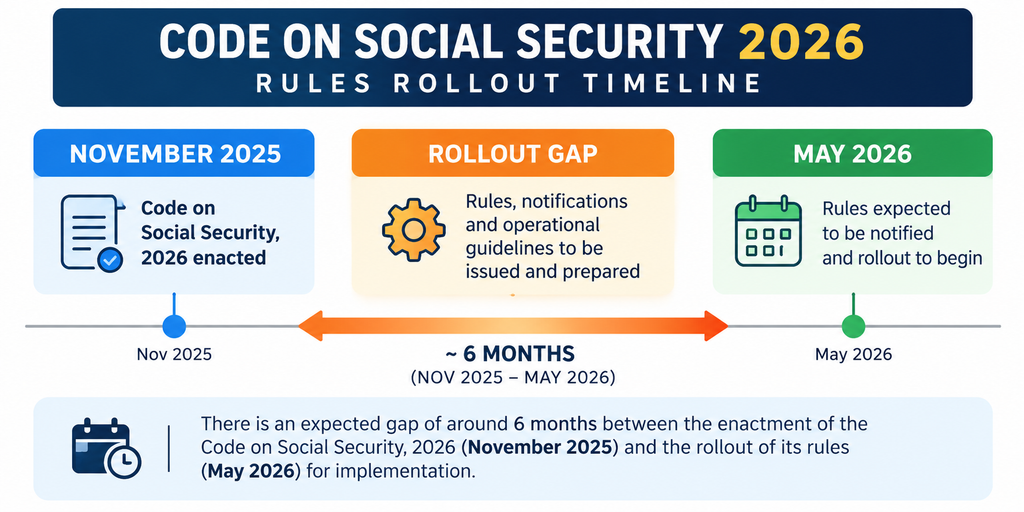
Why There Was a Six-Month Gap Between “In Force” and “Actually Working”
This follows a pattern worth recognizing if you’ve read other coverage on this site about India’s staggered regulatory rollouts — the DPDP Act,Gig Worker Social Security 2026 the broader labour code consolidation, the four-day work week provision. A law being “in force” and a law being genuinely operational with clear compliance mechanics are two different things. The Code on Social Security became legally effective in November 2025, but the actual technology-driven compliance architecture — registration requirements, the specific levy structure, the eligibility mechanics — only became concrete with the May 2026 Rules. If you checked on this law’s status between November and May and found it vague or seemingly inactive, that wasn’t a mistake on your part — the operational detail genuinely didn’t exist yet.
How the Funding Mechanism Actually Works
Aggregator platforms — the Code defines this broadly to include any entity using digital or electronic platforms to provide or facilitate services, covering delivery apps, ride-hailing services, and quick-commerce platforms — are required to contribute toward a Social Security Fund, generally in the range of 1 to 2% of their turnover, with a statutory cap ensuring the total contribution never exceeds 5% of the total amount actually paid to gig and platform workers in a given financial year. This cap exists specifically to preserve financial viability for lower-margin platforms while still establishing a genuine, meaningful funding mechanism. The Central Government uses this fund to formulate schemes covering life and disability cover, accident insurance, health and maternity benefits, and old-age protection.
The Critical Detail Almost Nobody Explains Clearly: The 90/120-Day Test
This is the single most important mechanic worth understanding if you want to actually benefit from this system, rather than just being nominally registered under it. Eligibility for benefits runs on a rolling annual test tied to your previous financial year’s actual work — meaning your work pattern during the 2026-27 financial year determines your eligibility for benefits in 2027-28, not the current year. This requirement must be met fresh every single financial year to maintain your eligibility; it isn’t a one-time qualification you satisfy once and then keep indefinitely. Practically, this means treating your registration on the e-Shram portal as the first step, not the only step — you need to actually maintain a sufficient level of documented platform work during each qualifying period to keep your eligibility for the following year’s benefits active.
The Mandatory Registration Process
Registration for every gig and platform worker aged 16 and above is mandatory, and must be seeded with your Aadhaar number to generate a Universal Account Number (UAN) — a structure that mirrors the same Aadhaar-linked registration pattern seen elsewhere in Indian government benefit systems, including the apprenticeship stipend system covered in a separate guide on this site. Aggregator platforms themselves are required to register on the government portal and upload their existing gig workers within a defined window (45 days from the rules’ notification, a deadline that had already passed by 21 June 2026), then report ongoing worker onboarding and exits in real time going forward. If you work through a platform and haven’t personally confirmed your own e-Shram registration and UAN generation, it’s worth checking directly rather than assuming your platform has automatically completed this on your behalf — since the accuracy and completeness of this registration data directly determines your eligibility for the benefits this entire system is built to provide.
Why Nobody Actually Knows How Many Gig Workers Exist in India
It’s worth being honest about a genuine, significant data problem underlying this entire system, since it affects how confidently anyone — including the government itself — can describe how well this framework is actually working. India’s Periodic Labour Force Survey, the primary source for employment data covered in more depth in this site’s broader unemployment coverage, still records gig workers under general “self-employed” or “own-account worker” categories and cannot isolate platform work specifically as its own tracked category. This means every headline figure about the size of India’s gig workforce is genuinely an estimate rather than a verified count — NITI Aayog’s 2022 projection put the figure at 23.5 million workers by 2029-30, while the Economic Survey estimated roughly 12 million for 2024-25 specifically. Against these estimates, actual registrations on the e-Shram portal for this specific gig worker category stood at roughly twelve lakh (1.2 million) — meaning genuine, achieved registration coverage could represent anywhere from a meaningful fraction to a small sliver of the actual workforce, depending on which underlying estimate turns out to be closer to reality. The government’s own rules acknowledge this uncertainty by empowering specific Board committees to estimate the workforce size themselves, rather than treating any single existing figure as authoritative.
Why You’re Not Covered by PF or ESI — The Same Pattern Seen With Apprentices
This is worth connecting directly to a structural pattern covered elsewhere on this site: just as apprentices under the Apprentices Act are explicitly not classified as employees under the EPF Act, ESI Act, or Gratuity Act, gig and platform workers under the Social Security Code are similarly excluded from these standard employee-benefit schemes. Instead, both categories receive access to a separate, purpose-built benefit mechanism — a dedicated Social Security Fund for gig workers, just as apprentices receive a dedicated stipend structure rather than standard employee benefits. This is a recurring, deliberate design choice across Indian labour law: rather than forcing every category of worker into the traditional employer-employee framework, newer legal categories increasingly get their own parallel, purpose-built protection systems. Recognizing this pattern helps you understand why “I’m not getting PF” isn’t a compliance failure in either the apprenticeship or gig-work context — it reflects the actual legal design of these specific worker categories, which are deliberately structured differently from standard employment from the outset.
State-Level Rules Layer on Top of the Central Framework
Consistent with the pattern seen across DPDP, the broader labour codes, and the four-day work week provision, individual states are building their own additional layers on top of this central framework. Karnataka introduced its own Platform-Based Gig Workers (Social Security and Welfare) Ordinance, later moved as a formal Bill, establishing its own registration system, welfare board, and welfare fund — but with a meaningfully different fee structure, ranging 1 to 5% of the payment per individual transaction, rather than the central Code’s percentage-of-turnover model. Karnataka’s state framework also includes specific provisions on transparency, grievance redressal, and protection against arbitrary deactivation of a worker’s platform account — a genuinely valuable protection not explicitly present in the central framework alone. Telangana has a draft bill following a broadly similar model. Where a state-specific law like Karnataka’s applies alongside the central Code, workers in that state may have access to both state and national welfare boards simultaneously, meaning your actual available protections can genuinely differ depending on which state you’re working in.
Protection Against Arbitrary Account Deactivation
This specific protection, currently more clearly established at the state level (Karnataka specifically) than in the central framework, deserves direct attention given how consequential a sudden account deactivation can be for someone whose entire livelihood depends on platform access. If you’re working in a state with this kind of specific protection in place, and you experience what seems like an arbitrary or unexplained deactivation, you have a more concrete legal basis to challenge it than in a state without this specific provision — worth knowing directly rather than assuming platform account decisions are entirely outside any regulatory oversight everywhere in India.
The Freelancer-Specific Tax Detail Worth Knowing
If you’re a freelancer specifically, rather than a platform-based delivery or ride-hailing worker, it’s worth connecting this to a related but distinct obligation covered in more depth in this site’s guide to ITR filing deadlines: freelancers generally file using ITR-4 or ITR-3, rather than the simpler ITR-1 most salaried employees use, given the different, business-income nature of freelance earnings. The standard deadline for freelancers not requiring an audit is 31 August, and it’s worth knowing directly that foreign client income is fully taxable in India regardless of where the paying client is based — a detail some freelancers working with international clients genuinely aren’t aware applies to them in full.
What This Means Practically for Gig and Platform Workers Right Now
Given everything covered above, a few concrete, actionable steps are worth prioritizing:
- Confirm your own e-Shram registration and UAN generation directly, rather than assuming your platform has completed this automatically on your behalf.
- Understand and track your own work pattern against the 90/120-day eligibility threshold, since this determines your benefit eligibility for the following financial year, and it must be re-satisfied annually rather than qualified for once.
- Check whether your specific state has its own additional gig worker framework (as Karnataka does), since this can provide meaningful additional protections — including against arbitrary account deactivation — beyond what the central Code alone establishes.
- If you’re a freelancer specifically, confirm your correct ITR form and filing deadline, since this differs from the standard salaried-employee filing process covered elsewhere on this site.
- Don’t expect PF, ESI, or gratuity-equivalent benefits under this framework — the entire system is deliberately structured as a separate, parallel mechanism rather than an extension of standard employee benefits.
Why This Framework Represents Genuine Progress, Even With Its Gaps
It’s worth closing on a fair, balanced note rather than either dismissing this framework’s genuine limitations or overselling its current completeness. For years, gig and platform workers existed almost entirely outside India’s formal labour protection framework, with no legal identity as recognized workers and no structured path to benefits of any kind. The current system, even with its genuine data gaps and uneven coverage, represents the first time this population has a formal legal identity and an actual, if still-maturing, mechanism for real benefits — life and disability cover, accident insurance, health and maternity benefits, and old-age protection genuinely didn’t exist in any structured form for this population before this Code. The honest, complete picture includes both halves: real, meaningful progress, and a system whose actual reach and effectiveness still depends heavily on registration completion, individual eligibility tracking, and continued fiscal and administrative follow-through that remains genuinely a work in progress.
Why This Matters Even If You Only Do Gig Work Part-Time
It’s worth clarifying directly that this framework isn’t limited to full-time gig workers who rely exclusively on platform income for their livelihood. A growing number of people take on delivery or ride-hailing work part-time, alongside a primary job, studies, or another income source, and it’s worth knowing that the same registration and eligibility mechanics described throughout this guide apply regardless of whether platform work is your primary or secondary income source. If you’re supplementing another income with occasional gig work, it’s still worth completing your e-Shram registration and tracking your work pattern against the eligibility threshold, since the benefits available under this framework — accident insurance in particular — carry real value even for someone whose gig work represents a smaller share of their overall income and time.
A Related Benefit Worth Knowing: The Creche Allowance Provision
Separately from the gig-worker-specific framework, it’s worth knowing about a related provision under the broader 2026 labour code rules that affects working parents more generally: employers are now required to pay a minimum ₹500 per month per child (for up to two children under age 6) as a creche allowance, specifically in workplaces that don’t have an on-site creche facility. While this provision is generally tied to standard employer-employee arrangements rather than the gig worker framework covered throughout this guide, it’s worth being aware of if you’re a working parent evaluating employment options more broadly, since it represents another piece of the same broader 2026 labour code modernization effort discussed throughout this site’s coverage of these reforms.
What to Watch for as This System Matures
Given how recently this framework became operational, it’s worth knowing what kind of developments would signal genuine progress versus continued gaps going forward. A meaningful increase in actual registered workers relative to the honest workforce estimates described above would suggest the system is genuinely reaching its intended population, rather than remaining a mostly theoretical protection for a small registered minority. Clearer, more consistent enforcement of the aggregator reporting requirements — real-time onboarding and exit reporting, rather than one-time historical uploads — would suggest the compliance architecture is genuinely functioning as an ongoing system rather than a one-off registration exercise. And more states following Karnataka’s lead in adding specific worker protections like protection against arbitrary deactivation would suggest a genuine trend toward strengthening this framework over time, rather than the current patchwork of state-by-state variation remaining a permanent, unresolved gap. None of these developments are guaranteed, but tracking them over the coming years is a reasonable way to gauge whether this genuinely new legal framework matures into a robust protection system or remains a partially realized one.
Quick Answers
When did India’s gig worker social security law actually become operational?
The Code on Social Security was legally in force from 21 November 2025, but the detailed rules making it operationally functional — the Social Security (Central) Rules, 2026 — were only notified on 8-9 May 2026.
How is the gig worker social security fund actually financed?
Aggregator platforms contribute 1-2% of turnover, capped at a maximum of 5% of the total amount paid to gig workers in a given financial year.
What is the 90/120-day eligibility test?
A rolling annual requirement where your actual documented work pattern in one financial year determines your benefit eligibility for the following year — this must be satisfied fresh every year, not just once.
Do gig workers get PF and ESI benefits?
No, gig and platform workers are explicitly excluded from these standard employee-benefit schemes, similar to how apprentices are excluded, and instead receive access to a separate, purpose-built Social Security Fund.
How many gig workers actually exist in India?
This is genuinely uncertain — official estimates range from roughly 12 million to a projected 23.5 million by 2029-30, since the primary labour survey (PLFS) cannot isolate platform work as its own tracked category.
Does every state follow the same gig worker rules?
No, some states like Karnataka have their own additional frameworks with different fee structures and protections (including against arbitrary account deactivation) that operate alongside the central Code.
What tax form should freelancers use, and when is it due?
Generally ITR-4 or ITR-3 rather than ITR-1, with a standard deadline of 31 August for freelancers not requiring an audit, and foreign client income is fully taxable in India regardless of the client’s location.
If you’re navigating gig or freelance work alongside other career options covered on this site, our guide on NAPS Apprenticeship 2026 explains a related “not classified as employee” legal structure worth understanding for comparison, and our piece on ITR Deadline 2026 covers the broader filing mechanics relevant to anyone earning outside a standard salaried structure — together, these three guides give a genuinely complete picture of how India’s non-traditional employment categories are each being addressed under the current wave of labour and tax reform.
Suggested Internal Links
- Trending Category
- NAPS Apprenticeship 2026: The Rule Companies Don’t Advertise
- ITR Deadline 2026: Worse Than Just a Late Fee
- DPDP Act 2026: What It Means When You Apply for Jobs
Suggested External References
- e-Shram Portal, Ministry of Labour and Employment: https://eshram.gov.in
- Code on Social Security, 2020 (Official Text): https://labour.gov.in
- National Career Service Portal (India): https://www.ncs.gov.in