AI Video Interviews 2026 In March 2026, a Bengaluru-based AI interview platform flagged something mid-call that hadn’t shown up at this scale before: a candidate whose camera was on, whose answers were fluent, and whose resume checked out cleanly — except the face on screen wasn’t genuinely theirs. It was a real-time synthetic overlay laid over a live feed. The incident barely made mainstream news, but inside HR and recruitment technology circles, it triggered something closer to sustained alarm than a passing story, because it wasn’t an isolated event. Across thousands of AI-assisted interviews tracked between late 2025 and early 2026, flagged cheating behavior roughly tripled within a three-month window.
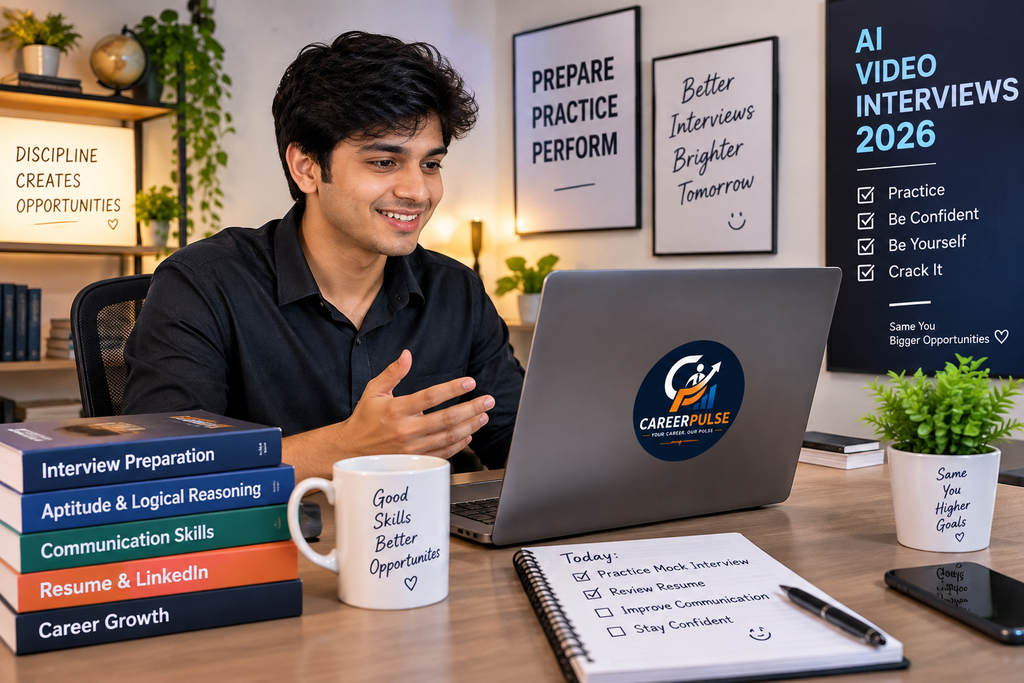
This matters directly for anyone navigating a job search in India right now, not because you’re likely to encounter fraud yourself, but because the response to this trend — heavier monitoring, more aggressive detection systems, growing employer wariness — is reshaping what an AI-conducted interview actually feels like for every genuine candidate going through the process. Understanding both halves of this story, the trust problem itself and the confidence gap it’s creating among honest applicants, matters more than treating AI interviews as just another box to check in your job search.
Table of Contents
Why This Incident Represents a Genuine Shift, Not Just a Headline
AI has been embedded in Indian hiring for a while now — resume screening, automated scheduling, AI Video Interviews 2026 and candidate communication have used AI tools for years without provoking this level of concern. What changed with incidents like the March 2026 case is the target: rather than gaming a keyword filter or an automated resume score, this represents an attempt to falsify identity itself, in real time, during a live interaction a company reasonably expected to be a genuine human conversation. Large-scale AI hiring platforms have responded by building increasingly sophisticated detection tools specifically aimed at catching synthetic video manipulation, but the fact that this arms race is now a standard, ongoing feature of the hiring process — rather than a hypothetical edge case — reflects a genuine, structural shift in how much trust any party can extend by default in an AI-mediated interview.
The Confidence Gap Most Coverage Misses
Separate from the fraud story, there’s a genuinely revealing statistic worth sitting with: LinkedIn’s January 2026 India job search report found that more than 90% of Indian professionals plan to use AI tools for job searching this year, and 66% believe AI genuinely boosts their interview confidence — yet 84% still report feeling unprepared to actually find a new role. That gap between confidence in the tool and confidence in the actual outcome is arguably the more important story for the average honest job seeker than the fraud cases making headlines. Widespread AI adoption in job searching hasn’t translated into widespread genuine readiness, and treating AI assistance as a substitute for real preparation, rather than a supplement to it, appears to be a common, costly mistake.
Why Low-Effort Applications Have Surged Alongside AI Adoption
A related, well-documented trend worth understanding: a 2025 Resume Now study found that 90% of hiring managers had seen a genuine increase in low-effort, “spammy” applications — a direct consequence of how easy AI tools have made it to generate and submit large volumes of generic applications with minimal individual customization. This creates a specific, practical problem for genuinely qualified candidates: as the volume of low-effort applications rises, recruiters and their AI screening tools alike become more aggressively filtered and skeptical by necessity, which means a genuinely strong, well-tailored application now has to work harder to stand out against a noisier overall applicant pool than it did before this volume surge.
A Genuinely Uncomfortable Statistic Worth Knowing
A 2026 Kickresume survey found that 39% of candidates said they would use a small AI-generated exaggeration or falsehood in their application materials if they felt it was justified, while 11% said they’d do so without hesitation. This context matters for understanding why AI hiring platforms have become more aggressively focused on verification and detection generally — the incentive to lightly embellish or, at the extreme, outright falsify has grown alongside the accessibility of tools that make doing so easier, and the resulting employer response affects every candidate going through the same screening process, honest or not.
What Companies Actually Report Gaining From This Technology
It’s worth presenting the employer-side rationale honestly rather than treating AI-driven hiring purely as a threat. Organizations implementing these tools properly report roughly 25 to 30% better candidate-role alignment and hiring cycles shrinking by close to a third. That said, it’s worth applying genuine skepticism to how much of that improvement reflects AI’s analytical sophistication versus a much simpler mechanical gain: automated screening simply prevents recruiters from spending weeks manually reviewing resumes that were never going to be a realistic match in the first place. Both explanations can be true simultaneously — the tools genuinely save time, without that necessarily meaning the underlying assessment technology is as sophisticated or bias-free as vendor marketing often suggests.
The Asymmetry Worth Understanding as a Candidate
One structural feature of an AI-conducted interview is worth naming directly, since it affects how you should approach the experience psychologically: the AI system is analyzing you in granular detail — tone, word choice, pacing, and in video formats, facial expression and body language — while you typically have very limited visibility into how it actually weighs any of these signals or what specifically it’s prioritizing in its assessment. This asymmetry is genuinely uncomfortable, and it’s reasonable to feel a different kind of pressure in this format than in a conversation with a human interviewer who might visibly react, follow up, or adjust based on your answers in ways an automated system generally doesn’t.
The Shift Toward Adaptive Questioning
A specific technical distinction worth knowing if you’re preparing for an AI interview: many current platforms still run on a fixed script — the same five preset questions regardless of how you answer the first one — while a smaller but growing number use adaptive questioning, where your specific answers genuinely shape what’s asked next, closer to how a skilled human interviewer would probe deeper based on your actual responses. If you know in advance which type of platform you’re being assessed through, it’s worth adjusting your preparation accordingly: a fixed-script system rewards well-rehearsed, complete answers to predictable question categories, while an adaptive system rewards genuine, in-the-moment clarity of thought more than pre-memorized responses, since a scripted answer to an unexpected follow-up question tends to read as noticeably disconnected from the actual question asked.
How to Actually Prepare for a Legitimate AI Video Interview
Given how much of this format now shapes early-stage hiring, particularly for high-volume campus placement and bulk enterprise recruitment rounds, a few concrete preparation steps genuinely help:
- Treat your physical setup as seriously as your answers. Face a window or a desk lamp positioned in front of you rather than behind you, since backlighting makes your face difficult for both a human reviewer and an automated system to read clearly. Choose a clean, uncluttered background, and use earbuds with a built-in microphone at minimum — audio quality is a more commonly underestimated factor than video quality in how professionally an interview actually comes across.
- Practice speaking clearly and at a measured pace, since automated systems and time-pressured human reviewers both respond better to answers that are complete but not rambling.
- Prepare for both fixed-script and adaptive formats by having genuine, specific examples ready that you can adapt to slightly different phrasings of the same underlying question, rather than a single rigid script you’d struggle to adjust if the exact expected question doesn’t come up.
- Never attempt to circumvent or falsify any part of the process. Beyond the basic dishonesty involved, detection systems specifically built in response to incidents like the one described above are increasingly capable of identifying manipulated video and audio, and the consequences of being caught — a permanently flagged candidate profile, in some cases shared across platforms and employers — are considerably more severe than simply performing less well in a genuine interview would be.
- Remember that feeling nervous in this format is normal, not a sign you’re doing something wrong. The asymmetry of an AI-mediated interview genuinely feels different from a human conversation, and acknowledging that discomfort to yourself, rather than assuming it reflects poor preparation, can reduce some of the pressure that leads to over-scripted, unnatural-sounding answers.
Where the Underlying Technology Is Actually Headed
Understanding the trajectory of the technology itself is useful for calibrating how much your specific phrasing and delivery genuinely matters, versus how much is still relatively crude pattern-matching. Current advancement in natural language processing specifically aims to interpret nuanced language, context, and sentiment with increasing precision, including improved detection of linguistic patterns associated with personality traits, tone, and confidence levels. This means the systems evaluating you are becoming genuinely more sophisticated at picking up on subtler cues than simple keyword matching, even as the fraud-detection side of this same technology grows more capable of catching manipulated video and audio. The practical implication for a genuine candidate: superficial tricks — reciting a memorized answer that doesn’t actually address the specific question asked, or performing enthusiasm without substance behind it — are becoming less effective as these systems mature, which is, if anything, a reason to lean further into genuine, specific, well-prepared answers rather than generic scripted responses, since the gap between authentic and superficial answers is becoming more detectable rather than less.
What This Means for Freshers Specifically
Given that Taggd’s research indicates 73% of employers plan to hire freshers in the first half of 2026, with a growing emphasis on demonstrated proof-of-work over academic credentials alone, freshers are disproportionately likely to encounter AI-driven screening early in their job search, often before ever speaking with a human recruiter. This makes genuine preparation for this specific format — rather than treating it as a lesser, less important stage than a “real” human interview — a meaningfully higher-stakes part of a fresher’s job search than it might have been in previous hiring cycles, since it’s increasingly the actual first gate a fresher’s application passes through.
The Human Reaction Worth Acknowledging
One detail from recent reporting on this shift is worth sitting with, since it says something honest about the pressure genuine candidates already feel navigating this format: recruiters have reported candidates deliberately scheduling AI interviews at 2 or 3 in the morning, specifically on weekends, so they don’t have to explain to colleagues why they’re stepping away during work hours. There’s a genuinely human logic to this — an AI interview doesn’t require coordinating around a human interviewer’s calendar, which gives candidates flexibility a traditional interview process rarely offers, and some candidates have specifically noted feeling more comfortable asking direct questions about compensation or benefits to an AI system without the same self-consciousness they might feel asking a human recruiter the same question. This is worth knowing both as a practical scheduling option if a genuine off-hours slot works better for your own circumstances, and as a reminder that this format carries real, if underdiscussed, advantages for candidates alongside its more publicized concerns.
What Recruiters Themselves Are Actually Debating
It’s worth knowing that the shift toward AI-conducted first-round interviews isn’t uniformly embraced even within the recruiting profession itself. Senior HR professionals observing this trend have openly questioned whether outsourcing an entire first interview round to an AI system, with a human recruiter only entering the process at a later stage, genuinely serves either the company’s or the candidate’s interests as well as proponents claim. This internal debate matters for how you should interpret the format if you encounter it: an AI-conducted first round isn’t necessarily a sign that a company has decided human judgment is unnecessary at every stage — it’s more often a genuine attempt to filter a very large volume of initial applicants efficiently, with human evaluation still expected to play a meaningful role once you’ve cleared this earlier, higher-volume filtering stage.
Why This Trend Is Unlikely to Reverse Soon
It’s worth understanding why this shift toward heavier AI-driven screening and verification is likely a durable feature of hiring going forward rather than a temporary reaction that fades. The global HR technology market is projected to reach roughly $40 billion by 2027, with AI-powered recruiting tools driving a significant share of that growth, reflecting genuine, sustained enterprise investment rather than a passing experiment. What happens next in terms of how heavily these tools get used likely depends on two counterbalancing forces: regulatory response if these systems produce demonstrably biased outcomes, and candidate pushback if job seekers begin actively avoiding companies perceived as relying too heavily on automated screening. For now, neither force has meaningfully slowed adoption, which means treating AI-mediated interviews as an occasional format you might encounter is less realistic than treating them as an increasingly standard part of how hiring works in India specifically.
A Practical Checklist for Your Next AI Interview
Bringing everything together into something genuinely usable: confirm your lighting and audio setup at least a day in advance rather than testing it minutes before your interview, since technical issues discovered at the last moment add unnecessary stress to an already unfamiliar format. Review the specific role and company details thoroughly enough that your answers can reference genuine, specific knowledge rather than generic statements that could apply to any employer. If the platform allows a practice or test-run mode, use it, since familiarity with the interface itself reduces one meaningful source of nervousness separate from the actual interview content. And throughout the process, resist the temptation to treat the AI system as something to be outsmarted or gamed — the growing sophistication of both the assessment technology and its fraud-detection counterpart means the safest, most effective strategy remains the same one that’s always worked in any interview format: genuine preparation, honest answers, and clear communication of your actual experience and thinking.
Quick Answers
Is AI interview fraud actually a widespread problem in India?
While most candidates are genuine, documented incidents — including a verified real-time synthetic video case in March 2026 — combined with flagged cheating behavior roughly tripling across tracked interviews in a recent three-month window, indicate this is a genuine, growing concern rather than a rare curiosity.
Does using AI to help with my job search actually help me get hired?
It can help with preparation and confidence, but LinkedIn’s own research found a significant gap between candidates’ confidence in AI tools and their actual confidence in finding a role — treat AI assistance as a supplement to genuine preparation, not a substitute for it.
Why have “spammy” low-effort applications increased?
AI tools have made it considerably easier to generate and submit large volumes of generic applications with minimal customization, which a 2025 study found 90% of hiring managers have directly observed increasing.
What’s the difference between a fixed-script and adaptive AI interview?
A fixed-script platform asks the same preset questions regardless of your answers; an adaptive platform adjusts its follow-up questions based on what you’ve actually said, closer to how a human interviewer would probe deeper.
What happens if someone is caught attempting to falsify their identity in an AI interview?
Detection systems built specifically in response to incidents like documented deepfake cases are increasingly capable of identifying manipulated video, and consequences can include a flagged candidate profile shared across hiring platforms — a considerably more severe outcome than an honestly imperfect interview.
Should I be worried about how much data an AI interview system collects about me? It’s reasonable to be aware of this asymmetry — the system analyzes you in considerable detail with limited visibility into its own criteria — though this is a structural feature of the current hiring landscape rather than something an individual candidate can meaningfully opt out of if a specific employer uses this format.
If you’re preparing for this kind of interview format specifically, our guide on How to Answer Tell Me About Yourself covers the opening question that comes up in nearly every interview format, AI-mediated or otherwise, and our piece on the ATS rejection myth is worth reading alongside this one, since understanding what these systems actually do — and don’t do — matters more with each new stage of AI adoption in hiring, and the same underlying principle applies across both: genuine, specific preparation consistently outperforms attempts to game or shortcut a system, whether that system is a resume-parsing algorithm or a live video interview evaluator.
Suggested Internal Links
- Trending Category
- How to Answer Tell Me About Yourself: Best 3-Step Guide
- The 75% ATS Rejection Stat Is Fake: Here’s What’s Real
- Campus Placements 2026: Rising Budgets, Falling Outcomes
Suggested External References
- LinkedIn India Job Search Report 2026: https://www.linkedin.com/business/talent
- World Economic Forum, Future of Jobs Research: https://www.weforum.org
- National Career Service Portal (India): https://www.ncs.gov.in