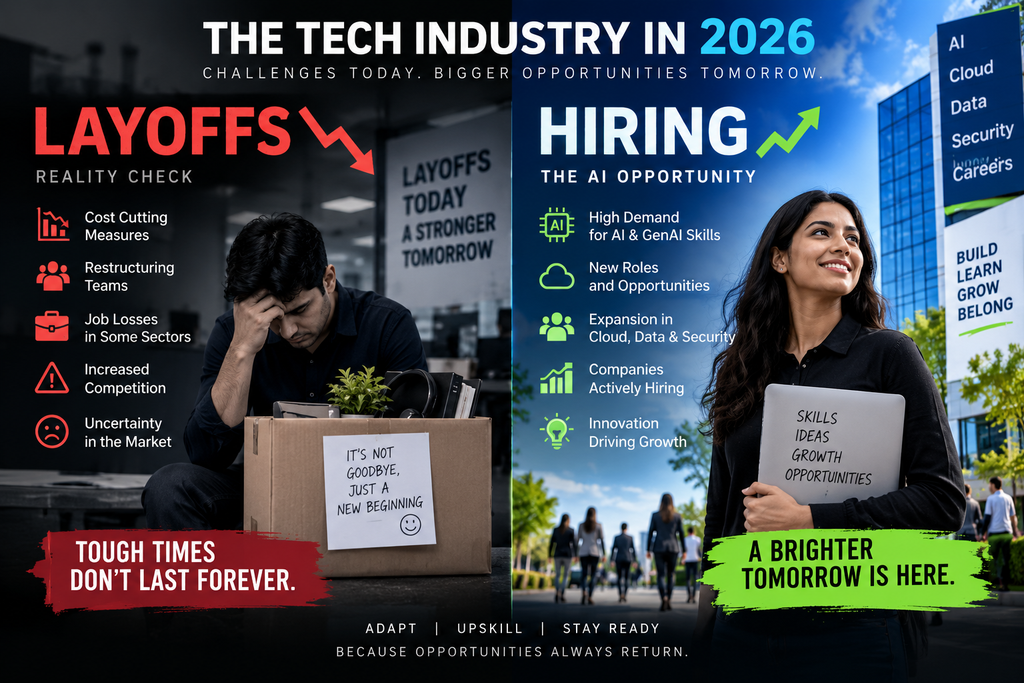
Campus Placements 2026 two things are simultaneously true about India’s 2026 campus placement season, and they sound like they contradict each other until you understand where each one is actually happening. Unstop’s Talent Report 2026, drawing on responses from more than 37,000 students and over 500 HR leaders, found that 87.8% of companies are actively recruiting from campuses this year, with hiring budgets and campus salaries both rising according to Deloitte India’s own Campus Workforce Trends research. At the same time, private engineering colleges across the country reported placement declines of 50 to 70 percent after major IT recruiters scaled back fresher hiring, according to an Economic Times analysis, with NASSCOM separately confirming a prolonged hiring slowdown tied to weaker client demand.
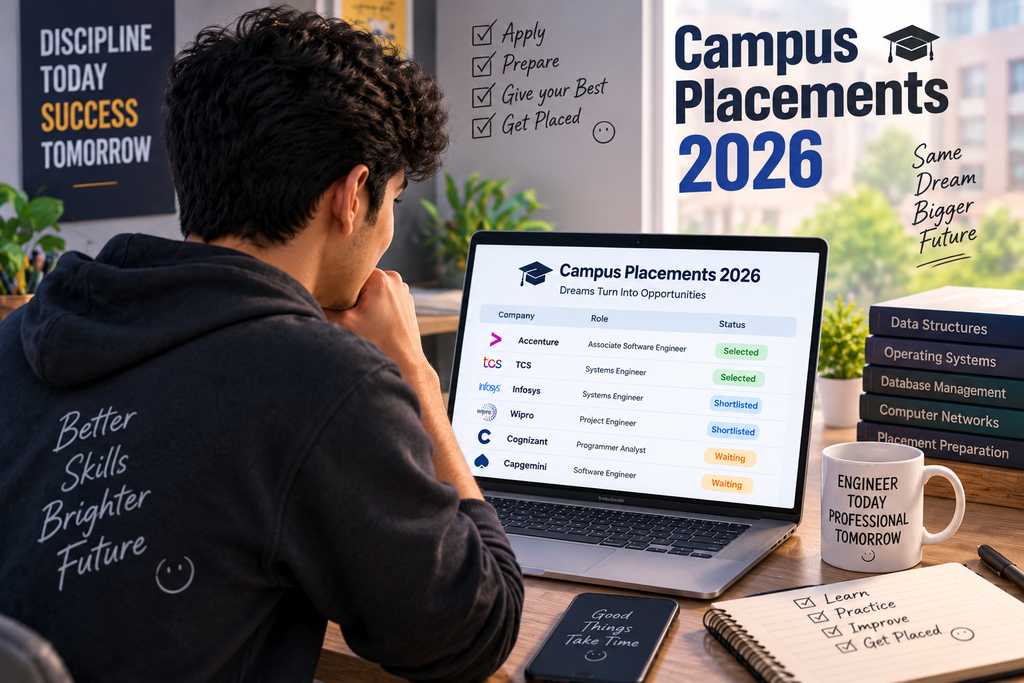
Both of these are accurate descriptions of the same academic year. What’s actually happening is a sharp, well-documented split in where campus hiring is concentrating — a split that matters enormously depending on which specific institution you’re sitting in, and one that most single-headline coverage of “campus placements” completely flattens into one misleading number that serves neither the students seeing genuine gains nor the students facing genuine, measurable decline.
Table of Contents
The Institution That Fell 43% in Two Years
At Devi Ahilya Vishwavidyalaya (DAVV) in Indore,Campus Placements 2026 the number of students placed dropped from 1,744 in 2021-22 to around 1,000 by 2023-24 — a decline of roughly 43% in just two academic years. This isn’t an isolated data point; Karnataka’s engineering colleges reported fewer recruiters visiting campus, lower total offer volumes, and declining participation from large IT firms across the same period, painting a consistent regional picture rather than a single institution’s unique struggle. The pattern repeats consistently enough across private and mid-tier institutions that the Economic Times’ reported 50-70% decline range for private engineering colleges reads less like an outlier statistic and more like the actual, lived experience for a large share of India’s engineering student population this year.
The Institutions Seeing the Opposite Story
At the exact same time, IIT Delhi logged 1,275 placement offers with a 33% surge specifically in pre-placement offers (PPOs) — offers extended before the formal placement season even begins, based on strong internship performance. More striking still: across IIT Delhi, Kanpur, Roorkee, and Hyderabad, a growing number of students are actually rejecting these pre-placement offers this year, choosing to bet on the formal placement season instead, since internship performance and market confidence have been strong enough that students expect to do better by waiting rather than locking in a guaranteed offer early. This is a genuine reversal from previous cycles, when an uncertain job market pushed students to grab any secured offer rather than risk the open market.
Software and big technology companies are returning to these top campuses in force, particularly for AI-related engineering roles, even as consulting recruitment has visibly contracted — the “MBB” firms (McKinsey, Bain, BCG) skipped several IIT campuses entirely this cycle, with students at IIT Hyderabad specifically noting there’s simply no current market requirement pulling consulting roles onto campus the way there once was.
Why Both Stories Are True Simultaneously
The explanation isn’t that one dataset is wrong — it’s that “campus placements” in India were never one uniform market, and 2026 has made the gap between its segments dramatically more visible than in previous years. Unstop’s own analysis frames this precisely: the defining story of 2026 campus hiring is not weak hiring demand, but the widening gap between hiring intent and hiring outcomes. Companies are genuinely increasing hiring budgets, adopting AI-powered recruitment technology, and competing aggressively for the specific pool of graduates they consider genuinely skilled and job-ready. That competition concentrates overwhelmingly at the top of the institutional hierarchy, while the same companies simultaneously pull back sharply on the kind of high-volume, lower-selectivity fresher hiring that private and mid-tier engineering colleges have historically depended on.
The Actual Numbers by College Tier
Rather than one national placement rate, the real picture breaks into three genuinely distinct tiers:
| Tier | Placement Rate | Typical Package Range |
|---|---|---|
| Tier-1 (IITs, IIMs) | 90-100% | ₹17-26 LPA |
| Tier-2 | 50-70% | ₹4-8 LPA |
| Tier-3 | 30-50% | ₹2.5-4 LPA |
Only about 7% of Indian colleges achieve 100% placement in any given year, and even that figure needs a specific caveat most institutions don’t volunteer — more on that below. At the very top of Tier-1, the specific institution-level numbers get even more extreme: IIT Bombay reports an average package of ₹26.45 LPA across all branches, while IIT Madras’s Computer Science branch specifically averages ₹53.2 LPA. Among private institutions, IIIT Hyderabad leads with an average CSE package of roughly ₹32.8 LPA. NIT Trichy, meanwhile, consistently tops NIT-level placement rankings with a ₹14-16 LPA average and what’s been calculated as the highest return-on-investment among all NITs, at 216%.
The “100% Placement” Claim Most Colleges Don’t Fully Explain
This is worth knowing before you take any college’s marketing material at face value: a “100% placement” claim is not always what it sounds like. Most institutions calculate this figure only against the students who registered for the campus placement process in the first place — not against their entire graduating batch. A student who opted out of placements to pursue further study, prepare for competitive exams, or pursue entrepreneurship isn’t counted in the denominator at all, which means a college’s headline “100% placement” figure can coexist with a meaningfully lower share of its total graduating class actually being placed through campus recruitment. Before treating any specific college’s placement statistics as directly comparable to another’s, check whether both are calculating the rate against the same base — registered candidates versus total batch strength — since this single methodological choice can shift the reported number dramatically without any change in actual hiring outcomes.
What’s Actually Driving Demand Where It Exists
Where hiring is genuinely growing, it’s concentrated in specific, identifiable domains rather than spread evenly. Computer Science and Engineering continues to command the highest packages across virtually every college tier, but it’s no longer alone at the top — AI and Data Science, Electronics and Communication Engineering (driven specifically by the ongoing semiconductor investment wave from companies like Nvidia, Qualcomm, and Intel), and Mathematics and Computing are all seeing premium packages that in some specialized firms now exceed what pure CSE graduates command. This mirrors a broader structural shift covered elsewhere on this site regarding the current job market: demand isn’t uniformly collapsing or uniformly growing — it’s concentrating sharply around AI, machine learning, and specialized technical domains, while more generalist, high-volume technical hiring contracts.
The Skills-First Shift Behind the Numbers
Deloitte’s own campus workforce research found that 93% of surveyed campuses now treat technical interview performance as a pivotal placement criterion, alongside a documented 33% reduction in campus placement budget allocation in one recent measured period even as variable, performance-linked pay rose by 250 basis points. Internship intake by hiring organizations fell roughly 10% on average in the same window, and pre-placement offers dropped by 26% annually in that specific measured cycle — figures that sit in visible tension with 2026’s reported budget increases, underscoring just how volatile and non-linear this hiring cycle has been year to year, even before accounting for the tier-based split covered above.
The throughline across all of this data is a genuine pivot toward skills-first, competency-specific hiring rather than broad degree-based recruitment — companies are increasingly selecting for specific skill clusters (AI/ML within engineering, for instance) rather than hiring broadly across an entire graduating class from a target list of colleges the way fresher hiring often worked in previous, higher-volume cycles.
What Actually Improves Your Individual Odds, Regardless of Tier
Since your specific college’s aggregate placement rate is largely outside your individual control, it’s worth focusing on what genuinely does move the needle at an individual level. Research specifically cited in current campus hiring analysis found that early preparation starting from the first year of college yields 40 to 50% better placement outcomes compared to last-minute preparation concentrated in the final year. Structured, repeated mock interview practice has been shown to meaningfully lift interview conversion rates compared to last-minute preparation crammed into the weeks before placement season. And given that 87% of companies now use AI at some stage of their hiring process, genuine digital assessment readiness — comfort with online coding tests, AI-proctored interviews, and algorithmic screening — has become a baseline expectation rather than an optional extra.
Soft skills specifically have also risen sharply in reported importance: current analysis places soft skills in 7 of the top 10 rising-demand skill categories for 2026, with employers now screening communication ability directly and explicitly, not treating it as a secondary consideration behind technical competence alone.
The Consulting Sector Contraction Deserves Its Own Explanation
The specific detail about McKinsey, Bain, and BCG skipping several IIT campuses entirely this cycle is worth dwelling on a moment longer, since it represents a genuinely notable shift for a career path that has historically been treated as a prestige default for top engineering and management graduates. Students directly involved in placement processes at IIT Hyderabad and IIT Delhi have specifically noted that current market conditions simply don’t require the volume of strategy consulting hires these firms once brought onto campus, and separately, fewer students themselves are actively applying for consulting roles this cycle — suggesting this isn’t purely a firm-side pullback but also a genuine shift in student interest and perceived opportunity, moving toward the AI and technical roles where campus hiring has concentrated instead. For students specifically building toward a management consulting career, this suggests the traditional campus-to-MBB pipeline that top Indian engineering graduates have relied on may require more deliberate, off-campus relationship-building and application effort than it has in recent years, rather than assuming these firms will simply show up to campus as they reliably did in prior cycles.
Why This Matters Beyond Just Engineering Students
While this data centers on engineering placements specifically, the underlying pattern — a widening gap between headline hiring intent and actual, individual-level hiring outcomes, concentrated heavily by institutional tier — reflects the same broader labour market bifurcation covered elsewhere on this site regarding India’s overall graduate unemployment picture. This isn’t a story unique to one academic discipline; it’s a specific, well-documented instance of a pattern playing out across India’s broader graduate job market this year, where aggregate positive indicators (rising budgets, rising overall employability scores) coexist with a genuinely harder individual experience for anyone outside the specific, narrow segment of institutions and skill profiles currently in highest demand.
What This Means If You’re Choosing a College Right Now
If you’re a prospective student weighing which college to attend based partly on placement outcomes, this data suggests a specific, actionable lesson: check branch-wise and tier-adjusted placement data for the specific college and specific branch you’re considering, rather than relying on a single, headline “X% placement” figure that may be calculated against a registered-candidates base rather than the full batch. A college’s overall reputation matters less for your individual outcome than the specific branch’s actual recent recruiter participation and package trends — a strong student from a mid-tier NIT can genuinely outperform an average student from a more prestigious IIT, precisely because individual preparation, projects, and skill-building matter as much as institutional brand once you’re actually in the interview process.
The BITSAT and JEE Decision Point Worth Understanding
For students still choosing where to apply, current admission-and-placement analysis offers a specific, actionable heuristic worth knowing. A BITSAT score above 300 is generally considered to make BITS Pilani (any campus) a strong choice, with placement outcomes described as broadly comparable to a mid-tier IIT for Computer Science specifically. For students with solid board results but a moderate JEE rank, institutions like VIT Vellore, Thapar, and SRM are commonly recommended specifically for their CSE and AI branches — with the explicit caveat that branch-wise placement data should be checked individually before applying, since these institutions’ outcomes vary considerably by specific department in a way their overall institutional reputation doesn’t fully capture. This distinction between an institution’s brand and its specific branch-level outcomes is precisely the gap that trips up many families making college decisions based on overall rankings rather than the granular, branch-specific data that actually predicts an individual student’s realistic outcome.
Why NIT Trichy’s ROI Figure Matters More Than It First Appears
The 216% return-on-investment figure reported for NIT Trichy is worth unpacking briefly, since it illustrates a genuinely useful way to evaluate a college beyond raw package numbers alone. This kind of ROI calculation typically weighs the total cost of education (tuition, fees, and often estimated living costs) against the average starting package, producing a measure of value that a raw ₹14-16 LPA figure alone doesn’t capture — a considerably more expensive private institution offering a similar package would show a meaningfully lower ROI by this same calculation. For families weighing the total cost-benefit of an engineering education rather than package size alone, this kind of value-adjusted comparison is a genuinely more useful lens than comparing raw placement package figures across institutions with very different fee structures.
What Recruiters Are Actually Prioritizing in Interviews Right Now
Given that 93% of surveyed campuses now treat technical interview performance as the pivotal placement criterion, it’s worth being specific about what that actually means in practice for a candidate’s preparation. This isn’t simply about knowing more theoretical computer science content than a peer — it reflects a broader shift toward evaluating genuine, demonstrated problem-solving ability under real interview conditions, often through live coding assessments or structured technical rounds rather than purely resume-based screening. Combined with the specific finding that soft skills now occupy 7 of the top 10 rising-demand skill categories, the clear signal for any student preparing for placement season is that technical depth alone, without the ability to communicate that technical thinking clearly and confidently under interview pressure, increasingly falls short of what recruiters are actually screening for in 2026’s more selective hiring environment.
Quick Answers
Are campus placements in India actually getting worse in 2026?
It depends entirely on which tier of institution you mean — Tier-1 institutions like IITs are seeing placement increases and rising pre-placement offer numbers, while private and mid-tier engineering colleges have reported placement declines of 50 to 70%.
Why are hiring budgets rising if fewer students are getting placed?
Because rising budgets and hiring intent are concentrating around a narrower pool of institutions and specific skill profiles (particularly AI/ML and specialized technical domains), rather than being distributed evenly across all colleges the way high-volume fresher hiring once was.
Is a college’s “100% placement” claim reliable?
Treat it with caution — most colleges calculate this figure only against students who registered for the placement process, not their total graduating batch, which can make the reported figure considerably higher than the share of the full class actually placed.
Which engineering branches command the highest packages in 2026?
Computer Science and Engineering remains the top branch broadly, with AI/Data Science, Electronics and Communication Engineering (driven by the semiconductor investment boom), and Mathematics and Computing also commanding premium packages at specialized firms.
Does the college I attend matter more than my own preparation?
Individual preparation matters significantly — research shows early, first-year preparation yields 40-50% better outcomes than last-minute effort, and strong students from mid-tier institutions frequently outperform average students from higher-ranked ones in the actual interview process.
Why are IIT students rejecting pre-placement offers this year?
Strong internship performance and market confidence have led more students to bet on the formal placement season for potentially better offers, rather than accepting a guaranteed pre-placement offer early, reversing a pattern from more uncertain previous hiring cycles.
If you’re navigating this more selective, skills-first hiring environment, our guide on AI Powered Software Engineer Preparation covers the specific technical fundamentals that matter most given how heavily current hiring has concentrated around AI and specialized engineering domains, and our piece on the ATS rejection myth is worth reading alongside this one, since 87% of companies now using AI in hiring means understanding how these systems actually work — and what they don’t actually screen for — matters considerably more than it did in previous, less algorithmically-driven hiring cycles.
Suggested Internal Links
- Trending Category
- AI Powered Software Engineer Preparation: Best 2026 Guide
- The 75% ATS Rejection Stat Is Fake: Here’s What’s Real
- India’s Unemployment Is 3.2%. Why Doesn’t It Feel Like It?
Suggested External References
- NASSCOM Industry Analysis: https://nasscom.in
- Deloitte India Campus Workforce Trends Research: https://www.deloitte.com/in
- National Career Service Portal (India): https://www.ncs.gov.in