Free Cloud Certifications India If you’ve searched for a free Microsoft Azure certification and landed on a page mentioning student discounts, there’s a detail worth checking before you get your hopes up: Microsoft’s own Learn platform explicitly confirms its standard student discount is not available in India and China — two of the largest markets for exactly this kind of certification. This isn’t a rumor or an outdated policy that’s since changed; it’s been directly verified against Microsoft’s own current student discount page, which explicitly names both countries in its list of exclusions rather than leaving this as an ambiguous, unstated gap in coverage. A lot of generic “free certification” roundups either miss this exclusion entirely or bury it deep enough that Indian readers walk away assuming a path exists that, for them specifically, simply doesn’t.
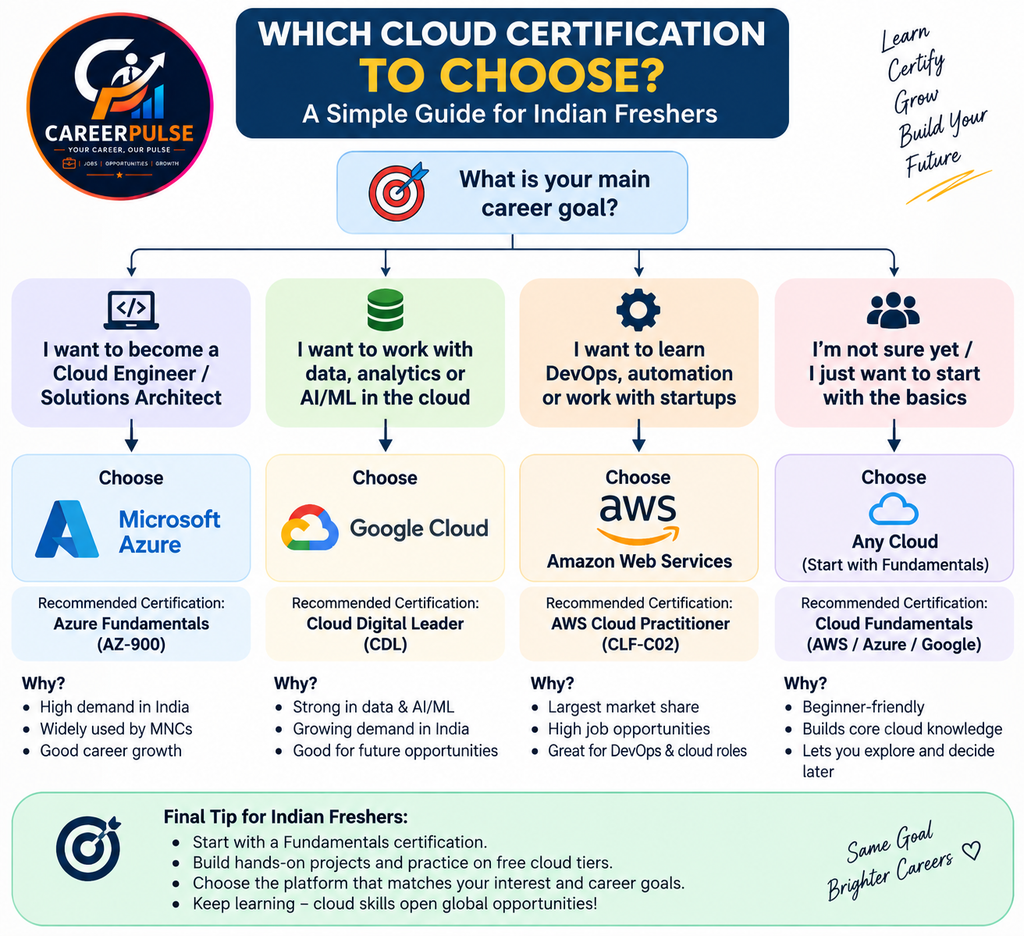
The good news is that this exclusion doesn’t mean Indian students are locked out of free or heavily discounted cloud certifications altogether — it means the actual working paths look different from what a generic global guide describes, and understanding which specific route genuinely applies to you matters more than following advice written primarily for a US or European student audience, since applying instructions meant for a different country’s eligibility rules wastes time you could spend on a path that actually works for your situation. This guide covers what actually works for Indian students across Microsoft, Google, and AWS specifically, and — just as importantly — which certification is worth prioritizing first given how India’s fresher job market is actually structured.
Table of Contents
The Exclusion, Confirmed Directly
To be precise about what’s actually excluded: Microsoft Learn’s student discount program, which in eligible countries provides a straightforward reduced-cost path to certification exams for verified students, Free Cloud Certifications India does not extend that specific discount mechanism to India or China. This has been directly verified against Microsoft’s own official student discount page as of April 2026. If a guide or forum post tells you to simply verify your student status through Microsoft’s standard student portal to unlock a discounted Azure exam, and you’re applying from India, that specific path won’t work — not because of an error on your end, but because the discount itself isn’t offered in your country.
What Actually Works for Microsoft Certifications in India
Since the direct student discount route is closed, the genuine working path for Indian students runs through a different mechanism: Microsoft Virtual Training Day events. These are free, structured training sessions Microsoft runs regularly, and attendees who complete the full training receive an email containing a discount voucher — typically 50% off the corresponding certification exam. For the AZ-900 (Azure Fundamentals) exam specifically, this reduces the cost from ₹3,696 to approximately ₹1,848, a genuine and verified discount mechanism that Indian students can actually access, unlike the standard student discount portal.
Beyond the Virtual Training Day route, Microsoft’s Cloud Skills Challenge program has also been documented as another voucher-earning mechanism, typically requiring completion of specific learning modules within a defined challenge period. Both of these routes require genuine time investment — attending live or scheduled sessions, completing structured learning paths — rather than simply verifying an eligibility status, but they represent real, currently working paths to a discounted exam fee for Indian students specifically.
Why Azure Specifically Matters More for Indian Freshers Than Global Rankings Suggest
This is worth understanding clearly, since global cloud market share data can mislead you about what actually matters for your specific career context. Globally, AWS holds the largest overall cloud market share. But for the Indian fresher job market specifically, Microsoft Azure has a broader and deeper practical reach, simply because Azure is the dominant cloud platform used internally by India’s largest IT services employers — TCS, Infosys, Wipro, HCL, Cognizant, and Tech Mahindra all standardize heavily on Azure for their client engagements. Since these companies collectively hire an enormous share of India’s engineering fresher intake every year, the volume of entry-level job postings on platforms like Naukri and LinkedIn specifically requiring or preferring Azure skills is significantly higher than AWS and Google Cloud combined, at the entry-level tier specifically.
This doesn’t mean AWS or Google Cloud certifications are less valuable in an absolute sense — for roles at Google-partnered companies, product-focused startups, or data-intensive organizations specifically, AWS and GCP credentials carry equal or sometimes greater weight. But if you’re a fresher trying to decide which single certification to prioritize first, given limited time and the reality of where the highest volume of entry-level Indian job postings actually cluster, Azure Fundamentals (AZ-900) is a genuinely well-reasoned starting point specifically because of this employer concentration, not because it’s inherently a “better” technology than its competitors.
The Google Path: GEAR and Get Certified
Google runs its own structured, no-cost path toward cloud certification through the GEAR (Get Certified) program under the broader Google Developer Program. This isn’t a simple discount code — it’s a genuine, structured learning cohort combining live instruction, hands-on labs in real cloud environments (not just simulations), and peer and mentor support, with a certification exam voucher earned only after completing all required learning milestones within your specific cohort’s timeline, including finishing labs and earning skill badges along the way. A notable detail: a faster, 6-week express path exists specifically for candidates already certified in AWS or Azure, letting existing cloud-certified professionals cross-qualify into Google’s ecosystem more quickly than starting from scratch.
To apply, you need to sign up with a valid work or institutional email address linked to a Google Workspace or Cloud account — a detail worth preparing for in advance if your only email is a personal Gmail account not linked to any institutional Google Workspace setup.
The AWS Path: Educate and Academy, Not a Direct Discount
AWS’s free offering for students works differently from a direct exam discount. AWS Educate provides free training content, hands-on labs, and sandbox cloud environments — genuinely useful for building practical skills — but it does not, by itself, hand you a discounted certification exam voucher. The actual route to AWS certification credits for students typically runs through AWS Academy, a program universities opt into and then distribute credits or vouchers to enrolled students taking AWS-aligned coursework. Practically, this means your access to AWS certification cost reduction depends significantly on whether your specific college or university has enrolled in AWS Academy — worth checking directly with your institution’s IT or placement department, since this isn’t something you can self-enroll into as an individual student the way you can with Microsoft’s Virtual Training Day route.
The GitHub Student Developer Pack: An Adjacent, Genuinely Useful Resource
Separate from direct certification vouchers, the GitHub Student Developer Pack unlocks a genuinely substantial bundle of free cloud credits and tools once you verify your student status — including credits toward MongoDB Atlas (alongside free access to MongoDB University certifications), Heroku platform credits, and various other developer tool discounts. While this doesn’t directly discount an AWS, Azure, or GCP certification exam specifically, it does provide genuinely free infrastructure to build the hands-on projects that strengthen both your certification preparation and your resume — treating this as a complementary resource alongside your certification path, rather than a substitute for one, is the most useful way to think about it.
A Genuine Decision Framework, Not Just “Get All Three”
Given limited time as a student, it’s worth having an actual framework for deciding where to start rather than attempting all three major cloud platforms simultaneously:
- Choose Azure first if you’re targeting roles at large Indian IT services companies specifically — the volume of entry-level job postings favoring Azure skills in this specific employer segment makes it the highest-leverage single certification for this common career path.
- Choose AWS if you’re specifically targeting global startups, e-commerce-focused companies, or roles emphasizing scalable infrastructure and DevOps specifically, given AWS’s broader global market recognition and the specific technical reputation it carries in these segments.
- Choose Google Cloud if your interests lean toward data engineering, machine learning, or AI-driven roles specifically — GCP’s certification tracks (particularly Professional Data Engineer) are specifically oriented toward this domain, and professionals in this space in India report starting packages in the ₹10-16 lakh range.
None of these choices is permanent or exclusive — many working cloud professionals eventually hold certifications across more than one platform — but as a fresher deciding where to invest your first serious preparation effort, matching your choice to your actual target employer segment is a more effective strategy than picking based purely on which platform sounds most prestigious in general technology discourse.
What to Actually Do, Step by Step
- If targeting Azure: Search for Microsoft’s current Virtual Training Day schedule and register for a session relevant to Azure Fundamentals or your target certification track; complete the full session to receive your discount voucher by email.
- If targeting Google Cloud: Look into the GEAR/Get Certified program specifically, prepare a Google Workspace-linked email if you don’t already have one, and be realistic about the time commitment, since voucher issuance depends on completing every required milestone within your cohort’s specific timeline.
- If targeting AWS: Check directly with your college or university whether it participates in AWS Academy, since this is the most realistic route to genuine AWS certification cost reduction as a student, separate from the free but non-certification-discounting AWS Educate program.
- Regardless of platform: Set up your GitHub Student Developer Pack if you haven’t already, since the credits and tools it unlocks support genuine hands-on project work that strengthens your certification preparation and your resume simultaneously.
- Verify current pricing and program terms directly on each platform’s own official page before committing time to a specific path, since exam fees, voucher mechanisms, and program structures do change over time.
Why the Certification Itself Isn’t the Whole Story
It’s worth being honest that a certification badge alone, without genuine hands-on project experience behind it, carries less weight with employers than the certification-plus-project combination. Recruiters and technical interviewers increasingly probe for actual, demonstrated experience working within a cloud environment — deploying something real, troubleshooting an actual configuration issue — rather than accepting a certification as sufficient proof of capability on its own. This is exactly why pairing your certification path with the free cloud credits and lab environments covered above (GitHub Student Pack, AWS Educate’s sandbox labs, Google’s hands-on GEAR labs) matters as much as the certification exam itself — the certification demonstrates you’ve covered the required knowledge; a genuine project demonstrates you can actually apply it.
Preparing Beyond Just the Voucher
Earning a discount voucher through any of these paths solves the cost problem, but it doesn’t solve the actual exam preparation itself. For Azure specifically, Microsoft Learn’s own free learning paths — self-paced, modular content covering exactly the material the AZ-900 exam tests — remain freely accessible regardless of which voucher route you pursue, and working through these systematically before attempting the exam is a genuinely more reliable preparation strategy than relying solely on the content covered during a single Virtual Training Day session. The AZ-900 exam itself runs 85 minutes and typically includes 40 to 60 questions, giving you a reasonably generous per-question time budget if your underlying conceptual understanding is solid, which makes thorough preparation through the free learning modules a better use of your remaining preparation time than extensive practice-test cramming alone.
What Happens If You Don’t Complete a Voucher Program’s Requirements
It’s worth being realistic about the commitment these programs actually require, since a partially completed cohort or training session generally doesn’t yield a partial voucher. Google’s GEAR program specifically requires completing all milestones within your cohort’s defined timeline — falling short partway through, even after genuine effort, typically means no voucher is issued for that cohort cycle, though many of these programs allow you to reapply for a future cohort rather than being permanently locked out. Before committing to a specific program, honestly assess whether your current semester’s schedule genuinely allows for the sustained engagement these structured programs require, since starting a cohort you’re unlikely to finish wastes both the opportunity and the time you do invest before dropping off partway through.
How Long This Realistically Takes
Given the multi-step nature of most of these voucher-earning paths, it’s worth setting realistic expectations about time investment rather than assuming a certification can be secured in a single weekend. Microsoft’s Virtual Training Day sessions themselves typically run a few hours, but genuine AZ-900 exam readiness on top of that session usually requires several additional weeks of independent study using Microsoft Learn’s free modules, particularly if you’re new to cloud computing concepts entirely. Google’s GEAR program is explicitly structured as a multi-week cohort with defined milestones, meaning it isn’t designed for rapid completion by design — the structure itself assumes sustained engagement over the cohort’s full timeline. Building this into your semester planning early, rather than treating it as something to squeeze in during a single free week, meaningfully improves your odds of actually completing whichever path you choose rather than abandoning it partway through once academic deadlines resurface.
A Note on Regional and In-Person Training Options
Beyond the fully online paths covered above, several Indian states and city-level initiatives — including some of the skilling programs covered elsewhere on this site, like TASK Telangana and APSSDC — occasionally run their own cloud-specific training tracks in partnership with major providers, sometimes bundling exam vouchers directly into a structured, college-linked program rather than requiring you to navigate a global provider’s self-serve voucher system independently. If your college participates in one of these state-level skilling initiatives, it’s worth checking specifically whether a cloud certification track is currently offered through that channel before defaulting entirely to the global, self-directed paths described above, since a college-linked program may offer more structured support and a clearer path to actually completing the certification than navigating an international provider’s requirements entirely on your own.
Why This Also Matters for Working Professionals Considering a Cloud Pivot
While this guide focuses primarily on students, it’s worth noting that several of these same paths — Microsoft’s Virtual Training Day vouchers and Google’s GEAR program specifically — aren’t formally restricted to enrolled students in the way a university-verified discount would be. If you’re an early-career working professional considering a pivot toward cloud infrastructure or DevOps work, these same voucher-earning mechanisms are generally accessible to you as well, making this guide’s practical advice relevant beyond the student population it’s primarily framed around.
Quick Answers
Is Microsoft’s student discount for Azure certifications available in India?
No, this has been directly confirmed on Microsoft’s own official student discount page — India and China are both explicitly excluded from this specific discount mechanism.
How can Indian students still get a discounted Azure certification?
Through Microsoft Virtual Training Day events, which provide a discount voucher (typically 50% off) via email upon completing the full training session — this works in India even though the standard student discount doesn’t.
Why is Azure recommended over AWS for Indian freshers specifically?
Because India’s largest IT services employers (TCS, Infosys, Wipro, HCL, Cognizant, Tech Mahindra) standardize heavily on Azure, making entry-level Azure-related job postings significantly more common than AWS or GCP postings at the fresher level specifically.
Does AWS Educate give students a free certification exam?
No, AWS Educate provides free training content and lab environments but not a direct certification discount — genuine AWS certification cost reduction for students typically comes through AWS Academy, which depends on your university’s participation.
What is Google’s GEAR program?
A structured, no-cost certification pathway combining live instruction, hands-on labs, and mentor support, where a certification exam voucher is earned only after completing all required learning milestones within your specific cohort.
Should I pursue certifications on all three major cloud platforms?
Not necessarily as a starting strategy — choosing the platform most aligned with your target employer segment first is generally a more effective use of limited preparation time than spreading effort across all three simultaneously.
If you’re building your resume around a new cloud certification, our guide on Free ATS Resume Builder Tools 2026 covers how to present a technical credential like this clearly, and our piece on AI Powered Software Engineer Preparation is worth reading alongside this one if you’re building toward a broader technical interview process beyond the certification itself, since employers increasingly expect certified candidates to demonstrate the underlying technical reasoning behind a credential, not just the badge itself.
Suggested Internal Links
- Career Resources Category
- AI Powered Software Engineer Preparation: Best 2026 Guide
- Free ATS Resume Builder Tools 2026: 7 Tested
- Skill India Digital Hub vs NCS: What’s Different
Suggested External References
- Microsoft Learn Student Discount Page: https://learn.microsoft.com/en-us/credentials/support/student-eligibility
- Google Developer Program GEAR: https://developers.google.com/program/gear/getcertified
- GitHub Student Developer Pack: https://education.github.com/pack