Most advice about exit interviews treats honesty as a personal virtue you either have the courage to display or don’t — be brave, speak your truth, don’t be a coward and just say “better opportunity” like everyone else does when they’d rather avoid an uncomfortable conversation entirely. This framing misses something genuinely more important and better documented: research from the Work Institute found that 40 to 63% of employees change their stated reason for leaving depending on whether they’re interviewed by internal HR or by a confidential third party. That’s not a story about individual courage varying wildly from person to person. It’s a story about how a specific structural feature of the conversation — who’s actually asking, and what their institutional loyalties are — predictably shapes what people say, almost regardless of how honest any individual genuinely wants to be.
Once you understand this, the real, useful question shifts from “how brave should I be” to “what does the actual structure of this specific exit interview tell me about how safe honesty genuinely is here” — and how to give feedback that’s both truthful and strategically sound given that structure. This guide covers both.
Why the Interviewer’s Identity Changes the Answer Before You’ve Said a Word
The core insight worth internalizing is stated precisely in one detailed analysis of how Indian exit interviews actually function: when an employee is interviewed by someone from the same organization they’re leaving — even an HR professional they genuinely respect — the underlying social and political dynamics of that relationship don’t simply disappear because there’s a form in front of them. Departing employees remain mindful of professional references. They know their feedback might eventually find its way back to their former manager, through channels they can’t fully control or predict. They understand that HR’s institutional loyalties, however well-intentioned any individual HR professional might personally be, are structurally distinct from the departing employee’s own interests. The result, consistently: people give the version of the truth that feels safest — “better opportunity,” “personal reasons,” “growth” — which tells the organization essentially nothing it didn’t already know, and tells you, the departing employee, nothing about whether your genuinely honest feedback would actually be received the way you’d hope.
The Single Most Common Structural Mistake in Indian Exit Interviews
Given how much the interviewer’s identity matters, it’s worth knowing the specific, well-documented failure pattern that undermines exit interview honesty most consistently in Indian companies, particularly smaller and mid-sized organizations with less formalized HR processes: employees will not criticize their manager to that manager’s own face. This sounds almost too obvious to need stating, yet it’s identified specifically as the single most common mistake companies make when structuring this process — scheduling the exit interview with the departing employee’s own direct manager, or someone close enough to that reporting line that genuine, unfiltered feedback about that manager specifically becomes functionally impossible to give.
This gives you a genuinely useful, concrete diagnostic before you even walk into your own exit interview: who is actually conducting it? If it’s your own direct manager, or someone clearly aligned with them, treat this as a structural signal that genuine safety for candid feedback about that specific person or their team’s dynamics simply isn’t present in this conversation, regardless of how the conversation is framed. If it’s a neutral HR representative or senior leader genuinely outside your reporting line, the structural conditions for more candid feedback are meaningfully better — though, as the research above shows, even this doesn’t fully eliminate the underlying trust gap compared to a genuinely external, confidential third party.
Loaded Questions Worth Recognizing in the Moment
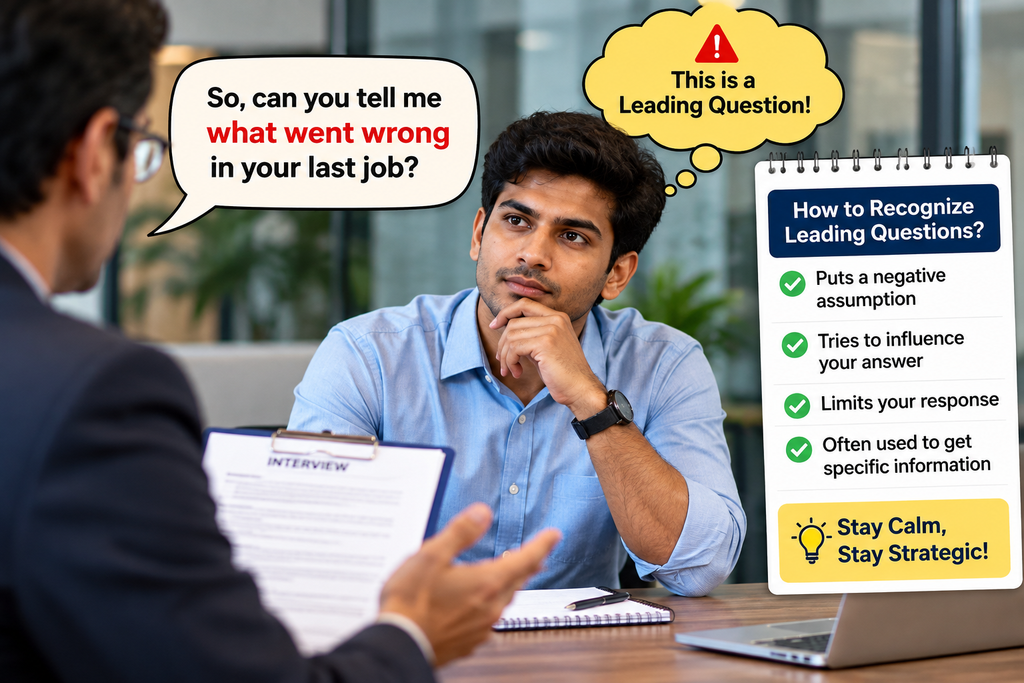
Beyond who’s asking, it’s worth being able to spot specific question framings designed, whether deliberately or not, to steer you toward a particular answer rather than genuinely inviting your honest view. Questions like “Don’t you think the company has been fair to you?” or “Wouldn’t you agree your manager was supportive?” put you on the defensive by embedding the desired answer directly into the question itself — disagreeing requires actively pushing back against the question’s own framing, which takes more social effort than simply agreeing. Recognizing this pattern in the moment lets you respond on your own terms rather than being subtly steered — a simple, neutral reframe like “I’d put it this way instead…” lets you answer the underlying question honestly without accepting the leading premise embedded in how it was originally asked.
What Genuine Downside Actually Looks Like, Honestly Presented
It’s worth being straightforwardly honest about the fact that professional opinion genuinely differs on how much real risk candid exit interview feedback carries, rather than presenting a single confident verdict either way. Some experienced professionals argue there’s minimal practical downside once you’ve already secured a new role — the company can’t meaningfully retaliate against someone who’s already leaving, and if a reference is needed later, a poor final interaction is unlikely to be the deciding factor given everything else in a multi-year employment record. Others caution more seriously: unfiltered criticism, even when well-intentioned, can result in being informally flagged as a “problem employee” or placed on an internal do-not-rehire list, entirely outside your own visibility, with consequences that surface unpredictably later, sometimes years down the line when you’d have no way of connecting a stalled opportunity back to a specific exit interview conversation. Neither position is objectively “correct” — the honest answer is that outcomes genuinely vary by organization, industry, and how the feedback itself is delivered, which is exactly why the structural read on who’s interviewing you, described above, matters as much as it does.
The Technique That Actually Works Across Most Situations
Regardless of how much structural safety you judge to be present in your specific exit interview, a consistent technique improves your odds of giving feedback that’s both genuinely honest and professionally protective:
- Address patterns and situations, not named individuals. Describing what made a specific type of situation stressful or dysfunctional, without attaching a name to it, conveys the same substantive information while giving you meaningfully more protection if that feedback does eventually circulate back informally.
- Pair any criticism with a specific, actionable suggestion. Rather than simply stating that something didn’t work, framing it as “this approach created friction; something like [specific alternative] might address it” reads as constructive input rather than a complaint, and it’s also simply more useful feedback for the organization to actually act on.
- Avoid framing anything as a personal grievance, even when it genuinely was one. Reframing a personally difficult experience as an observation about a broader pattern — “the team’s workload distribution created real strain” rather than “my manager overworked me specifically” — carries the same substantive information with less personal exposure attached to it.
- Express genuine gratitude where it’s authentic, without letting it dilute your substantive feedback. These aren’t mutually exclusive — you can genuinely value specific colleagues or experiences while still being honest about what didn’t work, and doing both together tends to land as more credible and balanced than either pure criticism or pure positivity alone.
Why This Matters for the Organization, Not Just for You
It’s worth understanding the actual stakes on the other side of this conversation too, since it clarifies why a well-run exit interview genuinely matters beyond just being a bureaucratic formality. SHRM’s benchmarking data puts the average cost of replacing an employee at several thousand dollars, with total costs — including lost productivity during the transition — reaching three to four times that position’s actual salary once fully accounted for. With projected average attrition in India standing around 13.6% for 2026, genuine, actionable exit interview feedback represents one of the more cost-effective tools an organization has available for understanding and addressing turnover drivers — but only if the structural conditions described throughout this guide actually allow honest feedback to surface in the first place. An organization that structurally undermines its own exit interview process, by having managers interview their own departing reports or by never actually reviewing and acting on what’s collected, is quietly discarding one of its most useful, low-cost sources of institutional feedback.
What Good Exit Interview Practice Actually Looks Like, From the Company Side
Understanding what a well-structured process looks like helps you calibrate how seriously to take your own specific exit interview. Genuine best practice, per current HR guidance for Indian companies, calls for the interview to be conducted by someone from HR specifically, not the departing employee’s direct manager, scheduled three to five days before the employee’s actual last working day (giving enough distance for a candid conversation without it feeling rushed on either side), running 30 to 45 minutes, and covering a structured set of 10 to 15 questions addressing role satisfaction, management effectiveness, company culture, compensation fairness, and career growth opportunities specifically. If your own exit interview matches this structure reasonably closely, that’s a genuine signal the organization is treating this process with real intent. If it’s a rushed, five-minute checkbox conversation scheduled with your own manager on your literal last day, that mismatch tells you something useful about how much weight to actually give your own honest input in that specific setting.
Remembering This Isn’t Really About You
A useful final reframe: the actual purpose of an exit interview, from the organization’s perspective, is gathering actionable feedback to reduce future turnover — not providing you with catharsis, and not serving as a final referendum on your entire employment experience. Approaching it with this in mind helps calibrate your own tone: neither withholding everything behind a flat “everything was great,” which gives the organization nothing useful, nor using the conversation to vent accumulated frustration in a way that primarily serves your own immediate emotional release at some risk to your professional standing. The middle path — specific, pattern-focused, constructively framed feedback, delivered with an accurate read on how much structural safety the specific conversation actually offers — serves both your own interests and the organization’s genuine purpose in asking, which is about as good an outcome as this particular, inherently imperfect conversation can realistically produce.
Written Versus Verbal: Does the Format Change Anything?
It’s worth knowing whether a written exit survey offers genuinely more safety than a verbal, in-person conversation, since companies increasingly use both formats. A written format does offer some genuine advantages — you have time to consider your wording carefully rather than responding under the social pressure of a live conversation, and there’s less risk of an offhand, unguarded comment escaping in the moment. That said, a written survey conducted through your employer’s own internal systems is still generally attributable back to you specifically, since it’s rarely genuinely anonymous even when framed that way, particularly in smaller organizations where the pool of recently departed employees at any given time is small enough to make individual responses identifiable by process of elimination. Treat a written exit survey with the same structural skepticism you’d apply to a verbal interview with internal HR — better than a live conversation with your own manager, but still meaningfully different from a genuinely anonymous, external, confidential third-party process.
Why the Relief of Finally Leaving Can Cloud Your Judgment in the Moment
It’s worth naming a genuine psychological dynamic that affects this specific conversation more than most other workplace interactions: by the time your exit interview happens, you’ve often already mentally and emotionally detached from the organization, sometimes for weeks. This detachment can manifest in two opposite, equally risky directions. Some people, feeling genuinely free for the first time in a while, use the moment to release months or years of accumulated frustration in a way they’d never have risked while still dependent on the organization for their livelihood — understandable, but still carrying the reputational risks discussed throughout this guide. Others swing the opposite direction, becoming so eager to simply be done and move on that they give hollow, disengaged answers that waste a genuine opportunity to provide feedback that might actually help colleagues who are staying behind. Being aware of which direction your own emotional state is pulling you toward in the moment — and consciously correcting for it — tends to produce a more measured, genuinely useful final conversation than simply reacting to however you happen to feel that specific day.
A Final Thought on How This Reflects on You, Long After the Conversation Ends
It’s worth closing on a point that extends slightly beyond the immediate transaction of the exit interview itself: how you handle this specific conversation is often one of the last, lasting impressions you leave with an organization, and professional networks in most industries are genuinely smaller and more interconnected than they initially appear, particularly within a specific city or sector. A colleague from this role may resurface years later at a different company, in a position to influence a hiring decision, a partnership, or a reference in a context you couldn’t have predicted at the time you were leaving. This isn’t a reason to suppress genuine, constructive feedback — the techniques described throughout this guide exist precisely so you don’t have to choose between honesty and self-protection. It’s simply worth remembering that the version of yourself you present in this specific, often-overlooked conversation genuinely does travel with you, in ways that are easy to underestimate in the moment when you’re mostly just relieved to be moving on to something new.
What to Do If You Genuinely Have Nothing Critical to Say
It’s worth addressing the opposite situation directly too, since not every exit interview involves navigating criticism at all — sometimes you’re leaving on genuinely good terms with no real grievances to raise. In this case, resist any pressure to manufacture criticism simply because you feel an exit interview is “supposed” to surface something negative. A genuinely positive departure, clearly and specifically articulated — what worked well, what you’d recommend the organization continue doing, genuine appreciation for specific people or experiences — is exactly as useful a data point to the organization as constructive criticism would be, and it costs you nothing in terms of the reputational considerations discussed throughout this guide. There’s no obligation to find something wrong just to seem appropriately critical or engaged with the process.
Quick Answers
Does the person conducting my exit interview actually matter for how honest I should be? Yes, genuinely — research shows people change their stated reasons for leaving significantly depending on whether they’re speaking to internal HR or a confidential third party, and being interviewed by your own direct manager specifically undermines candid feedback about that person.
What’s the biggest mistake companies make when running exit interviews? Having a departing employee’s own direct manager conduct the interview, which structurally prevents honest feedback about that manager specifically, regardless of how the conversation is framed.
How can I recognize a loaded or leading exit interview question? Watch for questions that embed the desired answer directly into their framing, like “Don’t you think the company was fair to you?” — a neutral reframe in your own words lets you answer honestly without accepting that embedded premise.
Is there real professional risk to being honest in an exit interview? Opinions genuinely differ — some professionals see minimal downside once you already have a new role secured, while others point to real risks like informal do-not-rehire flags, so calibrating your honesty to the actual structural safety of your specific situation is more useful than a single universal rule.
What’s a technique for giving honest feedback without burning bridges? Focus on patterns and situations rather than naming specific individuals, and pair any criticism with a specific, actionable suggestion rather than a pure complaint.
What does a well-structured exit interview actually look like? Conducted by neutral HR (not your direct manager), scheduled a few days before your last day, running 30-45 minutes, and covering a structured set of questions on role satisfaction, management, culture, compensation, and growth.
Should I mention specific coworkers or managers by name if they’re genuinely the reason I’m leaving? Generally no — describing the situation or pattern that made things difficult conveys the same substantive information with meaningfully less personal exposure than naming individuals directly.
If you’re navigating your final weeks at a role before a transition, our guide on Notice Period Buyout 2026 covers the practical mechanics of that same period, and our piece on Background Verification India 2026 is worth reading if your new employer’s verification process might involve contacting your outgoing employer for a reference during this same window — approaching your exit interview, your notice period, and your departing reference as three connected pieces of the same transition, rather than three unrelated events, tends to produce a more coherent and strategically sound exit overall.
Suggested Internal Links
- Career Resources Category
- Notice Period Buyout 2026: Can Employers Refuse It?
- Background Verification India 2026: What Actually Gets Checked
- Immediate Joiners Only: The Hypocrisy Nobody Names
Suggested External References
- SHRM Employee Retention Benchmarking Data: https://www.shrm.org
- National Career Service Portal (India): https://www.ncs.gov.in
- Ministry of Labour and Employment, Government of India: https://labour.gov.in