Search “TCS NQT 2026 registration deadline” and you’ll find genuinely contradictory answers: one source says register by 19 July, another says 13 August, another confidently states 7 October, and a fourth flags a “September” date circulating on an unofficial hiring poster that TCS’s own page never confirmed. None of these sources are necessarily lying to you. The reason for the contradiction is simpler and more useful to understand than picking which one is “correct”: TCS NQT doesn’t run on a single annual deadline at all. New registration windows open every two to four weeks, on a continuous, rolling basis, and every one of those specific dates you’re finding is accurate — for whichever cycle was open when that particular article was written.
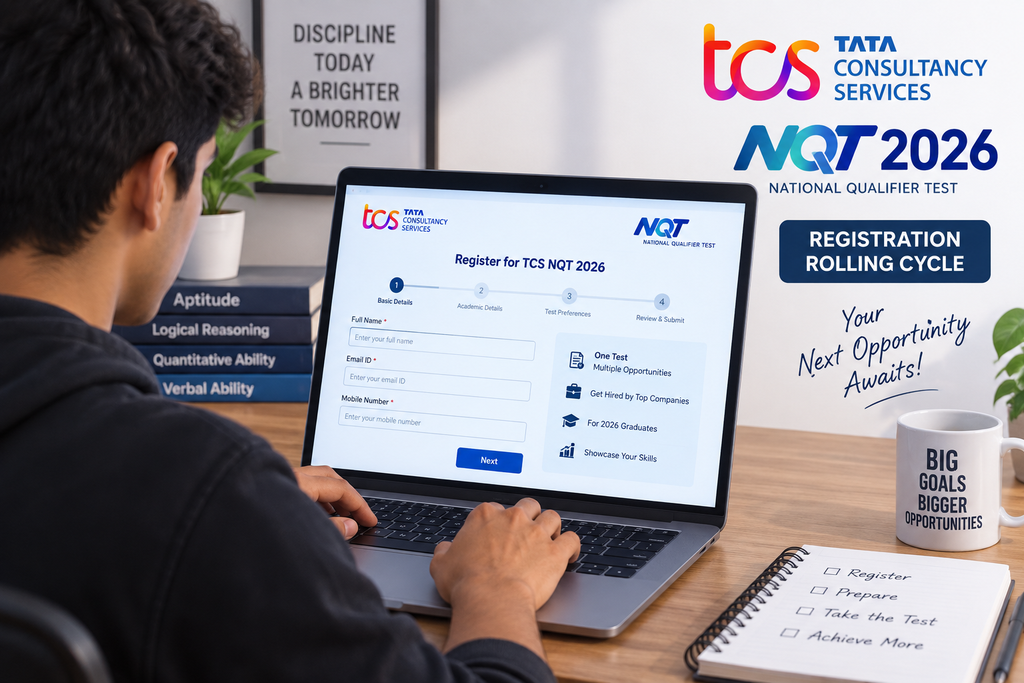
By the time you’re reading any given “TCS NQT 2026 deadline” article, there’s a genuine, high probability that the specific date it quotes has already passed, simply because a new cycle has opened since. This guide explains how the rolling structure actually works, what’s been independently confirmed about recent cycles, and — more usefully than chasing any single quoted date — exactly how to find whichever window is genuinely open right now.
Table of Contents
The Evidence That This Is a Rolling Cycle, Not One Annual Event
This isn’t speculation about why the dates conflict — it’s directly confirmable from tracking the specific cycles that have already run in 2026. A July 2026 cycle closed registration on 19 July, with the test held on 30 July. A separate August 2026 cycle closed registration on 13 August, with the test held on 26 August. TCS iON’s own hub page states plainly that new registration windows open every two to four weeks. Both of these cycles had already concluded by the time later articles began circulating September and October dates as though they were the definitive, singular deadline for “TCS NQT 2026” as a whole — when they were actually just describing the next window in an ongoing, recurring sequence.
The Specific Case of an Unverified Hiring Poster
One particularly useful piece of evidence worth knowing about directly: at least one tracked source documented a hiring poster circulating with a specific September registration deadline and September test date, while explicitly noting that TCS’s own official careers page did not confirm those dates at the time. This is a genuinely instructive example of exactly how misinformation spreads around a program like this — a poster or forward gets shared widely, sounds official, cites plausible-looking specific dates, and gets treated as authoritative by readers who have no easy way to independently verify it against TCS’s actual current portal. The lesson generalizes well beyond this one specific incident: any “TCS NQT deadline” you encounter through an image, forwarded message, or third-party site should be treated as a lead to verify, not a confirmed fact to plan around.
Why Even Careful Reporting on This Topic Runs Into Trouble
It’s worth being fair to the sources trying to report this accurately, since even careful, well-intentioned tracking of TCS NQT runs into a specific structural obstacle: TCS’s own official career pages have reportedly returned bot-blocked errors during attempts at automated verification, meaning even diligent trackers sometimes can’t directly confirm the very dates they’re trying to report. The most careful sources explicitly flag this limitation rather than presenting an unverified date with false confidence — a pattern worth recognizing and valuing when you encounter it, since a source that says “this is reported, not officially confirmed, please check directly” is doing you a genuine service compared to one that states a specific date with unwarranted certainty.
How to Actually Find the Currently Open Window
Given all of this, the single most reliable approach is not to trust any specific date from any secondary source, including this one, but to check the source that actually controls the information:
- Visit the TCS iON National Qualifier Test hub page directly, rather than a third-party aggregator site.
- Look specifically for the currently listed, active registration window — not a cached or outdated version of the page that might be showing you old information.
- If you’re unsure whether a specific date you’ve seen elsewhere is current, cross-check it directly against this official source before planning around it.
- Since new windows open every 2 to 4 weeks, if you’ve just missed one window’s registration deadline, the practical response is simply to wait for the next window rather than treating a missed cycle as a lost annual opportunity.
What Doesn’t Change Between Cycles: The Core Mechanics
While specific dates shift constantly, the underlying test structure and value proposition have remained consistent across cycles, and this is the part actually worth studying in depth rather than obsessing over exact dates. The TCS National Qualifier Test is run through TCS iON, TCS’s digital learning and assessment division, and functions as a standardized employability benchmark — not a TCS-exclusive test. A strong NQT score doesn’t just open doors at TCS itself; the scorecard remains valid for two years and is reportedly accepted by more than 4,000 partner companies, spanning IT services, product-based organizations, and other reputed employers across India. More than 75,000 candidates have reportedly been placed through this broader ecosystem, which is worth knowing if you’re evaluating whether the exam fee and preparation time are genuinely worthwhile — you’re not just buying a shot at one company, you’re building a credential with a genuinely wide acceptance footprint.
Eligibility: Who Can Actually Sit for This
Based on consistently reported criteria across recent cycles, TCS NQT is open to undergraduate, postgraduate, and diploma students across essentially any academic discipline — engineering, arts, science, commerce, and diploma holders are all eligible, with no restriction to a specific stream. Eligible batches have consistently spanned students graduating between 2021 and 2027, including candidates in their pre-final year, final year, or already passed out, along with freshers holding under roughly two years of prior work experience. This broad eligibility is a genuine, consistent feature of the program across cycles, distinguishing it from more narrowly-targeted recruitment drives that restrict eligibility to a single graduating batch or specific technical discipline.
One Test, Three Possible Outcomes
A detail worth understanding clearly before you register: you don’t take separate tests for different offer levels. One NQT session determines which of three tracks — Ninja, Digital, or Prime — you become eligible for, based entirely on your performance across the test’s sections. This means your single registration and test attempt covers the full range of possible outcomes; you’re not choosing which track to “apply for” upfront, your actual performance decides which interview track you’re invited into afterward.
The Exam Structure, and a Rule That Catches People Off Guard
The integrated test runs roughly 190 minutes total, split into two parts: a Foundation section (Part A, roughly 75 minutes, covering numerical, verbal, and reasoning ability at a moderate difficulty level appropriate for the entry-level Ninja track) and an Advanced section (Part B, roughly 115 minutes, testing more advanced material relevant to the higher Digital and Prime tracks). There is no negative marking, meaning attempting every question is always the mathematically correct strategy regardless of your confidence level in any specific answer.
Here’s the detail that genuinely catches candidates off guard: you cannot go back to a previous question once you click “Next.” The platform locks in each answer the moment you advance, unlike many other computer-based tests that allow free navigation and review before final submission. This makes careful, deliberate reading of each question before answering considerably more important on this specific exam than on tests where you can return and revise later — a rushed answer here is final in a way it might not be elsewhere.
Preparing Strategically, Given How the Test Repeats
Based on patterns reported by previous test-takers and verified community tracking, roughly 60 to 70% of TCS NQT questions draw on the same underlying concepts and patterns that repeat consistently across different testing cycles. This is genuinely useful for focusing your preparation time: rather than treating every practice session as needing entirely fresh material, working systematically through previous years’ question patterns and concept categories is a reasonably reliable way to cover the material most likely to reappear, alongside general aptitude practice across numerical, verbal, and reasoning categories.
The Salary Bands, Honestly Caveated
This is worth presenting carefully, since the reported figures across different sources vary and none of them constitute an official TCS disclosure. Commonly reported bands describe Ninja around ₹3.36 lakh per annum, Digital in the roughly ₹7.0 to 7.6 lakh range, and Prime cited anywhere from roughly ₹9 lakh up to ₹11.5-11.8 lakh depending on the specific source, with figures as high as ₹19 lakh reported for top-performing candidates across the wider partner network beyond TCS itself. These figures are consistently described by the more careful sources tracking this program as candidate-reported estimates based on past offer letters, not confirmed TCS disclosures — your actual CTC, if selected, is confirmed directly in your specific offer letter, and it’s worth treating any of these figures as a general planning reference rather than a guaranteed outcome.
Registration Steps, Based on Consistently Reported Process
- Visit the official TCS iON National Qualifier Test portal directly.
- Register or log in using your email and mobile number.
- Choose your test variant — commonly a Cognitive-only option, a Cognitive option with an additional prep pack, or an IT-specific variant including a coding component, priced roughly in the ₹500-700 range depending on the specific variant.
- Complete your academic and personal details, and select your preferred test centre and preferred job cities.
- Pay the applicable fee directly through the portal.
- Download your admit card once your test slot is confirmed.
- Track your application and eventual scorecard status through the same portal.
Why the Rolling Structure Is Actually Good News for You
Once you understand that TCS NQT isn’t a single, high-stakes annual event, the rolling structure becomes a genuine advantage rather than a source of confusion. If you’re not fully prepared for the currently open window, or if you miss a specific registration deadline, you haven’t lost your only opportunity for the year — a new window opens again within roughly a month. This gives you meaningfully more flexibility to prepare properly and attempt the test when you’re genuinely ready, compared to a single fixed annual exam where missing the date means waiting a full year for another chance. The practical implication: don’t rush into an underprepared attempt just because you’re worried about missing “the” deadline — there’s very likely another window coming soon regardless.
This Pattern Isn’t Unique to TCS
If this rolling-cycle confusion feels familiar, it’s because the same underlying pattern shows up across several other programs covered on this site — IBPS’s exam calendar gets confused with fixed application deadlines, and Microsoft’s internship postings roll continuously with individual listings appearing and disappearing within days rather than following one fixed annual window. This isn’t a coincidence specific to any one organization; it reflects a broader shift toward continuous, high-volume hiring pipelines rather than the single annual recruitment drive model that older career advice often assumes by default. Once you recognize this pattern — a program described with one specific “the deadline is X” framing that’s actually a recurring, rolling structure — you’ll likely spot it again in other hiring processes you encounter, and the same core lesson applies each time: check the official source for the currently active window rather than trusting any single point-in-time article’s specific date.
What to Actually Bring on Test Day
For candidates testing at a physical TCS iON authorised exam centre rather than remotely, a few practical preparation steps matter beyond just the content itself. Carry your downloaded admit card, either printed or accessible on your phone depending on the specific centre’s stated requirements, along with a valid government-issued photo ID matching the name on your registration exactly. Arrive with meaningful buffer time before your scheduled slot, since exam centres processing high volumes of candidates on a single test day can experience queuing delays, and arriving right at your scheduled time leaves no margin if check-in takes longer than expected. If you’re testing remotely instead, confirm your system meets the platform’s technical requirements well in advance — a stable internet connection, a functioning webcam if required for proctoring, and a quiet, uninterrupted testing environment — rather than discovering a technical issue only once your test session has already begun.
What This Means If You’ve Already Attempted the Test Once
If you’ve already taken TCS NQT in a previous cycle and didn’t achieve the track outcome you were hoping for, it’s worth understanding whether reattempting in a future window is realistic for your situation, since policies on reattempts can vary and are worth confirming directly on the official portal rather than assuming based on other candidates’ reported experiences. Given how much of the test draws on repeating concept patterns, a second attempt after a period of focused preparation on the specific areas where you underperformed is a reasonable strategy for candidates whose first result didn’t reflect their genuine preparation level — treat an unsatisfactory first result as data to guide targeted improvement rather than a final, unchangeable verdict on your candidacy.
Is Paying the Exam Fee Actually Worth It?
Given that this is a paid exam rather than a free application, it’s worth addressing the value question directly rather than assuming it’s obviously worthwhile. At roughly ₹500-700 depending on your chosen variant, the fee is genuinely modest relative to the potential outcome — a scorecard valid for two years, accepted across a reported 4,000+ partner companies, rather than a single-use application fee tied to one specific role at one specific company. Framed this way, the cost-per-opportunity is considerably lower than it might first appear, since a single successful attempt can support applications across a genuinely wide employer network for the full two-year validity period, rather than requiring a fresh fee and fresh attempt for each individual company you’d otherwise apply to separately.
Quick Answers
Is there one single deadline for TCS NQT 2026?
No, this is the core misunderstanding worth correcting — registration windows open on a rolling basis roughly every 2 to 4 weeks, meaning any single date you find online reflects one specific cycle, not an annual deadline.
Why do different websites report different TCS NQT dates?
Because each article was likely written during a different registration cycle, and the rolling nature of the program means dates that were accurate when written become outdated within weeks as new cycles open.
How can I find the actual currently open registration window?
Check the official TCS iON National Qualifier Test portal directly, rather than relying on any third-party aggregator’s specific quoted date.
Do I need to choose between Ninja, Digital, and Prime when registering?
No, one test session determines your eligible track based on your actual performance — you don’t select or apply to a specific track upfront.
Can I review and change my answers during the exam?
No, the platform locks each answer once you click “Next” — you cannot return to a previous question, making careful reading before answering more important than on tests allowing free navigation.
Is the reported salary information official?
No, commonly cited figures for Ninja, Digital, and Prime bands are based on candidate-reported past offer letters, not official TCS disclosures — your actual offer is confirmed directly in your specific offer letter.
What happens if I miss one registration window?
Simply wait for the next one — since windows open roughly every 2 to 4 weeks, missing a specific cycle doesn’t mean waiting a full year for another opportunity.
If you’re preparing for the aptitude and reasoning sections specifically, structured, repeated practice matters more than last-minute cramming — and once you clear the test, our guide on How to Answer Tell Me About Yourself covers the interview stage that follows for whichever track your NQT performance qualifies you for, since the aptitude test is only the first gate in a multi-stage process that still requires genuine interview preparation once you’ve cleared it.
Suggested Internal Links
- Career Resources Category
- How to Answer Tell Me About Yourself: Best 3-Step Guide
- Free ATS Resume Builder Tools 2026: 7 Tested
- Campus Placements 2026: Rising Budgets, Falling Outcomes
Suggested External References
- TCS iON National Qualifier Test Official Portal: https://www.tcsion.com/hub/national-qualifier-test
- TCS Careers Official Page: https://www.tcs.com/careers
- National Career Service Portal (India): https://www.ncs.gov.in