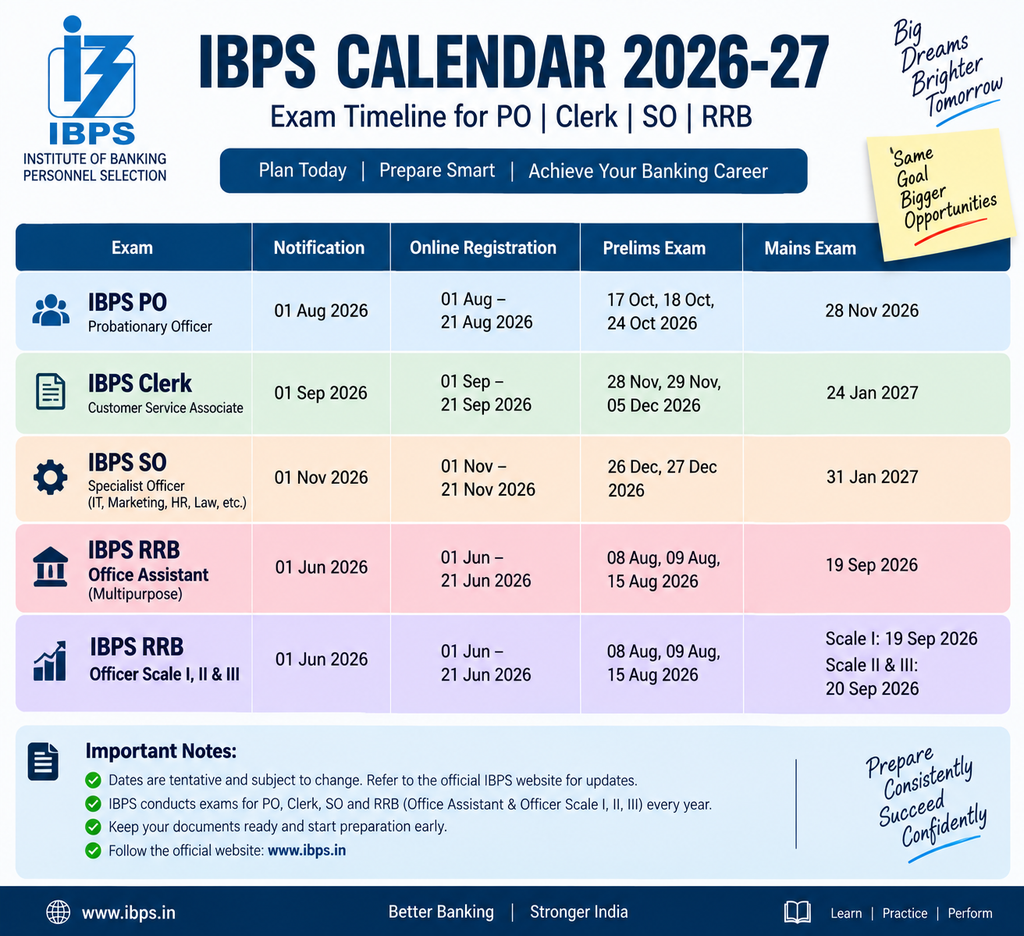
Every banking aspirant has seen the IBPS Calendar 2026-27 by now, listing exam dates for PO, Clerk, SO, and RRB stretching from August 2026 through January 2027. What a lot of coverage glosses over is a genuinely important distinction: this calendar tells you when exams are tentatively scheduled — it does not tell you when to apply. Registration for each specific exam opens through its own, separately released notification, on its own timeline. As of this writing, IBPS has released notifications for PO and SO, but the Clerk and RRB notifications are still pending, expected within the next couple of months. If you’ve been searching for “IBPS Clerk 2026 last date to apply” and found only exam-date information, that’s exactly why — the application window for Clerk genuinely hasn’t opened yet, even though its prelims date (October 10-11, 2026) is already public.
This guide lays out the complete calendar, clarifies exactly which exams already have live notifications versus which are still pending, and organizes everything by what’s genuinely relevant depending on where you are today, rather than dumping the entire year’s schedule at you as an undifferentiated list.
Table of Contents
The Complete IBPS 2026-27 Schedule
| Exam | Prelims | Mains | Notification Status |
|---|---|---|---|
| IBPS PO | 22-23 August 2026 | 4 October 2026 | Released |
| IBPS SO | 29 August 2026 | To be announced | Released |
| IBPS Clerk | 10-11 October 2026 | 27 December 2026 | Pending (expected soon) |
| IBPS RRB Officer Scale I | 21-22 November 2026 | 20 December 2026 | Pending |
| IBPS RRB Clerk/Office Assistant | 6, 12-13 December 2026 | 30 January 2027 | Pending |
Note that IBPS RRB Officer Scale II and III candidates go through a single exam with no separate prelims stage, unlike the other categories listed here.
What’s Genuinely Relevant Right Now
Since IBPS PO’s prelims have already concluded by the time of this writing, and SO prelims have just happened, the two most immediately actionable items for most current aspirants are:
- IBPS PO Mains on 4 October 2026 — if you cleared prelims, this is your very next milestone, and it’s close enough that your remaining preparation time should be treated as genuinely limited.
- IBPS Clerk registration, which hasn’t opened yet but is expected within the next couple of months given the October prelims date — this is the one to actively watch for, since a notification with a real application window could open at any point now, and Clerk drives typically don’t leave a long runway between notification and registration closing.
If you’re specifically targeting RRB positions (Officer Scale I, II, III, or Clerk/Office Assistant), those notifications are further out, but the exam calendar’s already-published tentative exam dates (November-December 2026 for Officer Scale I, December 2026-January 2027 for Clerk) give you a genuinely useful head start on structuring your preparation timeline, even without a live application window yet.
Why the Notification-vs-Calendar Distinction Actually Matters
This isn’t a pedantic technicality — it has real, practical consequences for how you should be spending your time right now. If you assume the calendar’s published exam date means you can apply today, you’ll either waste time searching for a registration link that doesn’t exist yet, or worse, you might mistake an unofficial “apply now” link circulating on some site for the genuine registration process, when the actual application period hasn’t opened. The safe, correct approach: use the calendar purely for preparation planning — how much time you have before each exam — and treat the notification release as the separate, distinct trigger for actually registering, checking eligibility specifics, and paying any application fee.
Eligibility: The Baseline Across These Exams
While exact criteria are detailed in each individual notification, the general baseline across IBPS’s banking exams is:
- Educational Qualification: A Bachelor’s degree from a recognized university for PO, Clerk, and most SO categories (specific SO categories like IT Officer or Law Officer may require a relevant specialized degree)
- Age: Typically 20-30 years for PO and Clerk, with standard relaxation for SC/ST/OBC/PwD/Ex-servicemen candidates as per IBPS norms — exact brackets vary by specific exam and are confirmed in each notification
- Nationality: Indian citizenship, or eligibility as defined under standard IBPS citizenship provisions
- Computer Literacy: Basic computer knowledge is commonly expected, though this varies by specific role
Which Banks Actually Participate
For PO, Clerk, and SO recruitment, 11 nationalized banks participate in the common IBPS process — worth knowing since a single successful IBPS attempt can result in placement at any one of these participating banks, not a bank you individually choose in advance. For RRB recruitment specifically, 43 Regional Rural Banks participate across the country.
One detail worth flagging clearly, since it’s a common point of confusion: the State Bank of India (SBI) conducts its own, entirely separate recruitment process and is not part of IBPS. If you’re specifically targeting SBI Clerk or SBI PO, that’s a distinct exam cycle with its own notification, application process, and exam pattern — don’t assume IBPS registration covers SBI roles.
The Standard Selection Process
IBPS’s selection process for PO, Clerk, and SO typically follows three stages:
- Preliminary Examination — a qualifying round; marks don’t carry forward to final merit
- Main Examination — the stage that actually determines your ranking and shortlisting
- Interview — conducted for PO and SO candidates; Clerk and Office Assistant positions do not include an interview stage, with selection based purely on Mains performance
This interview distinction is worth remembering specifically if you’re deciding between tracks — Clerk-track preparation should treat the Mains exam as the single decisive stage, with no interview round to fall back on or prepare separately for.
How Registration Actually Works
Once a specific exam’s notification is released:
- Registration happens entirely online at ibps.in.
- There is a single registration covering both the Preliminary and Main Examination for a given cycle — you don’t register separately for each stage.
- Application fees must be paid online, and only fee-paid applications are considered complete — an unpaid registration doesn’t count as a valid application.
- Keep your registration number safely recorded, since you’ll need it throughout the entire recruitment process, from admit card download through final result checking.
- Admit cards are typically released 7-10 days before each exam, downloadable by logging in with your registration number/roll number and password or date of birth.
Building a Preparation Timeline Around This Calendar
Rather than treating the whole year’s schedule as one undifferentiated block, a more effective approach is to work backward from your specific target exam’s actual date:
- If your target is IBPS Clerk (Prelims 10-11 October 2026): With roughly a month remaining as of this writing, treat this as your final, focused preparation stretch — prioritize full-length mock tests and sectional accuracy over introducing new topics at this stage.
- If your target is IBPS RRB Officer Scale I (Prelims 21-22 November 2026): You have a genuinely longer runway — use this time for foundational concept-building now, shifting toward intensive mock practice in the final 4-6 weeks before your prelims date.
- If your target is IBPS RRB Clerk (Prelims early December 2026): Similar runway to Officer Scale I — avoid the common mistake of treating a later exam date as a reason to delay starting preparation, since foundational work benefits from an early start regardless of how far off the exam itself is.
Understanding the Officer Scale Structure in RRB Recruitment
Since IBPS RRB recruitment has a somewhat different structure than PO/Clerk/SO, it’s worth explaining the officer scale system in more detail for anyone specifically targeting Regional Rural Banks. RRB recruitment covers three officer scales plus the Office Assistant (Clerk-equivalent) role:
- Officer Scale I: Entry-level officer position, following the standard Prelims-then-Mains structure like PO recruitment
- Officer Scale II: A more senior officer role, typically requiring some prior banking or relevant professional experience depending on the specific specialization, assessed through a single exam without a separate prelims stage
- Officer Scale III: The most senior of the three officer scales, generally requiring significant prior banking experience, also assessed through a single exam
- Office Assistant (Multipurpose): The RRB equivalent of the Clerk role, following its own Prelims-then-Mains structure
If you’re a fresher specifically, Officer Scale I and Office Assistant are your realistic entry points — Scale II and III typically require the kind of prior banking sector experience most fresh graduates won’t yet have. Understanding this distinction early prevents wasted preparation time studying for a scale you’re not actually eligible to sit for.
How This Calendar Compares to State-Level Job Calendars
If you’ve also been tracking state-specific recruitment calendars — similar in spirit to how some states publish comprehensive job calendars covering multiple departments and phases — it’s worth understanding how a national banking calendar like this one differs structurally. A state job calendar typically covers many different departments and post types under one government’s direct administrative control, with a single body coordinating phase timing. IBPS’s calendar, by contrast, covers one sector (banking) across many different employer banks that share IBPS as a common recruitment vehicle, but each exam category (PO, Clerk, SO, RRB) still requires its own separate notification and registration process, even though they’re coordinated under one overarching yearly calendar. The practical lesson carries over either way: a published calendar of dates — whether state or national — is a planning tool, not a substitute for checking the specific, individual notification relevant to the post you’re actually targeting.
What to Do While You Wait for Clerk and RRB Notifications
Since the Clerk and RRB notifications haven’t been released yet, use this waiting period productively rather than passively. Gather your documents now — educational certificates, category certificate if applicable, a recent photograph in the standard specification, and a valid ID — so you’re not scrambling once the application window actually opens, which for Clerk specifically may be a tighter window given how close the October prelims date already is. Set up a direct alert or bookmark the official IBPS website rather than relying solely on secondary aggregator sites for the notification release, since being among the first to register can matter when exam centre allocation is influenced by application timing. If you’re eligible for both a nationalized bank role and an RRB role, decide now which track better matches your strengths and preferences, so you’re not making that decision under time pressure once both notifications are simultaneously live.
Reading the Pattern: How Far Ahead Does IBPS Usually Notify?
Looking at how the already-released PO and SO notifications lined up against their calendar-published exam dates offers a genuinely useful pattern for predicting when Clerk and RRB notifications are likely to appear. In past cycles, IBPS has typically released a specific exam’s detailed notification somewhere in the range of 6 to 10 weeks before its prelims date, giving candidates a registration window that closes several weeks ahead of the actual exam. Applying that same rough pattern to Clerk’s 10-11 October prelims suggests a notification landing sometime in the weeks immediately surrounding this article’s writing — which is exactly why treating “the notification hasn’t dropped yet” as a reason to relax rather than prepare would be a mistake. The gap between notification and registration closing tends to be tight, often just two to three weeks, so candidates who wait for the notification to begin their document preparation and eligibility double-checking often find themselves rushing through what should be a straightforward administrative step.
The SO Category: More Specialized Than Most Realize
The IBPS Specialist Officer (SO) exam is worth understanding as its own distinct category rather than a variant of the general PO exam, since it covers a genuinely different set of roles: IT Officer, Agricultural Field Officer, Rajbhasha Adhikari (Official Language Officer), Law Officer, HR/Personnel Officer, and Marketing Officer, among others depending on the specific cycle’s notified vacancies. Each of these carries its own specific educational qualification requirement — an IT Officer role typically requires a relevant computer science or IT degree, a Law Officer role requires a law degree, and so on — meaning SO eligibility isn’t a single uniform bar the way PO’s general degree requirement is. If you hold a specialized degree that doesn’t map neatly onto a general banking career path, the SO category is worth checking specifically, since it’s designed exactly for candidates whose qualifications suit a specialized banking function rather than a generalist officer role.
Common Mistakes to Avoid
- Assuming the calendar’s exam dates are also application deadlines. They’re tentative exam-date targets; actual registration opens through each exam’s own separate notification.
- Searching for a Clerk or RRB application link before the notification is actually released. As of this writing, these remain pending — any “apply now” link claiming otherwise before the official notification drops should be treated with suspicion.
- Assuming SBI recruitment falls under IBPS. SBI runs its own entirely separate process — don’t conflate the two when planning your applications.
- Registering separately for Prelims and Mains. IBPS uses a single registration covering both stages within a given exam cycle.
- Forgetting that Clerk and Office Assistant roles have no interview stage. Treat the Mains exam as your single decisive round for these specific tracks, not a stepping stone to a later interview.
- Waiting until a notification is released to start preparing. The exam calendar’s tentative dates are published well in advance specifically so you can begin preparation before the formal application window even opens.
- Not saving your registration number after applying. You’ll need it for admit card downloads and status checks throughout the entire process.
Frequently Asked Questions
Is the IBPS Calendar 2026-27 the same as an application deadline list?
No, it lists tentative exam dates for planning purposes. Actual registration opens through each exam’s own separate notification, released on its own timeline.
Which IBPS notifications have already been released?
As of this writing, PO and SO notifications have been released. Clerk and RRB notifications are still pending, expected within the next couple of months.
When are IBPS PO Mains and IBPS Clerk Prelims scheduled?
IBPS PO Mains is scheduled for 4 October 2026, and IBPS Clerk Prelims for 10-11 October 2026, per the official calendar.
Does IBPS Clerk selection include an interview?
No, Clerk and Office Assistant positions are selected based on Mains examination performance alone, with no interview stage.
Is SBI recruitment part of the IBPS process?
No, the State Bank of India conducts its own separate recruitment process entirely independent of IBPS.
How many banks participate in IBPS PO, Clerk, and SO recruitment?
11 nationalized banks participate in the common IBPS process for these categories.
How many Regional Rural Banks participate in IBPS RRB recruitment?
43 Regional Rural Banks participate across the country.
Do I need to register separately for Prelims and Mains?
No, IBPS uses a single registration that covers both the Preliminary and Main Examination stages for a given recruitment cycle.
When are admit cards typically released?
Usually 7 to 10 days before the respective examination, downloadable by logging into the IBPS portal with your registration details.
Should I wait for the Clerk notification to start preparing?
No, given the already-published tentative exam date (10-11 October 2026), it’s genuinely more effective to begin preparation now, since a notification release doesn’t leave much additional runway once it drops.
The Bottom Line
The IBPS Calendar 2026-27 is a genuinely useful planning tool, but only if you understand what it actually tells you: tentative exam dates, not application windows. PO and SO already have live notifications and are progressing through their cycles; Clerk and RRB notifications remain pending despite their exam dates already being public. Use the published calendar to structure your preparation timeline now, and actively watch for the Clerk and RRB notifications specifically, since their respective October and November-December exam dates suggest their application windows should open relatively soon. Whichever specific exam category you’re targeting — PO, Clerk, SO, or one of the RRB tracks — the underlying discipline is the same: separate the planning value of a published calendar from the legal reality of an actual, live application window, and never assume the two are the same thing just because they’re often discussed together in the same breath.
For more fact-checked coverage of exam calendars and career-relevant policy changes, check out our Trending category page for regularly updated analysis. And if you’re building your preparation strategy for any of these exams, our guide on RRB Group D Preparation Strategy 2026 covers preparation principles that translate well across competitive banking and government exams alike.
Suggested Internal Links
- Trending Category
- RRB Group D Preparation Strategy 2026: Best Guide
- CTC vs In-Hand Salary 2026: What Actually Changed
- Resume Tips for Freshers 2026: Best First Job Guide
Suggested External References
- Official IBPS Website: https://www.ibps.in
- Reserve Bank of India (for broader banking sector context): https://www.rbi.org.in
- SBI Careers (for SBI’s separate recruitment process): https://sbi.bank.in/web/careers