
ATS Rejection Statistics 2026 If you’ve read even a handful of resume advice articles, you’ve encountered this line: “75% of resumes are rejected by ATS before a human ever sees them.” It’s repeated on career blogs, in LinkedIn posts, inside resume-builder marketing copy, and probably in more than a few videos and guides you’ve watched while job hunting. It’s also, according to multiple independent investigations published through 2026, not backed by any actual study. The figure traces back to a 2012 marketing pitch from Preptel, a resume-optimization startup that shut down in 2013 — no dataset, no methodology, ever published. It spread not through evidence, but through years of one article citing another citing another, until it calcified into something that sounds like established fact.
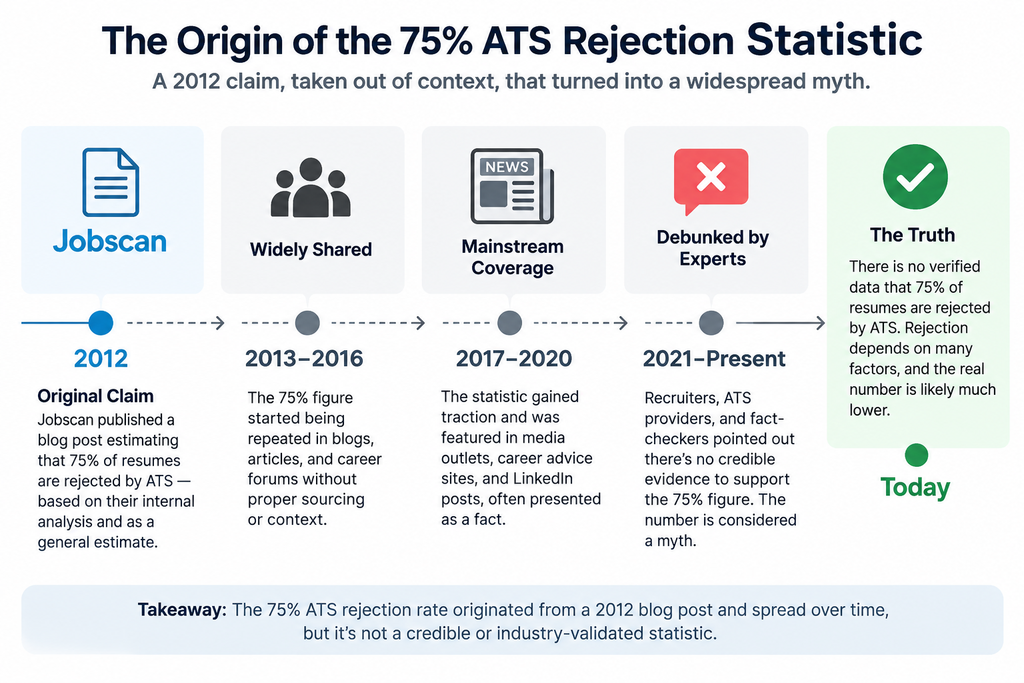
This matters for more than just correcting internet trivia. If you genuinely believe three out of every four resumes vanish into an algorithmic void regardless of quality, that belief shapes how you approach job hunting — sometimes toward paranoid over-optimization, sometimes toward giving up on tailoring altogether because “the ATS will reject me no matter what.” The real, better-sourced picture is both more reassuring and more specific about where the actual risk lies — and there’s a genuinely serious, well-documented problem in AI hiring tools that gets far less attention than this fake statistic does.
Tracing the 75% Figure to Its Actual Source
Multiple 2026 research efforts specifically went looking for the origin of this number, since its ubiquity made it worth verifying. ATS Rejection Statistics 2026 What they found: no peer-reviewed study, no large-scale employer survey, no primary dataset behind the 75% figure anywhere. It originates from a piece of marketing material published by Preptel in 2012 — a company that no longer exists, having gone out of business the following year. No methodology was ever disclosed for how that number was calculated, if it was calculated at all rather than simply asserted for promotional effect. In the years since, it’s been cited and re-cited across so many articles that its actual origin became invisible, and it now reads as an authoritative, oft-repeated fact rather than an unsourced marketing claim from a defunct startup more than a decade ago.
What Recruiters Actually Report Their Systems Doing
Here’s where the real 2026 data meaningfully contradicts the myth. A 2025 study surveying 25 recruiters found that 92% said their ATS systems do not auto-reject resumes at all — only 8% had any content-based automatic rejection configured. Separately, a Q1 2026 survey covering nearly 140,000 applications and over 25,000 job seekers found that while 44% of hiring platforms have some kind of AI or algorithmic “fit score” feature, only 8% of recruiters treat that score as a definitive filter, while 36% explicitly use it only as guidance they then verify by hand.
None of this means ATS software doesn’t matter — it clearly does, and adoption is genuinely near-universal, with 97.8% of Fortune 500 companies confirmed using some form of applicant tracking system. What it means is that “using an ATS” and “auto-rejecting three-quarters of applicants without human review” are two very different claims, and the evidence supports the first while consistently failing to support the second.
Where ATS Actually Does Cause Real Problems
This is worth being precise about, since the goal here isn’t to tell you ATS software is harmless — it’s to redirect your concern toward where the genuine risk actually sits. Formatting remains a real, documented issue: text boxes, tables, multi-column layouts, and embedded images in resume templates are consistently associated with parsing failures, since many ATS platforms still struggle to correctly read content structured this way, particularly when it comes to optical character recognition on image-based elements. A resume that looks polished and modern in a visual template can genuinely parse into garbled, reordered, or missing information on the other side of an ATS upload — this specific piece of common resume advice holds up under scrutiny even as the 75% headline figure doesn’t.
Keyword and skill matching also remains genuinely important, just not in the binary “match or get auto-rejected” sense the myth implies. Since more than 90% of employers do filter or rank candidates by ATS-parsed criteria — skills, credentials, years of experience — before human review, a resume that fails to surface the right keywords for a specific role can rank poorly in that initial sort, making it less likely a recruiter reaches it early in their review, even if it isn’t automatically discarded outright.
The Documented Problem That Deserves the Attention the 75% Myth Gets Instead
While the 75% rejection figure has no real evidence behind it, a genuinely serious, rigorously documented issue exists in this same space and gets comparatively little attention: racial and gender bias in AI-driven resume evaluation. A widely cited 2024 academic study, evaluating roughly 40,000 paired resume comparisons, found that language-model-based resume rankers preferred white-associated names over Black-associated names 85.1% to 8.6% — and in direct head-to-head comparisons of Black men against white men, Black men were selected in zero out of three separate model tests. Male-associated names were similarly favored over female-associated names by a wide margin.
This is a fundamentally different kind of problem than “does the ATS reject too many resumes” — it’s evidence that when AI tools are used to rank or screen candidates, they can encode and amplify real discriminatory patterns from their training data, in ways that specifically disadvantage certain groups regardless of actual qualification. This has drawn genuine regulatory attention: the EEOC and Department of Justice issued joint guidance warning that algorithmic hiring tools can violate disability discrimination law even when the bias is unintentional, and several US jurisdictions — including New York City’s Local Law 144 and comparable legislation in Illinois and Texas — have introduced specific legal requirements around auditing and disclosing AI use in hiring decisions.
If you’re looking for a genuine reason to be concerned about AI in the hiring process, this is it — not the sourceless 75% figure, but a real, measured pattern of discriminatory outcomes that regulators are actively working to address, and one worth staying informed about as legal frameworks in this space continue to develop over the coming years.
The Paradox Worth Understanding: Companies Screen With AI, Then Penalize You for Writing With It
Here’s a genuinely strange dynamic worth knowing about if you’re using AI tools to help draft your resume: research shows 82% of companies now use AI in some capacity to review incoming resumes, while separately, 49% of hiring managers say they automatically dismiss a resume they suspect was generated by AI. The asymmetry is stark — companies frame their own AI use as efficiency, while treating a candidate’s AI use as a shortcut or a lack of genuine effort, even though both are using broadly similar technology toward opposite ends of the same hiring process.
The practical response isn’t to avoid AI assistance entirely — used well, it genuinely helps. Data specifically shows that AI’s most effective, safest use in resume writing is bullet-point optimization: rewriting vague, generic descriptions into specific, quantified, action-driven language while preserving your actual, authentic experience — not generating a resume wholesale from a job description. A resume that reads as entirely AI-generated, with generic phrasing and no specific personal detail, is what triggers hiring manager suspicion and rejection — not the underlying fact that a tool was involved somewhere in the drafting process.
What Actually, Verifiably Improves Your Callback Rate
Cutting through both the myth and the more legitimate concerns, a few specific practices are consistently supported by genuine data:
- Tailoring your resume to each specific job posting is associated with roughly three times more interview callbacks compared to sending a generic, one-size-fits-all resume to every application.
- Avoiding complex visual formatting — multi-column layouts, embedded text boxes, tables used for layout, and image-based elements — genuinely reduces parsing risk, independent of whether “75% get rejected” is true.
- Using AI to refine and quantify your existing achievements, rather than to generate your resume’s substance from scratch, captures the documented benefit of AI assistance (one large randomized study found AI-assisted resume writing increased hire rates by nearly 8%) without triggering the AI-detection penalty tied to fully generic, ghostwritten content.
- Understanding that a fit score or algorithmic ranking, where used, is treated as guidance rather than a definitive gate by most recruiters — meaning a resume that ranks imperfectly on keyword match can still reach and interest a human reviewer, particularly at smaller-volume roles where automated filtering is used less aggressively.
Why This Kind of Myth Spreads So Easily
It’s worth understanding briefly why an unsourced statistic like this survives for over a decade, since the same pattern shows up with other career-advice numbers too. A dramatic, specific-sounding figure is inherently more shareable and more anxiety-provoking than a nuanced “it depends on the platform, the role, and the company’s specific configuration” explanation — and anxiety-provoking content tends to get repeated and cited more readily than cautious, qualified content does. Once a few moderately authoritative-looking sources cite a number, subsequent writers often cite those secondary sources rather than tracing back to an original study, and the number’s authority compounds through repetition rather than through actual verification. This is worth keeping in mind generally when you encounter a strikingly specific, alarming statistic in career advice — the specificity itself isn’t evidence of rigor, and it’s worth a quick check for an actual primary source before treating it as settled fact.
What This Means for How You Should Actually Feel About Job Hunting
Beyond the practical tactics, there’s a genuine psychological benefit worth naming directly: believing a wildly exaggerated rejection statistic can make an already stressful job search feel even more hopeless than it needs to. If you’ve internalized the idea that three-quarters of your applications are being silently discarded by an unaccountable algorithm regardless of how well-qualified or well-written they are, it’s reasonable to feel like effort barely matters. The more accurate picture — that most systems don’t auto-reject at all, that formatting and tailoring genuinely do move the needle, and that a human being is considerably more likely to actually read your application than the myth suggests — is worth holding onto specifically because it restores a sense that your effort has a real, measurable effect on your outcomes, rather than being swallowed by an invisible, unbeatable filter. This reframing matters just as much for your motivation and persistence through a long job search as any single tactical change to your resume itself.
A Practical Way to Evaluate Any Resume Statistic You Encounter
Given how easily a number like this spreads, it’s worth having a simple habit for evaluating any striking resume or career statistic you come across going forward, on this site or anywhere else. Ask specifically who conducted the research, how large and how recent the sample was, and whether the source is a company selling a product that benefits from the statistic sounding alarming. A figure attributed vaguely to “studies show” or “experts say,” with no named research body, no sample size, and no publication date, is worth treating with real skepticism regardless of how many places you’ve seen it repeated — as this specific case demonstrates, wide repetition is not the same thing as verification.
Which ATS Platforms You’re Actually Up Against
Since “the ATS” often gets discussed as one monolithic system, it’s worth knowing that the actual landscape is more fragmented, and this fragmentation itself is part of why blanket statistics like the 75% figure don’t hold up well. By share of tracked job applications, Greenhouse leads at roughly 23.7%, followed by Workday at about 21.7% and Ashby at around 15.4%. By share of large employers specifically, Workday leads more decisively, powering applications at roughly 39% of major companies. Each of these platforms has its own parsing engine, its own default configuration options, and its own approach to how aggressively (or not) a specific employer chooses to filter incoming applications. A resume that parses cleanly through Greenhouse’s system isn’t guaranteed to parse identically through Workday’s, which is part of why formatting advice generally recommends the simplest, most universally compatible structure — plain single-column layout, standard section headers, no embedded graphics — rather than optimizing narrowly for one specific platform’s quirks.
How This Applies Specifically in the Indian Job Market
Much of the underlying research behind these statistics comes from US-based studies and surveys, which raises a fair question about how directly it applies to hiring in India specifically. The core finding — that outright automatic rejection is rarer than commonly believed, while formatting and keyword relevance genuinely affect how a resume is prioritized — holds up reasonably well across markets, since the same major ATS platforms (Workday, Greenhouse, and similar) are widely used by large multinational and Indian IT services companies operating in India. That said, India’s hiring volume for entry-level and BPO-adjacent roles specifically tends to be extremely high relative to open positions, which means even without automatic ATS rejection, the sheer volume of applications a recruiter needs to work through in a single sitting makes a clearly formatted, easily scannable resume meaningfully more likely to receive real attention than one that requires extra effort to parse visually, regardless of what the underlying software does or doesn’t automatically filter.
Why This Matters More the Earlier You Are in Your Career
If you’re a fresher or early-career job seeker, the stakes around resume myths like this one are arguably higher than for someone with a decade of experience and an established professional network. Experienced candidates often get pulled into roles through referrals, direct recruiter outreach, or a track record that speaks for itself well before a resume becomes the primary basis for a decision. Freshers, by contrast, are disproportionately dependent on a cold resume submission actually working as intended — parsing correctly, ranking reasonably on keyword relevance, and reaching a human reviewer. Getting the actual mechanics right, rather than operating on a decade-old, unsourced statistic, matters disproportionately more at exactly the career stage where you have the least room to compensate for a resume that isn’t performing as it should.
Quick Answers
Is it true that 75% of resumes are rejected by ATS?
No, this figure has no documented source — it originated from 2012 marketing material by a company that no longer exists, and current research finds most recruiter systems don’t auto-reject resumes at all.
Does that mean ATS software doesn’t matter?
No, ATS adoption is genuinely near-universal among large employers, and formatting and keyword matching still meaningfully affect how your resume ranks and parses, even without automatic rejection at the scale the myth suggests.
What’s a genuinely documented problem with AI in hiring, if not the 75% figure?
Racial and gender bias in AI-driven resume ranking is real and rigorously documented, with studies showing significant preference for white-associated and male-associated names over Black-associated and female-associated names in head-to-head model comparisons.
Should I avoid using AI to help write my resume?
Using AI to refine and quantify your existing achievements is supported by genuine data on improved outcomes; generating your resume’s substance wholesale from a job description risks the documented AI-detection penalty many hiring managers apply.
Does tailoring my resume to each job actually make a measurable difference?
Yes, tailored resumes are associated with roughly three times more interview callbacks compared to generic, one-size-fits-all versions.
What formatting choices should I actually avoid?
Multi-column layouts, text boxes, tables used for layout, and embedded images all carry genuine, documented parsing risk with many ATS platforms, independent of the debunked 75% statistic.
If you’re building or refining your resume with this more accurate picture in mind, our guide on Free ATS Resume Builder Tools 2026 covers specific tools that avoid the formatting pitfalls that genuinely do cause parsing problems, rather than chasing a rejection statistic that was never real to begin with. And if you’re weighing how much AI assistance to use in the drafting process itself, our guide on Cover Letters 2026 covers the same detection-and-authenticity tension in more depth, since the underlying dynamic — genuine skepticism of AI-generated content colliding with the fact that most hiring processes already use AI themselves — runs through both documents in a job application, not just the resume.
Suggested Internal Links
- Resume Tips Category
- Free ATS Resume Builder Tools 2026: 7 Tested
- LinkedIn Profile Tips 2026: Old Advice Now Hurts You
- Cover Letters 2026: The AI Detection Numbers Don’t Add Up
Suggested External References
- EEOC Technical Assistance on Algorithmic Hiring Tools: https://www.eeoc.gov
- Jobscan ATS Research and Statistics: https://www.jobscan.co
- National Career Service Portal (India): https://www.ncs.gov.in